
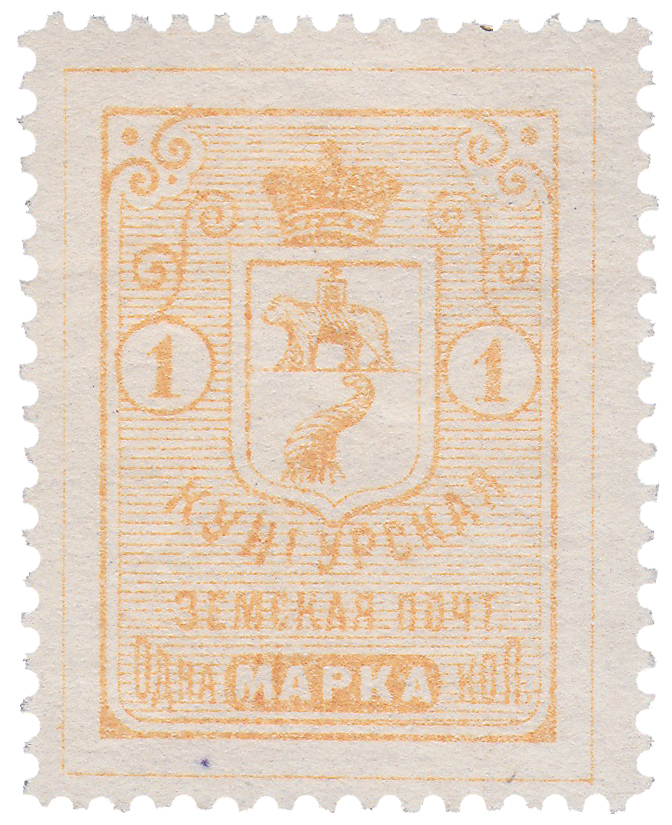
Printed in Perm.
January 15, 1871 — the Zemstvo post of Kungur Uyezd (Perm Governorate) was opened. Mail was sent from the uyezd center, the town of Kungur, to most volost administrations along the Proselochny and Goroblagodatsky routes twice a week.
From January 1, 1890, zemstvo postage stamps of 1 and 2 kopecks were used to pay for the delivery of private letters and packets. The stamps bear images of the governorate and uyezd coats of arms. In 1891, 5- and 10-kopeck stamps were issued, and in 1893–96 new 1- and 2-kopeck stamps were issued. All of them were printed in private printing houses. The stamps were cancelled with oval handstamps. From 1898, all correspondence was forwarded free of charge.
October 23, 1889 — the Zemstvo Assembly resolved: “As an experiment for one year, to establish the collection of a postal tax for the benefit of the zemstvo on the following bases: for ordinary letters, 2 kopecks per packet (letter) …; for money packets, 2 kopecks per packet (letter) and 1 kopeck per ruble of the sums sent. Regarding the procedure for collecting the fees, to establish the following rules:
- all private letters and packets must be prepaid with special zemstvo postage stamps prepared by the board;
- the stamps are to be prepared in 1- and 2-kopeck denominations.”
October 16, 1890 — the Kungur board reported to the Zemstvo Assembly that “from January 1 … a fee was charged for the forwarding by zemstvo post of parcels of private persons, as well as private correspondence.” In that same year, 1890, the first stamps of the Kungur Zemstvo post, with face values of 1 and 2 kopecks, were put into circulation. The design of the stamp was based on an oval ornamented with a crown, and inside it the uyezd coat of arms consisting of two parts: above, the coat of arms of the Perm Governorate; below, ears of grain pouring from a cornucopia, symbolizing the “fruitfulness around that town.”