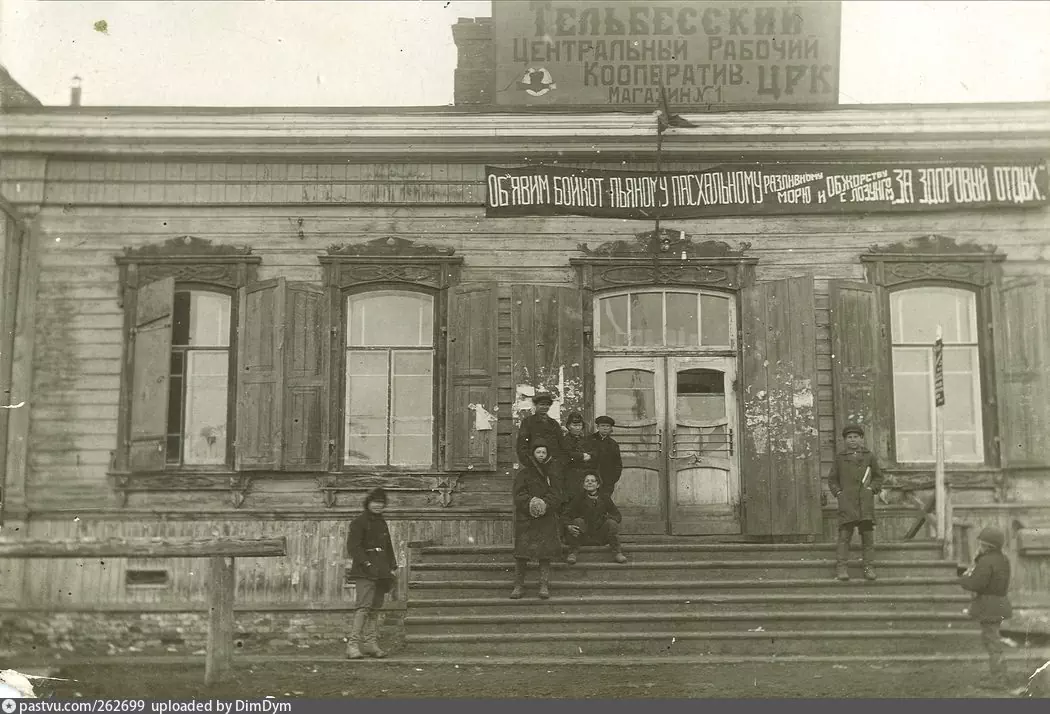
The Telbes CRK was located in a former wooden shop belonging to the merchant Ermolaev (a Guryevsk merchant who conducted trade in Kuznetsk through a manager).
In G. I. Rogov’s catalog *Paper Monetary Signs Issued in the Territory of Kemerovo Oblast. 1918—2006* (Kemerovo, 2006), the place of issue of these coupons is given as the settlement of Telbes. P. P. Lizogub believes this is a mistake:
“Most likely, the author of the catalog was misled by the word ‘Telbes.’ In fact, the explanation is as follows: after the government adopted a decision to build a metallurgical plant near Kuznetsk in 1928, ‘Telbesstroy’ was established (initially it was assumed that the Kuznetsk Metallurgical Plant would operate on Telbes ore). Prospecting work connected with the planned construction had previously been carried out by Kopikuz. In Gornaya Shoria, in the area of the Telbes River, substantial reserves of iron ore were found. Soon, a railway was designed for this area and construction began (preparatory work on routing, pouring concrete overpasses, etc.)—the so-called new construction of the Kolchugino railway. So from that time, ‘Telbes’ began to loom as a synonym for an iron-ore region. From the mid-1920s, when the Soviet government began to consider building a plant here, Telbes became the name for virtually all the South Kuzbass iron ores. But after additional surveys, the Telbes reserves proved to be far more modest and did not ‘pull their weight’ as полноценный supply for the plant under construction.
And then, in April 1929, a new name appeared to replace the former one—Kuznetskstroy. At the same time as Telbesstroy was created, the Telbes CRK also arose—an organization within which, in an era of total shortages of everything, workers and engineering-technical personnel could reliably buy certain goods in shops, receive meals in canteens, and so on. More than half of the workers and employees of the plant under construction, as well as their family members, were members of the Telbes CRK. The rest were members of AKORT (the Joint-Stock Company of Retail Trade). The Telbes CRK had a large network of shops, stores, and canteens at the Kuznetskstroy site, in Kuznetsk, and in other emerging districts of the new city.
When the name changed from Telbesstroy to Kuznetskstroy, the Telbes CRK kept its прежнее name. That is why the word ‘Telbes’ appears on the coupons. And the settlement of Telbes did not exist at all at that time (there was a mine there that was only just being laid out). Such coupons could have been issued from 1928 (the time the Telbes CRK was formed) until 1934 (when this CRK was dissolved), but most likely date to 1930—1932. Upon presentation of these coupons, goods were issued in all warehouse and торговые premises of the Telbes CRK. They circulated, as stated in the text on the coupon itself, ‘...only in internal settlements between the CRK’s shops, stores, kiosks, and warehouses.’ Thus, these are purely Novokuznetsk scrip.”
Unfortunately, only a 1-kopeck note is known today. The coupons were printed in sheets.
If even this note did not exist, we would hardly know of their existence at all. This gives grounds to assume that at that time, in the territory of Kuznetsk and Stalinsk, there also circulated monetary signs about which nothing is known today.
Whether these notes were actually issued is hard to say (perhaps they were planned—since there are blank forms, but not issued—there are no filled-in notes). Therefore, the question of the printing houses where these notes were printed remains open for now. If they were issued after all, then accordingly this could have occurred during the period when the Telbes CRK was in operation. There are no data on exactly when this CRK was formed, but in any case it happened before 1929. Most likely, in 1928 the first workers appeared at the site of the future plant (construction of the settlement in the Upper Colony in the city of Novokuznetsk began even before the 1929 STO Resolution—an order to begin construction of Magnitka and Kuznetskstroy). This CRK existed until 1934, when it was dissolved (trade functions were transferred to ‘Sibtorg’).
Regarding the direct activity of this workers’ cooperative, the following data can be cited (as of June 1, 1931): the cooperative served 72,491 people (workers—41,091; employees—1,954; dependents—12,399; children—17,047).
At that time there were 45 retail outlets, including 13 shops (including 1 department store, 4 general stores—one of them in Kuznetsk, the one in the photo), 18 small shops, and 14 kiosks.
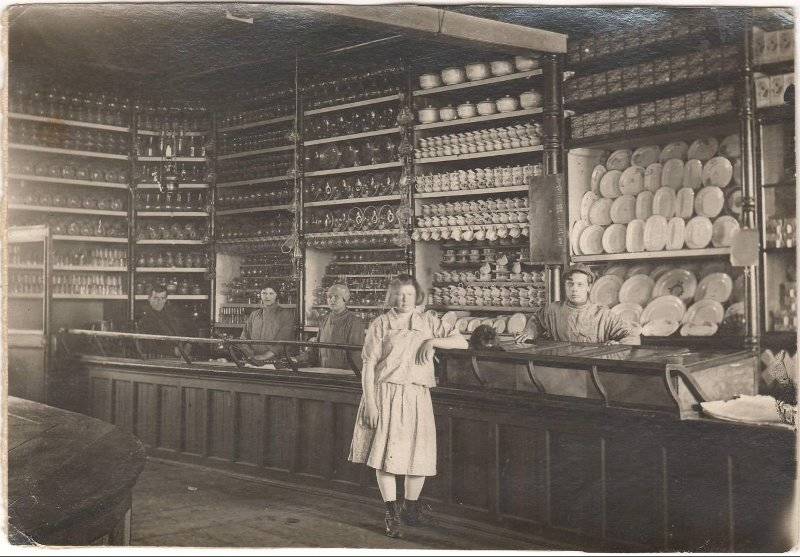
The Telbes CRK also provided public catering. In the specified period the CRK owned 24 canteens (7 public ones had their own kitchens, and 17 shop-floor ones were in fact distribution points directly at production sites). Of the 7 public canteens, 4 were closed, i.e., they served only the contingent assigned to them—workers of a specific workshop or a certain category of employees. The location of the seven public canteens: Lower Colony—No. 2, No. 4 (closed, served the shop-floor distribution points), No. 6; Upper Colony—No. 3; Sadgorod—No. 10 (closed, for brickworks workers), plant administration—No. 13 (closed, for engineering-technical staff and other specialists), Old Kuznetsk—No. 1.
Each month, up to 40,000 people were served in the CRK’s canteens. Tokens used in the canteens of the Telbes CRK are also known.
From this detailed description of the network of shops and canteens of the Telbes CRK, the area of operation of this workers’ cooperative becomes clear. The deputy director for research of the Novokuznetsk Local History Museum, P. P. Lizogub, states: “I am sure that there was no CRK in the settlement of Telbes. The fact that ‘Telbes CRK’ is stamped on the token is just an abbreviation and nothing more. In the end, I can allow (and even then with great stretch) that in Telbes there was still a single small shop and one canteen that were part of the Kuznetskstroy ‘Telbes CRK’ system as a branch for Kuznetskstroy workers employed at the mine, but this does not change the essence of the matter in the slightest: the Telbes CRK, whose board was located at the Kuznetskstroy site (including Old Kuznetsk), served the needs of Telbesstroy and has nothing in common with the settlement of Telbes except the name (the совпадение of names, of course, cannot be called accidental—both ‘grow legs’ from the same idea). Agree that ‘dragging’ the entire massive Telbes CRK from the city to a small, essentially settlement is absolutely incorrect and also meaningless. Why? If the CRK is needed precisely to organize catering and supplies for the workers who built (and then operated) the plant.”
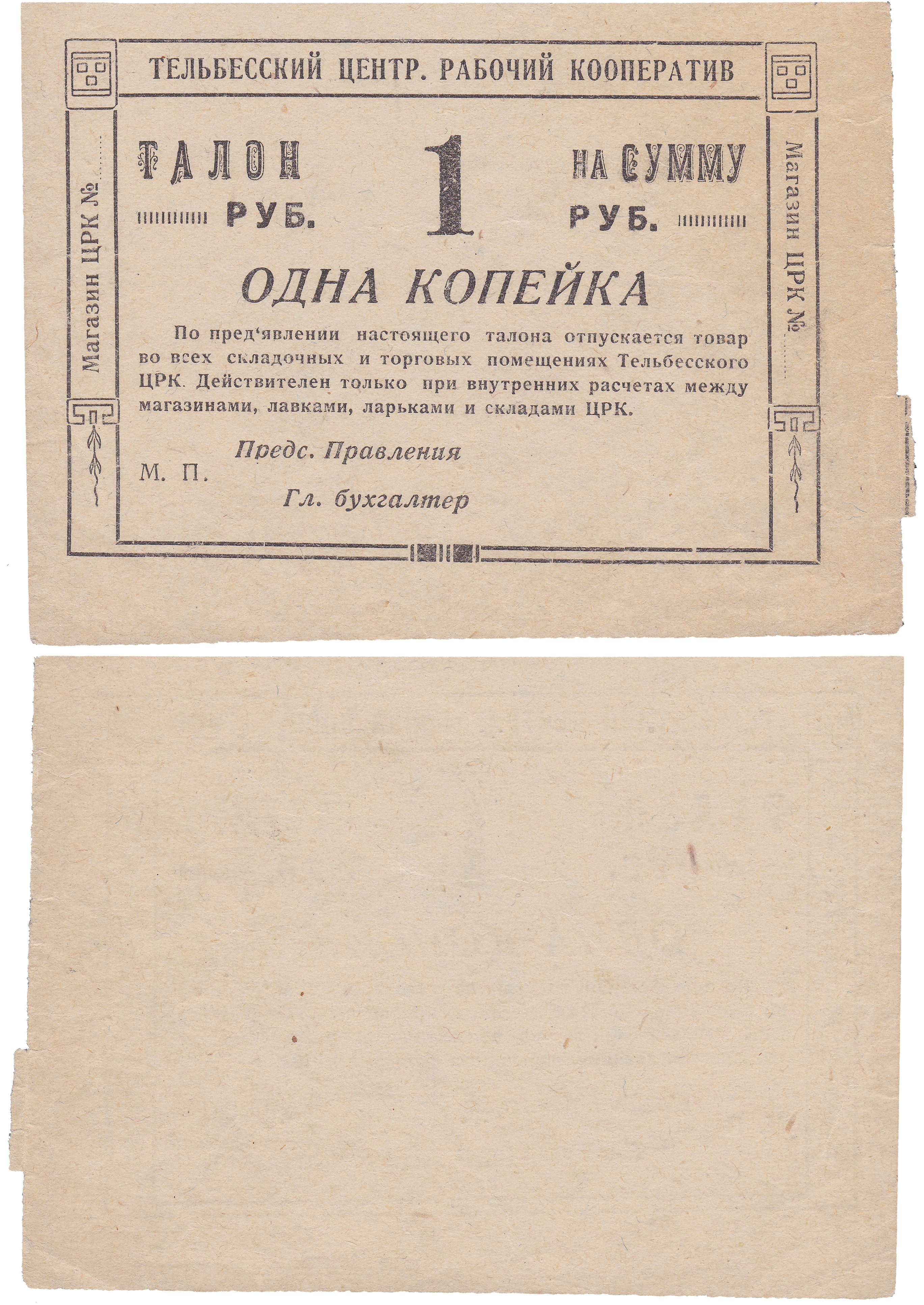
Coupon 1 Kopeck 1928.
Telbes Central Workers' Cooperative.