
In 1696, the Tomsk voivode Rzhevsky, in a charter addressed to Tsars Ivan and Peter, “beats his forehead” (humbly petitions) and reports the discovery of silver ore 6 km from the village of Tisul on the Koshtak River.
In 1697–1698, by decree of Peter I, exploration work was carried out at the deposit under the leadership of the Greek Levandian; it produced no positive results.
In 1738–1740, the deposit was visited by Academician Gmelin, who noted that the assays he took from the workings carried out in 1697–1698 did not confirm the presence of silver. He also suggested that the work performed had been falsified.
On August 11, 1828, merchant Popov submitted an application to the Dmitrov volost administration of Tomsk Governorate for the allocation of land for a placer mine on the Berikul Creek. This date is considered the official beginning of private gold-mining industry and the opening of the Berikul mine. Popov discovered a gold placer on the Mokry Berikul River, a right tributary of the Kiya River.
In 1899, quartz-sulfide gold-bearing veins were discovered on the Sukhoy Berikul River, a tributary of the Mokry Berikul River, which marked the beginning of lode-gold mining.
In 1900, gold industrialist I. B. Khotimsky began developing the gold-bearing veins, Mikhailovskaya and Magistralnaya, which laid the foundation for organizing the mine.
In 1909, the mine passed to the Tomsk merchants Rodyukov and Malyshev; in 1915, to the Achinsk merchant Mokrousov (it belonged to him until 1919).
Beginning in 1914, production levels declined; by 1917, it had ceased due to the revolutionary events, until 1927.
In May 1920, it came under the administration of the trust “Marzoloto,” then in 1921 of the trust “Tomzoloto,” from 1925 of the German firm “Stolzenberg,” from 1926 of the Soviet joint-stock company “Sibzoloto.” In 1927, work was resumed again in connection with the formation of “Soyuzzoloto.”
In 1932, the trust “Zapsibzoloto” was established.
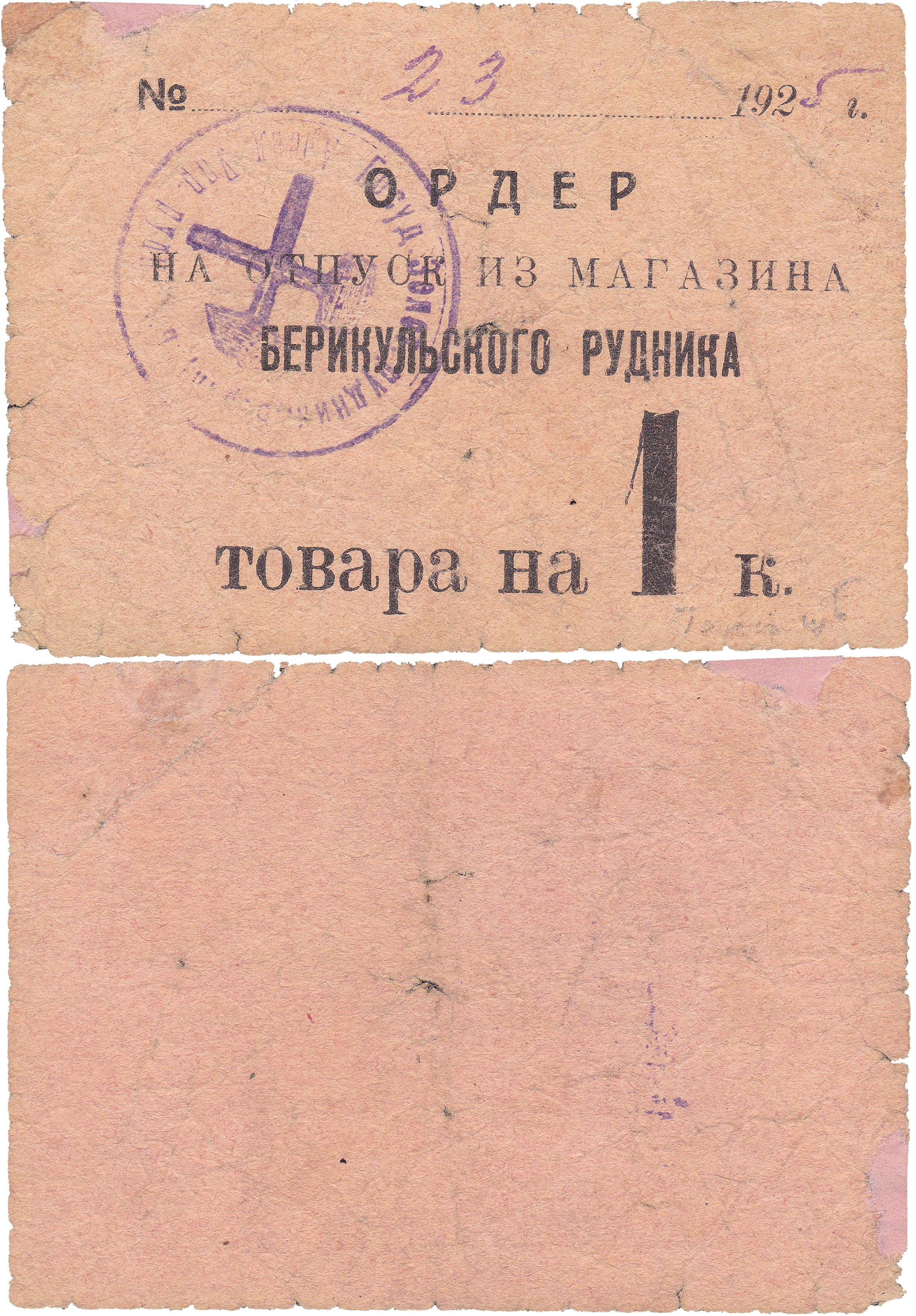
Scrip of the Berikul gold mine, issued in 1925 by the mine’s lessee, the German firm “Stolzenberg.”
At first, the workers tolerated this scrip, since it was accepted as payment for goods at the shop of the Tisul Consumers’ Society. But after the scrip was not redeemed within the agreed period, the Consumers’ Society refused to accept it, as a result of which the workers could obtain goods only at the mine’s store, where the goods were poor and expensive. An article about the scrip appeared in the Tomsk newspaper “Krasnoye Znamya.” Soon, at the insistence of the prosecutor, the scrip was withdrawn from circulation.
However, the mine’s lessee did not stop; he issued new scrip under another name: “Order.” A strike broke out, an article appeared in “Pravda,” and the scrip was finally withdrawn by the judicial authorities.