
On July 8, the decisive episode of the Great Northern War (1700–1721) took place—the Battle of Poltava.
It involved the Russian army of Peter I and the Swedish army of Charles XII. After Peter I recaptured Livonia from the Swedes and founded the new fortress city of Saint Petersburg, the Swedish king Charles XII decided to attack central Russia and seize Moscow. He led his army toward Moscow from the south, through Ukraine, and this was his main mistake. Unfavorable climatic conditions hindered him.
By the time the Swedish army approached Poltava, Charles had been wounded, had lost a third of his army, and his rear was attacked by Cossacks and Kalmyks.
At the end of April 1709, Swedish troops that had invaded Russian territory began the siege of Poltava. Its garrison—4.2 thousand soldiers and 2.6 thousand armed townspeople—under the command of Colonel A. S. Kelin successfully repelled a number of assaults. A month later, the main forces of the Russian army led by Peter arrived at Poltava. They took up positions on the left bank of the Vorskla River, opposite Poltava. After Peter decided at a military council in June to fight a general battle, on the same day an advance Russian detachment crossed the Vorskla north of Poltava, near the village of Petrovka, ensuring the possibility of the entire army’s crossing.
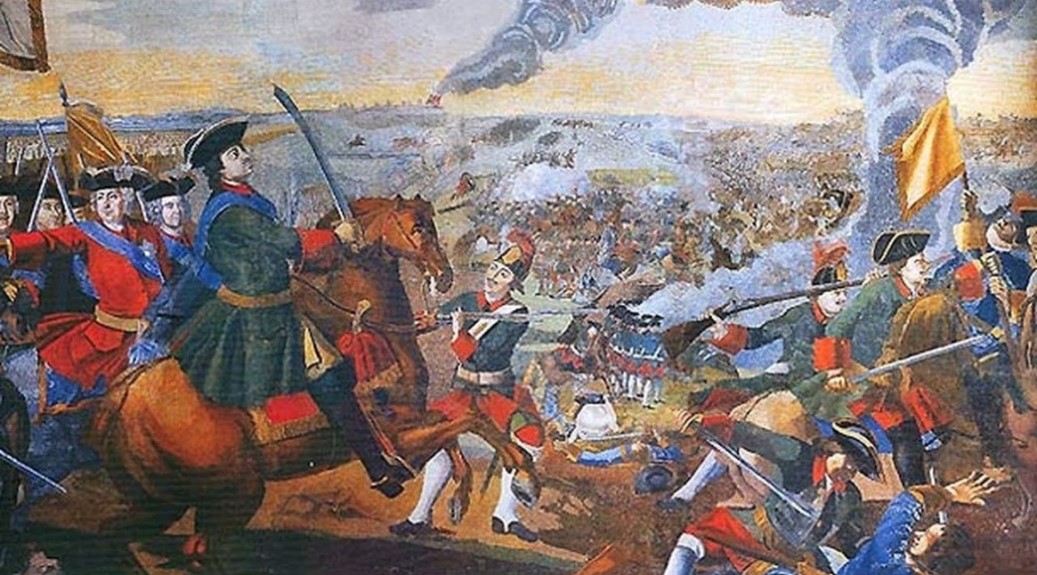
As a result of the Battle of Poltava, the army of Charles XII ceased to exist. The king, together with the Ukrainian hetman Mazepa, who betrayed Peter and went over to the Swedes, fled to Bessarabia. The victory at Poltava marked a fundamental turning point in the long, exhausting Northern War and predetermined its outcome in Russia’s favor. It was at Poltava that a solid foundation was laid for the Russian army’s subsequent victories.