
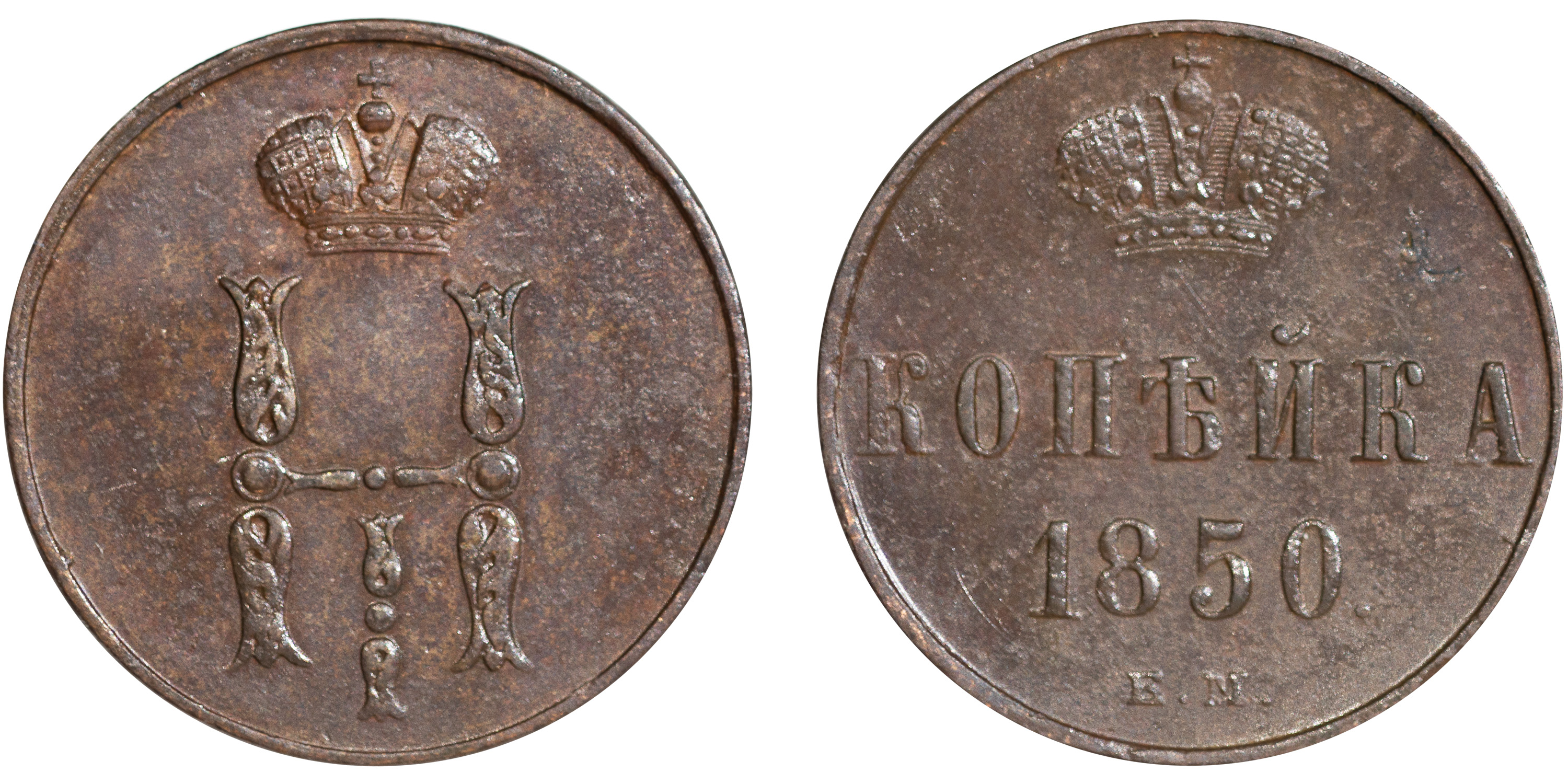
In January, Deputy Minister Prince Shirinsky-Shikhmanov presented the sovereign with a memorandum in which he argued that teaching at universities should be arranged so that “henceforth all principles and sciences would be based not on speculation, but on religious truths in connection with theology.” Nicholas read this memorandum and appointed the prince Minister of Education.
Surgeon and anatomist Nikolai Ivanovich Pirogov published the classic work “Anatomical Illustrations of the External Appearance and Position of the Organs Contained in the Three Principal Positions of the Human Body.”
Of 253,068 hereditary nobles in Russia, 148,685 have no serfs, and another 23,984 have fewer than 10 souls; 109,444 nobles personally engage in farming.
After finishing gymnasium, fifteen-year-old D. I. Mendeleev tried to enroll first at Moscow University and then at St. Petersburg University. But under the existing regulations, those who had completed gymnasiums in Siberia were not admitted to the capital’s universities. He then entered the Natural Sciences and Mathematics Faculty of the Main Pedagogical Institute in St. Petersburg.
It is forbidden to stage A. N. Ostrovsky’s comedy “It’s a Family Affair—We’ll Settle It Ourselves” and to write reviews of it, and the author himself was placed under police supervision because of it.
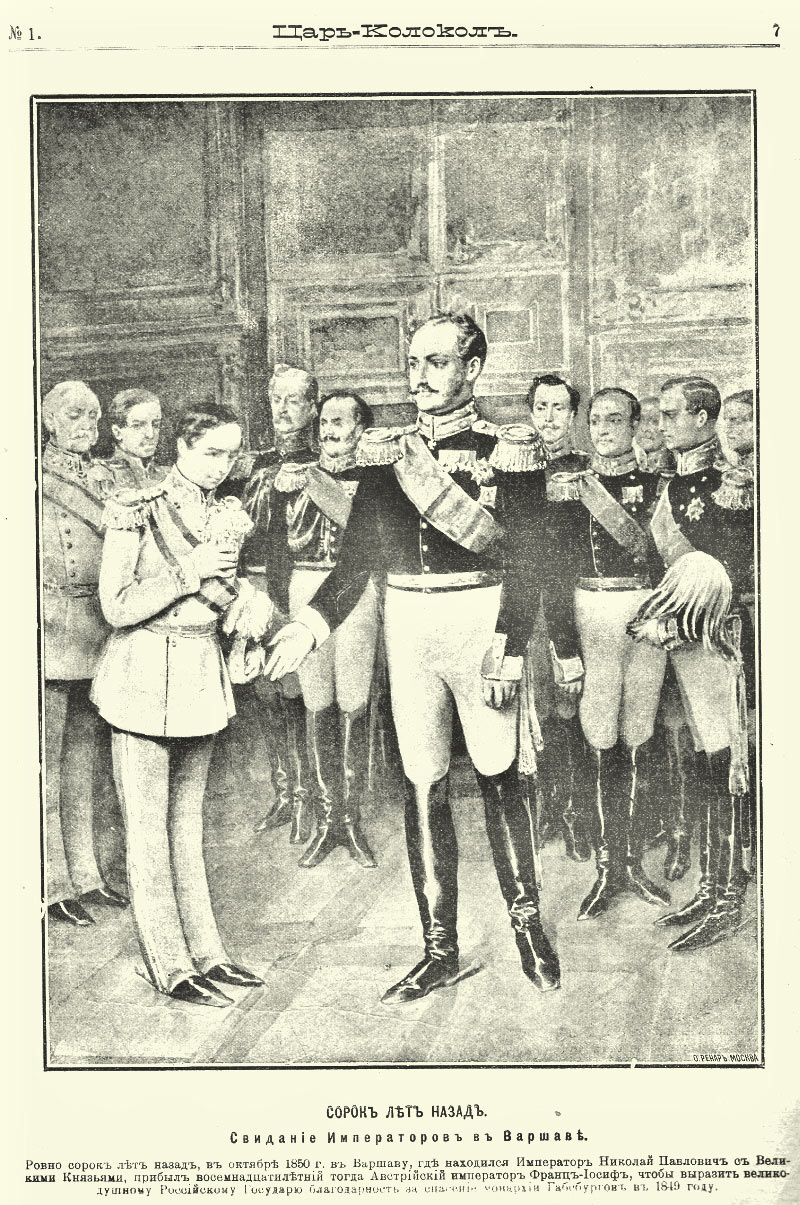
October 1850. Warsaw. Emperor Nicholas Pavlovich accepts thanks from the Austrian Emperor Franz Joseph for saving the Habsburg monarchy in 1849. A lithograph from a bound volume of the weekly “Tsar-Kolokol” for 1891.
January 15 — Sofia Vasilyevna Kovalevskaya was born, a Russian mathematician, the first woman in the world to receive the title of professor. One day she will write: “I inherited a passion for science from an ancestor, the Hungarian king Matthias Corvinus; a love of mathematics, music, and poetry from my maternal grandfather, the astronomer Schubert; personal freedom from Poland; from my great-grandmother, a Gypsy woman, a love of wandering and an inability to submit to accepted customs; the rest—from Russia.”
June 6 — Levi Strauss made his first blue jeans.
August 18 — Honore de Balzac, French writer, died.
November 13 — Robert Louis Stevenson, English writer, was born.