
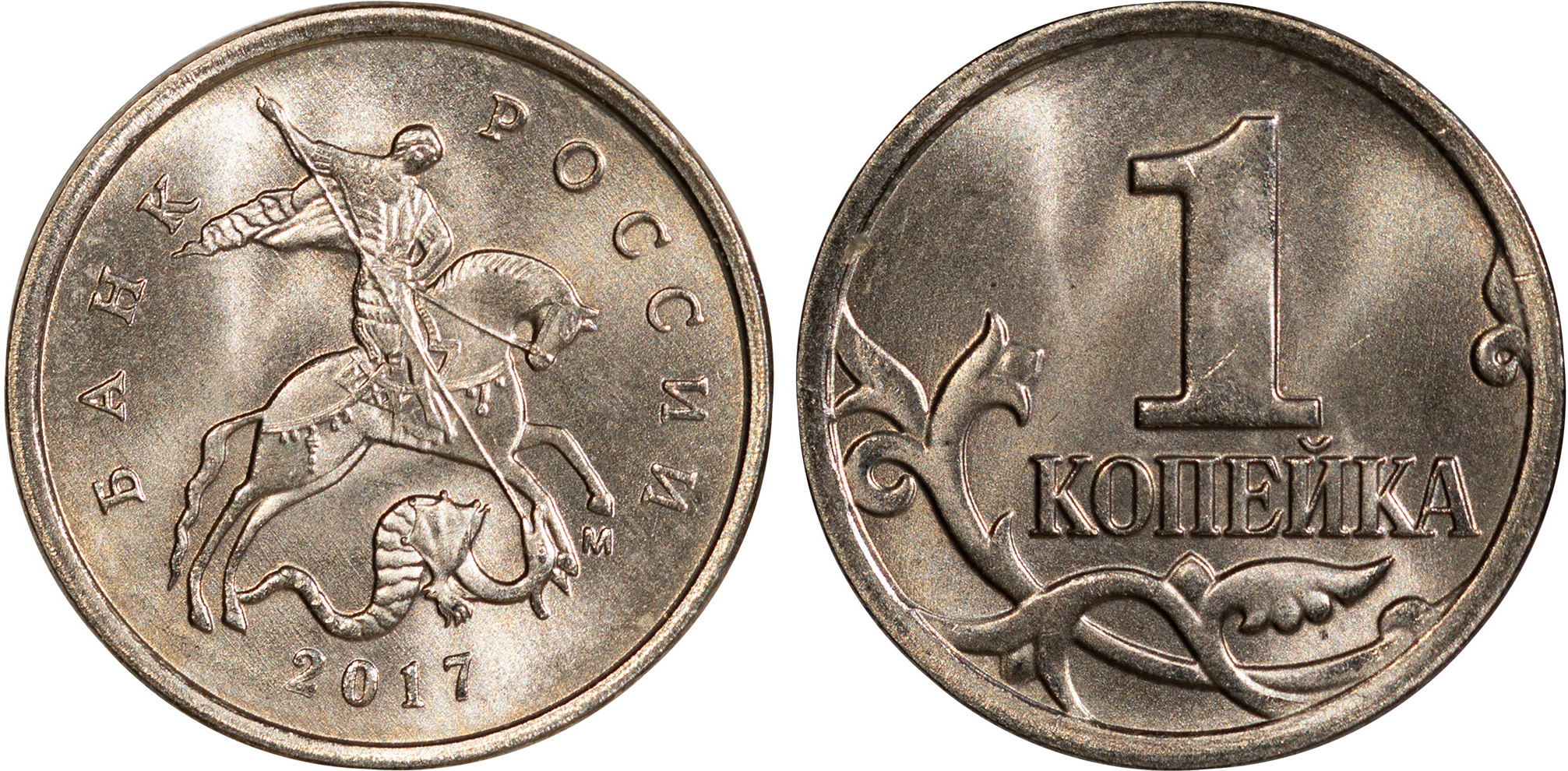
Since 2010, the Bank of Russia has stopped the mass issuance of 1- and 5-kopeck coins, citing that a sufficient quantity of money in these denominations is already in circulation, while demand for them keeps steadily declining. A major factor was also that producing the lowest denominations had become extremely unprofitable. In 2005, the 1-kopeck coin required metal worth 7 kopecks, and the 5-kopeck coin required metal worth 11 kopecks. The process was further made more expensive by technological costs classified as "Secret." The situation became a bit clearer in 2008, when the First Deputy Chairman of the Bank of Russia, Georgy Luntovsky, in an interview with RIA Novosti, added some certainty: "The minting cost of a 5-kopeck coin is 71 kopecks. For the 1-kopeck coin, the ratio is slightly lower." If we disregard the trial coins of 2011, then numismatists saw these denominations with new dates only in 2014, when minting was temporarily resumed.
In response to numerous requests demanding clarification about the mysterious kopecks, the Bank of Russia sent the following reply:
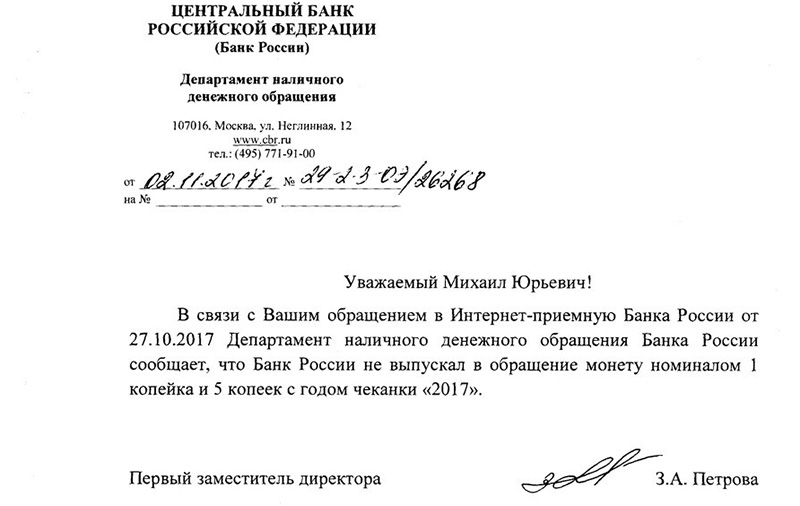
The words "did not release into circulation" did not mean "did not plan to release into circulation" or "did not place an order with the Moscow Mint." And even more so, this phrase was, in meaning, very far from the statement: "The Moscow Mint did not mint 1- and 5-kopeck coins dated 2017." Meanwhile, experts stated that the examined specimens have all the признаки of being minted on MMD equipment.
Vladimir Demidenko, Deputy Director of the Cash Circulation Department of the Central Bank of the Russian Federation, when asked about the enigmatic coins, said plainly: "In 2014, the Bank of Russia released into circulation 1-kopeck and 5-kopeck coins with the minting year 2014. Coins with the minting year 2017 were not released into circulation by the Bank of Russia. Accordingly, all such coin-like items are not legal tender." However, it should be understood that the Bank of Russia and the Moscow Mint are two different organizations. Therefore, for technological processes, MMD could well have tested dies for small denominations with the date "2017," without planning to hand them over to the Bank of Russia for release into circulation. Numismatists did not calm down and went for an interview with the director of MMD, Konstantin Nikolaevich Krokhmal, who had previously headed the Saint Petersburg Mint and was appointed head of the Moscow Mint in April 2018. A numismatist blogger also asked him: "Did the Moscow Mint mint such a coin?" The answer followed immediately: "If the Central Bank did not release it, then the Moscow Mint could not have minted it. It is just that sometimes a desired situation is presented as the real one. The process by which these coins appeared remains a mystery to this day. And it has absolutely nothing to do with the production history at the Moscow Mint. That is completely guaranteed." In principle, the director's stance is understandable. Had he given even the slightest hint of the possibility of minting, he would immediately have been asked how several thousand coins could have left a restricted facility if there had been no will from the Bank of Russia.
At present, numismatists have no doubt that the remarkable mintage was nevertheless made at MMD. First, all reverses feature designs known from previous years. Second, there is no observable difference between the planchets on which this issue was struck and standard Bank of Russia coins. Third, the blanking process for the planchets, accompanied by certain traces on the edge, is also similar to coins of other years. Fourth, under high magnification, the characteristic die polishing is visible (fine lines oriented in a specific direction). That is, third-party production is completely ruled out.