
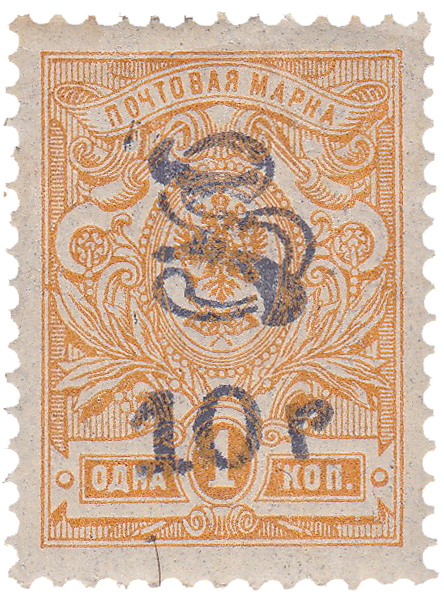
Science fiction. The 3rd issue of Armenia postage stamps. Small monogram.
There exists a large number of unofficial overprints of the second monogram, produced using genuine handstamps of the heads of the Yerevan post and telegraph office by T. Petrosyan. Unofficial overprints were applied both to stamps submitted by private individuals (mainly dealers) and never stored in the post and telegraph office warehouses, and to denominations that were at the disposal of the official authorities. On the latter, revaluations were fabricated that contradicted the established procedure. Stamps of the former Russian Empire were revalued only in the following combination: 1 kopeck — revalued to 1 ruble.
The ongoing inflation in Armenia required an increase in postal and telegraph rates. On October 15, 1919, a report by the Central Committee of postal and telegraph employees expressed a demand to raise the existing tariff for postal and telegraph correspondence by 100%. The new tariff, however, was introduced much later, and the payment rates were increased not by 100% but by 800-1000%. The third issue of Armenia postage stamps is an overprint of the second monogram and a new value in rubles on Russian stamps of the 1909-1917 issues, whose stock and assortment increased significantly through the purchase of postage stamps from private individuals on terms favorable to the postal administration.
Stamps of the third issue were in postal circulation from March 1920 through June 1921 inclusive.
A significant number of provisionals is associated with the Civil War of 1918-1922. At that time, there was no stable central authority in most of the country; many regions became independent, and due to devastation and war there was substantial inflation. Frequent tariff changes and the inability to supply the postal network with stamps of the required denominations led to periodic revaluations of available stocks according to the instructions of the People's Commissariat of Posts and Telegraphs of the RSFSR, which did not provide for any overprints. However, locally some postal offices still applied overprints to the revalued stamps being sold, or simply wrote on them by hand. All these stamps are characterized by extremely simple overprint techniques.