
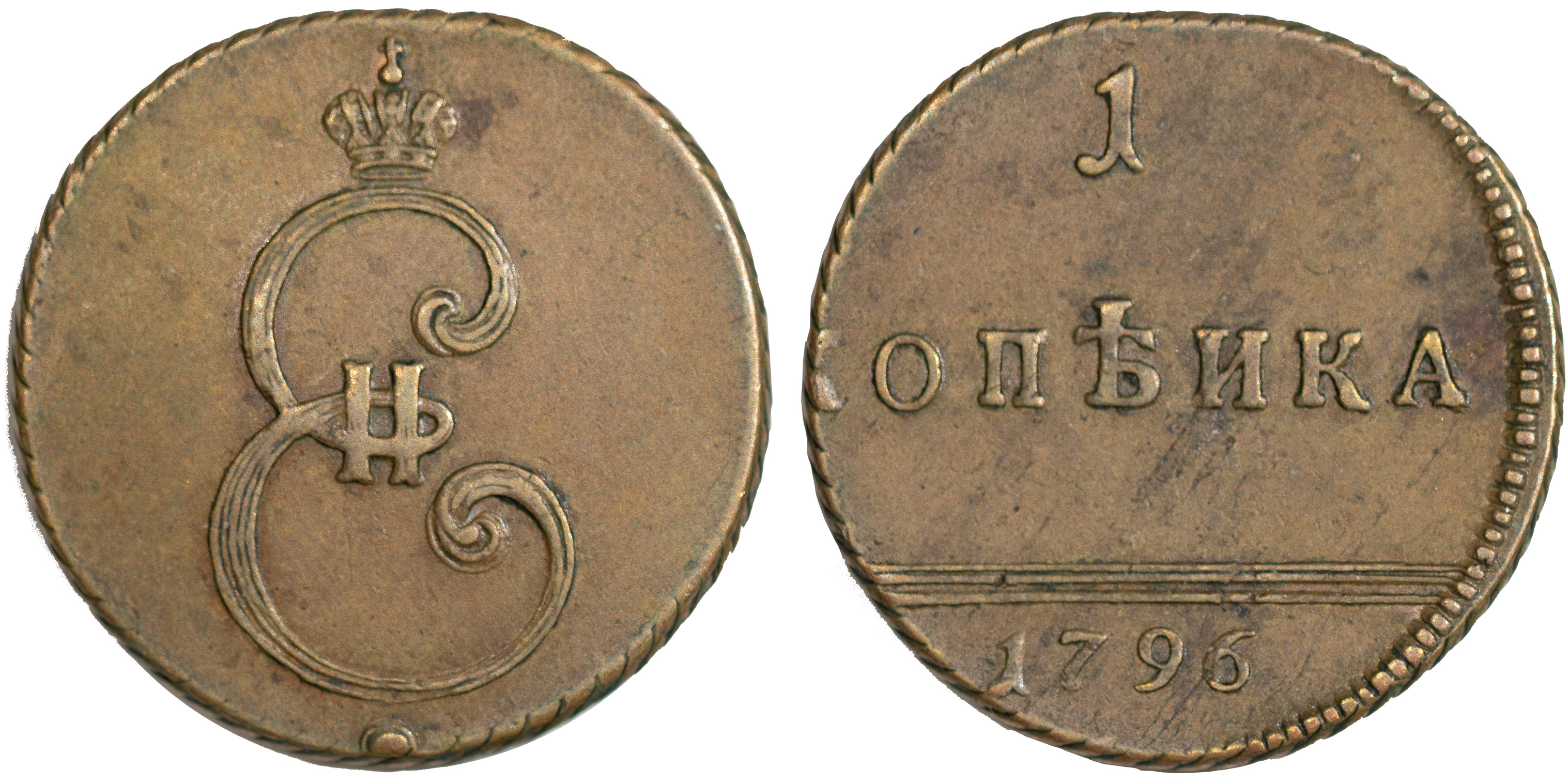
In the final year of Catherine II’s reign, in May 1796, the 67-year-old empress’s favorite, the 29-year-old Most Serene Prince Platon Zubov, proposed reforming the minting of copper coinage in the Russian Empire and switching to an increased mint standard—producing not 16 rubles but 32 rubles from a pood of copper. On May 8, 1796, Catherine II wrote her resolution on Prince Zubov’s report: “So be it.”
The recoinage was supposed to cover the gigantic amount of internal debt, which in 1796 totaled 37 million rubles. It was planned that in the first year of the reform alone, 14 million rubles in copper coin would be sent for recoinage, from which 28 million rubles in new coin should be produced. In total, it was planned to recoin 50 million rubles’ worth of old copper coin.
On May 19, the denominations and designs of the new coinage were approved. The previous coinage was recoined into double its face value. Accordingly, 5-kopeck pieces, 2-kopeck pieces, 1 kopeck, denga, and polushka of the 1763 type were recoined into 10-kopeck pieces, 4-kopeck pieces, 2-kopeck pieces, 1 kopeck, and denga of the new type.
One of the main features of the new coinage was the placement on the obverse of Empress Catherine II’s monogram, as well as the indication of the denomination not only in numerals/words, but also with counting dots (on coins of ten, five, four, two, and one kopeck).
The new coins featured a wide variety of edge treatments. The standard was a corded edge, but because the old coinage struck at various mints was recoined without re-eding, monogram coins are found not only with a corded edge, but also with a mesh and reeded pattern, and even with a smooth edge.
Not only all copper coin flowing into the treasury from taxes and fees was sent for recoinage, but also coin bought back from the population. For this purpose, a significant quantity of paper assignations and the first issue of the new lightweight coinage were produced. The government planned to complete the buyback, exchange, and recoinage of the coins within three years.
Because the scale of the work was enormous, a special regulation established a work schedule for the mints. After subtracting weekends and holidays, each mint worked 324 days a year. Each day was divided into two shifts, during which one coin press recoined 5-kopeck coins into the new denomination totaling 700 rubles. Accordingly, in a year one machine recoined 226,800 rubles. Across all mints, 76 coin presses worked virtually without interruption. Since the work ahead was extensive, staffing levels were increased at all mints.
After Catherine II’s sudden death on November 6, 1796, all coins minted to the lightweight standard, never having entered circulation, were “arrested” at all mints and then either recoined (the 10-kopeck and 4-kopeck coins were recoined, respectively, into 5-kopeck pieces and 2-kopeck pieces) or melted down (all other denominations). It is telling that the coins of 1796 recoined under Paul I retained the old design—with Catherine II’s monogram—and were even dated with the years of her reign.
All known genuine monogram coins of 1796 survived only because they accidentally escaped destruction. Paul I’s government regarded Platon Zubov’s project as a coinage swindle unworthy of practical implementation, and therefore decided to eliminate the monogram coinage and return to the 16-ruble mint standard. It should be noted that the “Pavlovian recoinage” was the last in the history of Russian minting. Paul I’s government rightly concluded that recoinage, though economically beneficial for the state treasury, inevitably leads to a sharp deterioration in a coin’s appearance. For the first time in the entire history of the country’s monetary circulation, considerations of state prestige in minting proved far more important than economic gain.