
From the early 1960s, the USSR began to develop active cooperation with socialist and developing countries. Thousands of Soviet specialists were sent abroad to work. The government faced the question of how to “protect” them from foreign currency.
A practical need arose to create a system in which citizens would not receive foreign currency in their hands and would spend funds earned in foreign currency at home.
The most important parts of the new system were the Bank for Foreign Trade of the USSR (Vneshtorgbank of the USSR) and the all-Union association Vnesposyltorg. In the first, citizens were required to keep foreign currency in the form of “invalyut” rubles, and through the network of shops and firms of Vnesposyltorg to spend it.
It is important to note that, unlike other socialist countries, “substitutes” for currency in the USSR were issued not for foreigners, but for its own citizens.
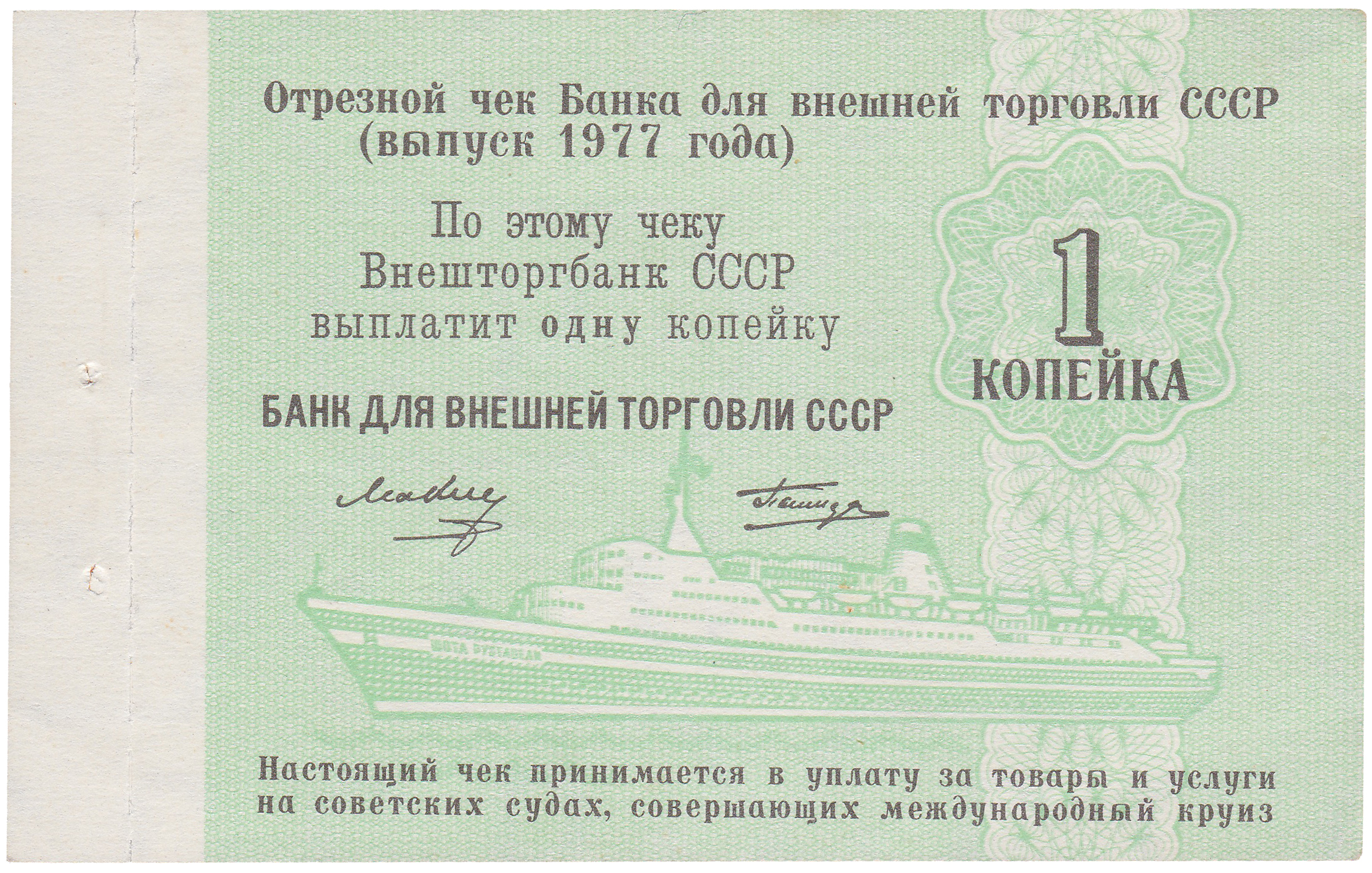
A detachable cruise cheque of Vneshekonombank (Vneshtorgbank) of the USSR is a monetary obligation of Vneshekonombank (Vneshtorgbank) of the USSR to pay the amount indicated on the cheque. The cheques were bound into chequebooks of the corresponding denomination. Detachable cheques were intended for payments by certain categories of citizens for goods and services on Soviet cruise ships operating on international routes. All cheques were printed by GOZNAK.
The cheque depicts the motor ship “Shota Rustaveli”.
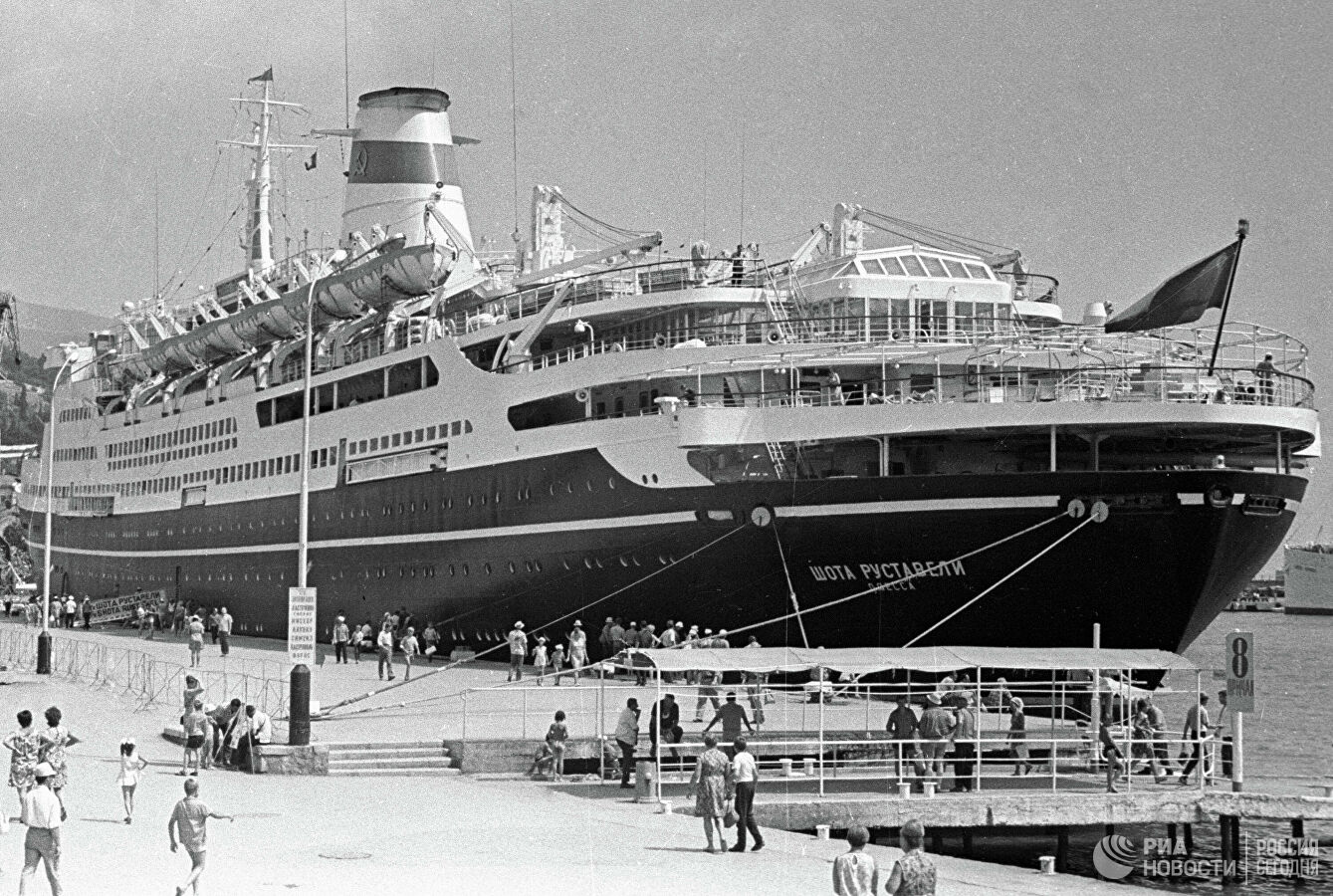
The history of the motor ship “Shota Rustaveli” began with its construction in 1968 at the “Mathias Thesen Werft” shipyard, Germany. On board the liner there was a fine interior: paintings, tapestries, and Georgian-style ornamentation, bright spacious cabins with shower stalls, most of which had safes installed.
For comfortable conditions, the vessel was equipped with roll stabilizers. For passengers’ leisure, the ship offered two swimming pools and saunas, a gym, a massage room, a sports court on the upper deck, a cinema hall, a disco, seven bars with a menu for every taste (one of them a night bar), a casino, a slot-machine hall, a children’s club, shops, a hairdresser, and a medical station. The ship was built to the order of the USSR Ministry of the Merchant Fleet for the Black Sea region and was considered the fourth in a series of five ships of the same type.
From July 1968, the passenger liner “Shota Rustaveli” began making sea cruises between the ports of Odessa and Batumi, and two months later set out for the shores of the United Kingdom. In the port of Southampton, the ship took tourists on board and departed on a three-month round-the-world cruise. The route passed through the ports of Las Palmas, Sydney, Auckland, Papeete, and Panama. During such a long voyage, the vessel left almost 26,000 nautical miles astern and crossed the Atlantic, Indian, and Pacific Oceans, as well as the Tasman Sea and the Caribbean Sea.
The passenger ship was chartered by various foreign companies—“Grandi Viaggi,” “Italnord,” “Orienturist,” “Transtur,” and others. Guests of the comfortable liner included tourists from the republics of the Soviet Union, including prominent figures—on August 20, 1973, Vladimir Vysotsky, Marina Vlady, and her two sons, Pierre and Voldemar, traveled on the ship.
In 2002, after completion of an extensive refit in the port of Sevastopol, the ship, under its new name “Assedo” (which, when reversed, means Odessa—the ship’s home port), as the property of “Kaalbye Shipping Ltd Ukraine,” began operating cruise voyages in the Black, Mediterranean, and Caribbean Seas, and also calling at ports in Western Europe.
Soon after long passages, the technical condition of the liner “Assedo” deteriorated and no longer met steadily increasing international requirements, and on November 28, 2003, the ship was sent to be scrapped in the Indian port of Alang.