
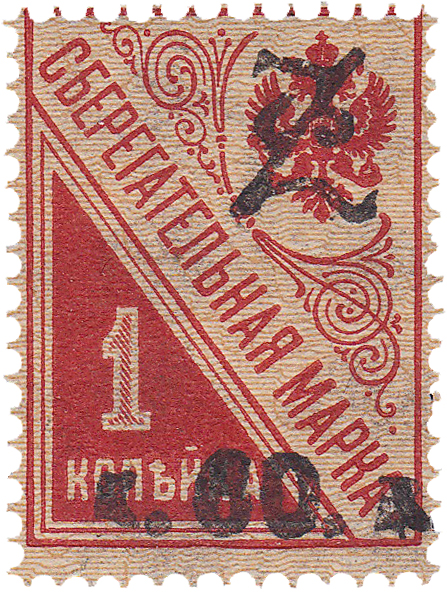
2nd issue of postage stamps of Armenia. Type 2.
Russian stamps of the 1909–1917 issues, as well as the stamps of the First issue of Armenia, were overprinted with a monogram. The overprint did not change the face value of the stamps; its purpose was to record the new state affiliation of Armenia’s stamps, to oblige the population to purchase stamps only through the post-office counter, and—by excluding the possibility of paying for postal services with stamps bought from speculators to the detriment of the post—fully to safeguard the financial interests of the postal administration.
A significant number of provisionals is associated with the Civil War of 1918–1922. At that time, in most of the country there was no stable central authority; many regions became independent, and due to devastation and war there was substantial inflation. Frequent changes in rates and the inability to supply the postal network with stamps of the required denominations led to periodic revaluations of existing stocks in accordance with instructions of the People’s Commissariat of Posts and Telegraphs of the RSFSR, which did not предусматривать any overprints. However, locally some post offices nevertheless applied overprints to the revalued stamps being sold, or simply wrote on them by hand. All these stamps are characterized by an extremely simple overprinting technique.
In the Russian Empire, savings stamps were used from 1890.
On January 1, 1900, the third issue of Russian savings stamps took place. These were accumulation-purpose stamps in three denominations: 1, 5, and 10 kopecks.
The stamps were intended to be affixed to special accumulation forms issued free of charge at savings banks. The forms were designed to be filled with stamps of a single denomination. After the form was filled, it was submitted to the savings bank and the corresponding amount was credited to the depositor’s account. The stamps affixed to the card were canceled, most often by rolling a roller cancel that applied intersecting lines. Canceled cards were destroyed after the установленный period had elapsed. The introduction of such stamps gave low-income people the opportunity to save without visiting the bank and to buy stamps at any time and in various places.
In 1915, the use of savings stamps for their direct purpose was discontinued.
In 1918, due to a shortage of low-denomination postage stamps and the complete cessation of deposits in savings banks because of the Civil War that had begun, savings stamps in denominations of 1, 5, and 10 kopecks began to be used as postage. The circulation of these stamps soon ceased on its own, since, as a result of the rapid падения of the paper money exchange rate, the postal tariff kept rising, and low-denomination postage stamps fell out of use.
This continued until March 1920, when, for the payment of postal items, due to the continuing decline in the value of money, stamps almost exclusively of ruble denominations were needed.