
During the first three months of the siege—the defense—the thirty-thousand-strong mass of peasants, compressed around the village of Cherkasskoye, used for cash settlements "credit notes of the Semirechye Regional Council," secured by a "stock of opium kept in the State Bank and, for greater reliability, signed by the Regional Military Commissar (numbers 8045–8054 and onward)." However, given the limited capacity of the Verny printing house, the Lepsinsk uyezd executive committee, constantly in need of banknotes, began issuing its own money, setting an example for other towns and villages.
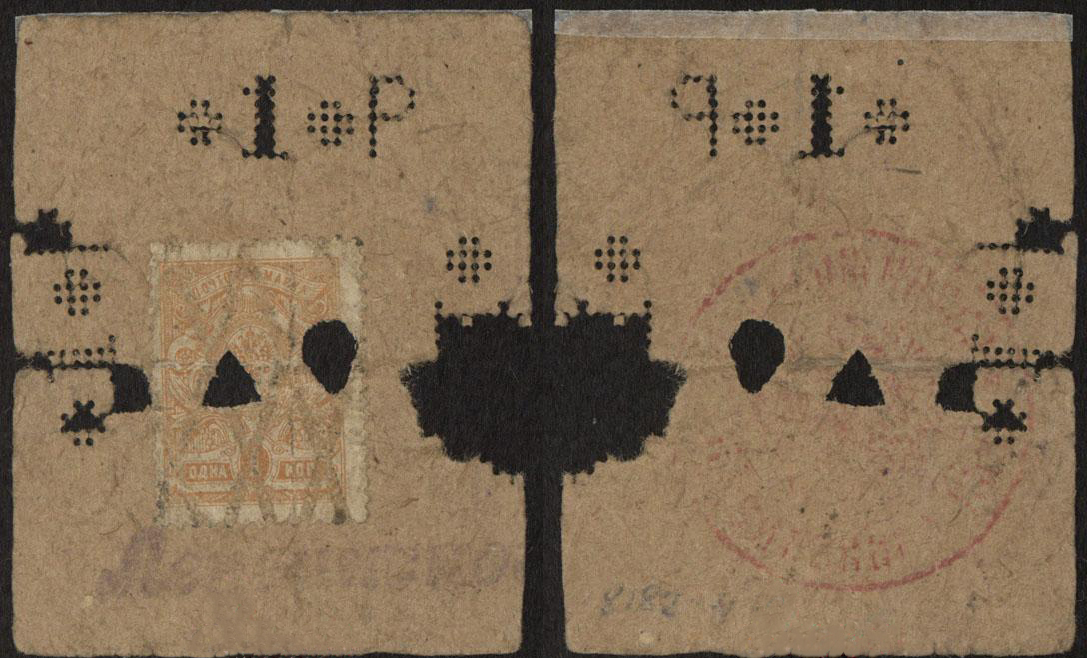
The Military-Revolutionary Committee of the Cherkassk Front followed this example when the shortage of regional and uyezd-issued money became noticeable.
As a result of the joint work of the "Extraordinary Commissioner of the Military-Revolutionary Committee for Monetary Affairs," staff of the Cherkassk post office, and the treasurer of State Savings Cash Desk No. 596, A. Utkin, in May 1919 Cherkassk issued its own money.
The model was the notes issued in Lepsinsk, but taking into account that Lepsinsk was a town while Cherkasskoye was only a village, additional simplifications were made and the money took the following form:
a) The paper was taken from the archives and consisted of parts of a promissory-note form with a vignette.
b) The size was the same as the "Lepsinsk notes": 56 × 40 mm.
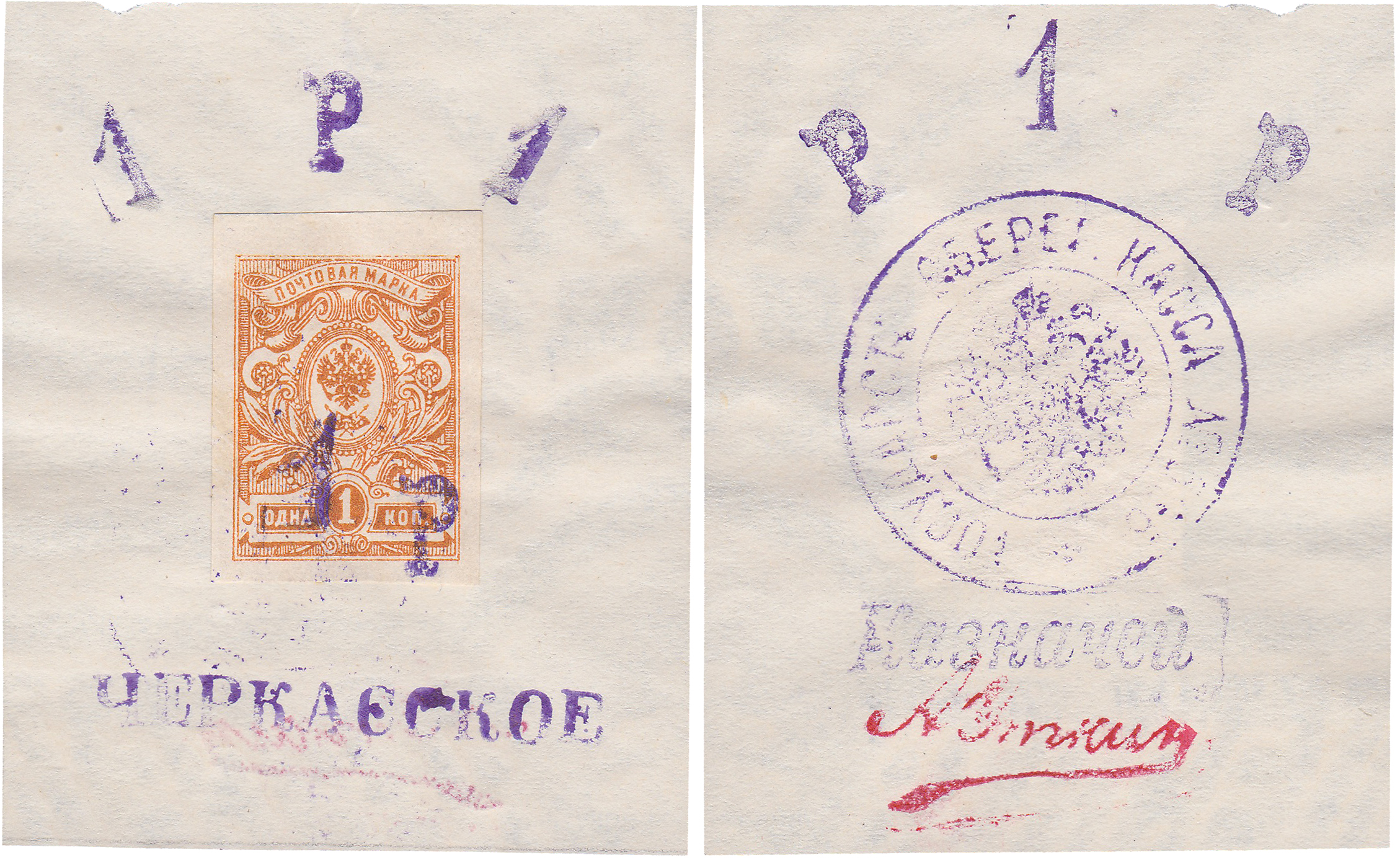
c) The front was filled with a postage or revenue stamp (from the former Russian Empire), matching the denomination of the issued notes, but only in kopeks, and with an overprint containing the conversion from kopeks to rubles, with the inscription "Cherkasskoye."
d) The reverse side was even simpler: an overprint of the value in rubles, the old (with the eagle) seal "State Savings Cash Desk No. 596" (long since closed by order of the Soviet authorities), and the signature of the cashier A. Utkin, overprinted in red ink.
The Cherkassk "nameless ones" ceased to circulate in the same year, 1919, when Cherkasskoye was crushed by the avalanche of the White bands of Ataman Annenkov.