
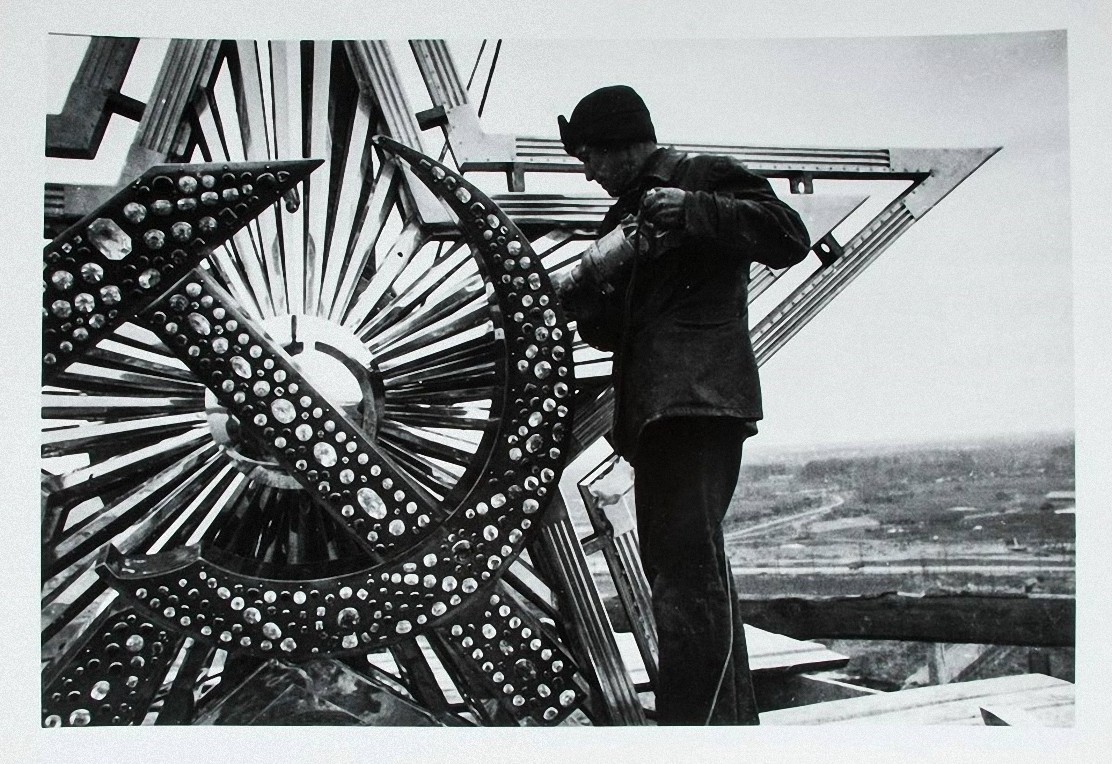
23 August — a decree by the Council of People’s Commissars of the USSR and the Central Committee of the All-Union Communist Party (Bolsheviks) was published on replacing the double-headed tsarist eagles on the Kremlin towers with five-pointed stars. By 1 November, the stars adorned the Nikolskaya, Troitskaya, and Borovitskaya towers. The stars were made of stainless steel and red copper; the hammer-and-sickle emblems were inlaid with rock crystal, amethysts, alexandrites, topazes, and aquamarines. The stars were produced at two Moscow factories and in the workshops of TsAGI. Lit from below by floodlights, the first stars decorated the Kremlin for almost two years, but under the воздействие of atmospheric precipitation the gemstones grew dull and lost their festive appearance.
In May 1937, for the twentieth anniversary of the October Revolution, it was decided to install ruby stars on five Kremlin towers. The sketches were prepared by the People’s Artist of the USSR, F. Fedorovsky.
He calculated the dimensions, determined the shape and pattern, and proposed the ruby color of the glass. Special ruby glass was invented by N. Kurochkin, who had made the first sarcophagus for Lenin’s Mausoleum. To ensure even, bright illumination of the entire surface of the star, unique incandescent lamps with a power of 3,700 to 5,000 watts were produced, and to protect the stars from overheating, specialists developed a special ventilation system. The Kremlin stars have double glazing: milk glass on the inside, ruby glass on the outside. The new stars were lit on the Kremlin towers on 2 November 1937.
Since then, they have been shining day and night.
9 June — the Soviet authorities adopted a law establishing the death penalty for escaping across the border. At the same time, the relatives of defectors were declared criminals. This extreme measure was introduced mainly as a precaution: the authorities feared mass emigration in the event of famine in the country. Although it should be noted that the danger of escapes from the USSR at that time was quite low.
In the hungry years, people tried to make their way not abroad but to large cities and grain-rich regions. However, this did not always work either. Nevertheless, the authorities still decided in this way to seal themselves off from the West.
For most of the population, these measures had no effect. Peasants were tied to their place of residence, had no passports, and could not move freely around the country. The border itself was poorly guarded, so many potential emigrants contacted smugglers who, for the necessary fee, transported them to Germany and from there to America. After Joseph Stalin’s death, execution for illegal emigration was abolished, although people could still be imprisoned. Such harsh restrictions remained in place until 1990, when the Law “On Entry and Exit” was adopted.
15 May — the ceremonial opening of the first line of the Moscow Metro took place, and regular service of four-car trains began. The line ran from Sokolniki station to Park Kultury station with a branch to Smolenskaya; its total length was 11.2 km. The line included 13 stations and 17 vestibules. Initially, the capital’s metro bore the name of L. Kaganovich.
31 August — Donbas miner Alexey Stakhanov exceeded the daily coal-mining norm by 14 times, which marked the beginning of the “Stakhanovite movement”.
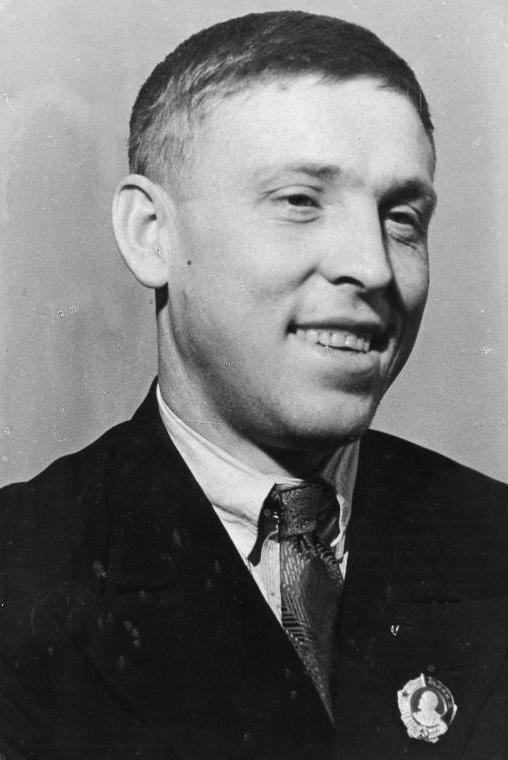
In December, a plenum of the Central Committee of the All-Union Communist Party (Bolsheviks) resolved to turn the “Stakhanovite movement” into a movement of millions. It became the main form of socialist competition and quickly spread across the entire country. Within just a few months, Stakhanovites appeared at almost every Soviet enterprise. Workers themselves sought to become pace-setters: some for ideological reasons, others for the benefits and rewards provided. In 1936, on the initiative of trade unions, schools of Stakhanovite experience began to be established.
In certain branches of industry, Stakhanovites accounted for 20 to 27 percent of all workers. Stakhanovite shifts, days, five-day periods, ten-day campaigns, and months were actively carried out, with entire enterprises taking part. “Records” were in many cases created artificially. At the same time, no one cared about technical standards, safety procedures, or product quality.