

From the newspaper Rabochny Potrebitel of January 1, 1925.
A bonus on purchases or a dividend on the share? What our readers say.
A lively debate has flared up around the question of how to reward consumers. The редакция has received many letters from readers who have taken a keen interest in this issue.
Most of those who sent in their views speak in favor of a bonus based on purchases.
Comrade A. P. writes:
“It is not enough to be a shareholder of a cooperative; one must also be an active member, i.e., take an interest in its affairs and buy goods only at one’s own cooperative. To reward both the mere shareholder and the conscious member of the cooperative in the same amount is entirely unfounded.”
“I believe that the bonus should be issued on the basis of all purchases—the larger the purchases, the larger the bonus.”
A. A. Oidnenko, a regular reader of “Rabochny Potrebitel,” did not doubt at all that Tserabkoop would opt for a bonus-on-purchases system. An article by Comrade Lyubitov proposing to establish a dividend on the share, and which, in Comrade Vidmenko’s view, has “the character of something final,” prompted him to immediately express his thoughts on this matter.
“After all, if a housewife knows that for the purchases she makes—say, totaling 10 rubles—she will get the right to take whatever she wants for 30–40 kopecks, she will not only refrain from losing those one-kopeck or two-kopeck vouchers, she will save them in a way that even Tserabkoop itself will not save them in its iron cashboxes. For her, these vouchers will turn into money. And besides, only active members of the cooperative—those who truly and consciously support it—will be rewarded, not dead weight that got into the cooperative by mistake.”
Both Comrade A. P. and Comrade Vidmenko equally believe that what matters to a cooperative is not so much shareholders in general as devoted members who buy only at their own cooperative. Therefore, they support the bonus-on-purchases system and believe that this system is not so complicated that it should be abandoned for that reason. They propose accounting for purchases by means of duplicate receipts or special stamps.
There is, however, an opposing point of view.
T. Davidovich believes that issuing bonuses on purchases “will increase overhead costs and will not be able to satisfy the consumer because it will not fully cover his purchases.” Comrade Alivkon is against bonuses altogether. Rewarding 50,000 members of the cooperative “will entail such expenses that it will significantly raise the cost of goods, as a result of which the bonuses will be reduced to zero. Profit should be used to improve and reduce the cost of goods, and, on the other hand, to organize assistance to the members of the cooperative who are most in need.”
The question of a system for rewarding members has been ripe for a long time. Numerous responses from consumers themselves speak to this. The issue must be resolved as soon as possible.
From the newspaper Rabochny Potrebitel of June 11, 1925.

What the KhTsRK is doing to improve the operation of canteens.
The Organizational Department of the KhTsRK conducted an inspection of the work of the Public Catering Department. In total, the KhTsRK has 16 canteens: 4 open and 12 closed, located at factories and plants.
In April, the closed canteens produced a loss of 16,000 rubles. This is explained by the fact that while meat prices, compared with autumn, doubled, meal prices in workers’ canteens remained the old ones. For example, at the 4th canteen (VEK), revenue from meals in April was 10,663 rubles, while raw ingredients alone cost 11,592 rubles. At the 7th canteen (Serp i Molot), revenue was 5,920 rubles, while raw ingredients alone cost 6,420 rubles. Together with overhead, the loss for the 4th canteen in April was 3,794 rubles, and for the 7th, 1,736 rubles. The total loss for all canteens was 16,000 rubles.
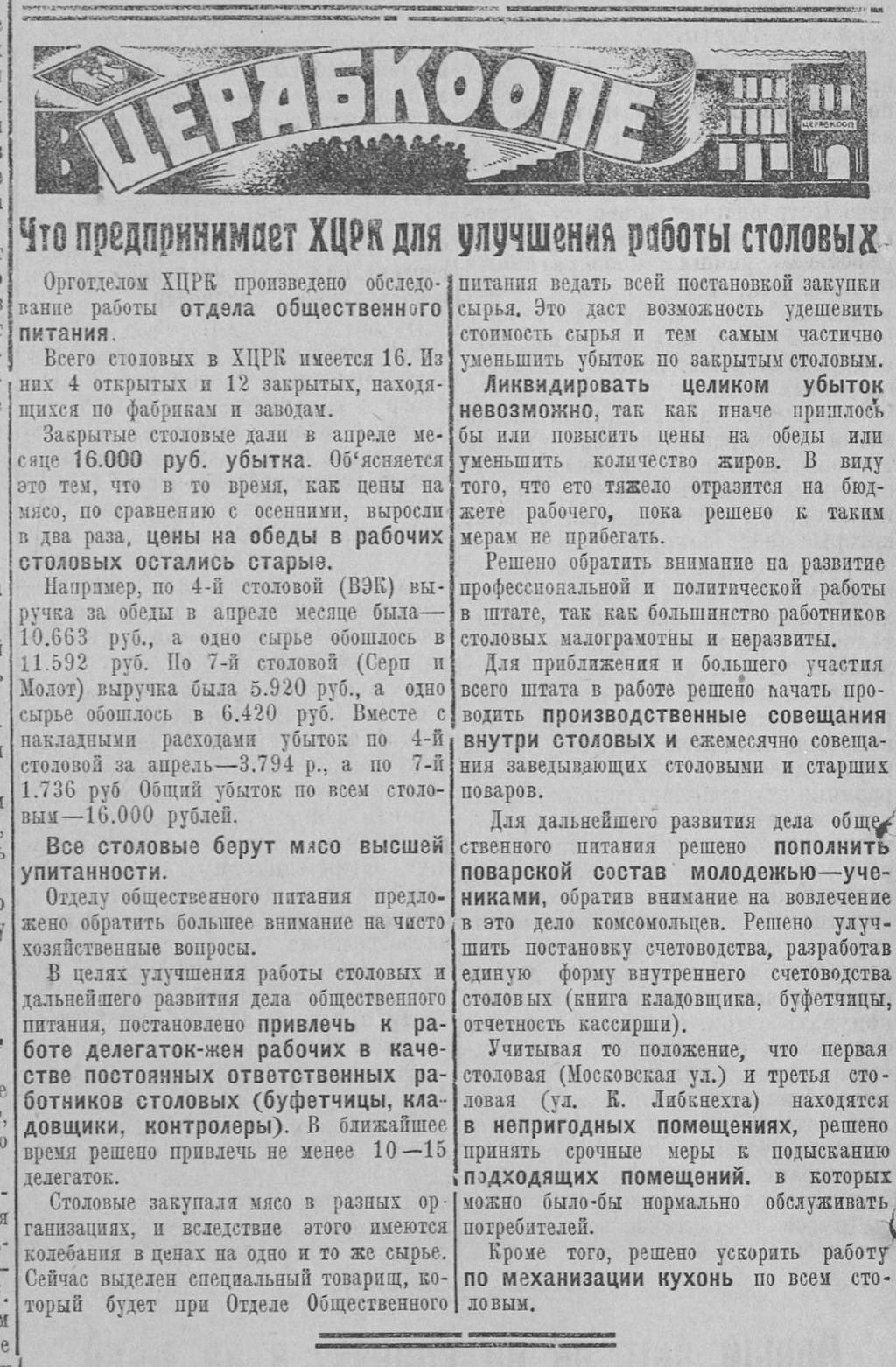
All canteens purchase the highest-grade, best-fattened meat. The Public Catering Department has been instructed to pay greater attention to purely хозяйственные matters. In order to improve the operation of canteens and further develop public catering, it has been decided to bring in female worker delegates as permanent responsible canteen staff (buffet attendants, storeroom keepers, controllers). In the near future, it has been decided to involve at least 10–15 delegates. The canteens purchased meat from various organizations, and as a result there are fluctuations in prices for the same raw materials. A special товарищ has now been assigned who, under the Public Catering Department, will be responsible for organizing all procurement of raw materials. This will make it possible to reduce the cost of raw materials and thereby partially reduce the loss of the closed canteens.
It is impossible to eliminate the loss entirely, since otherwise it would be necessary either to raise meal prices or reduce the amount of fats. Since this would hit the worker’s budget hard, it has for the time being been decided not to resort to such measures. It has been decided to pay attention to the development of professional and political work among the staff, as most canteen workers are barely literate and underdeveloped. To bring the entire staff closer to the work and increase participation, it has been decided to begin holding production meetings within the canteens and monthly meetings of canteen managers and head cooks.
For the further development of public catering, it has been decided to replenish the cooking staff with youth—apprentices—paying attention to involving Komsomol members in this work. It has been decided to improve bookkeeping by developing a unified form of internal accounting for canteens (the storeroom keeper’s book, the buffet attendant’s book, the cashier’s reporting). Considering that the 1st canteen (Moskovskaya St.) and the 3rd canteen (K. Liebknecht St.) are located in unsuitable premises, it has been decided to take urgent measures to find suitable premises where consumers can be served normally. In addition, it has been decided to speed up work on mechanizing kitchens in all canteens.