
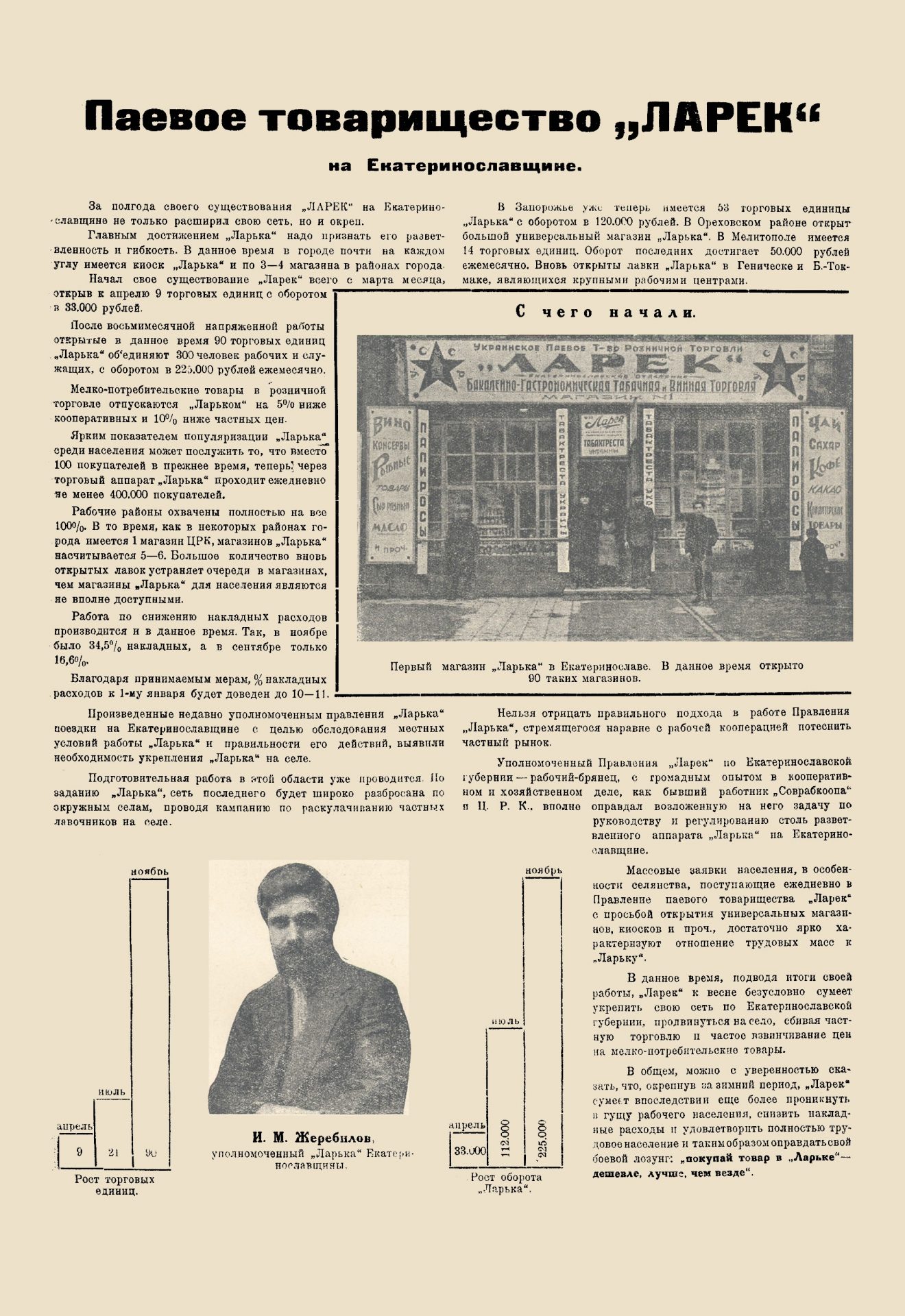
In 1921, the “Laryok” partnership was established for the retail sale of tobacco products. This was done on the initiative of F. E. Dzerzhinsky. At the time, he was the chairman of the VTsIK Children’s Commission. “Laryok,” in fact, was created mainly to combat the growing problem of children’s profiteering. Tobacco products, especially in times of shortage, are a fast-selling and profitable commodity, and children are the first to realize this (pensioners are second; after them, law enforcement agencies get involved).
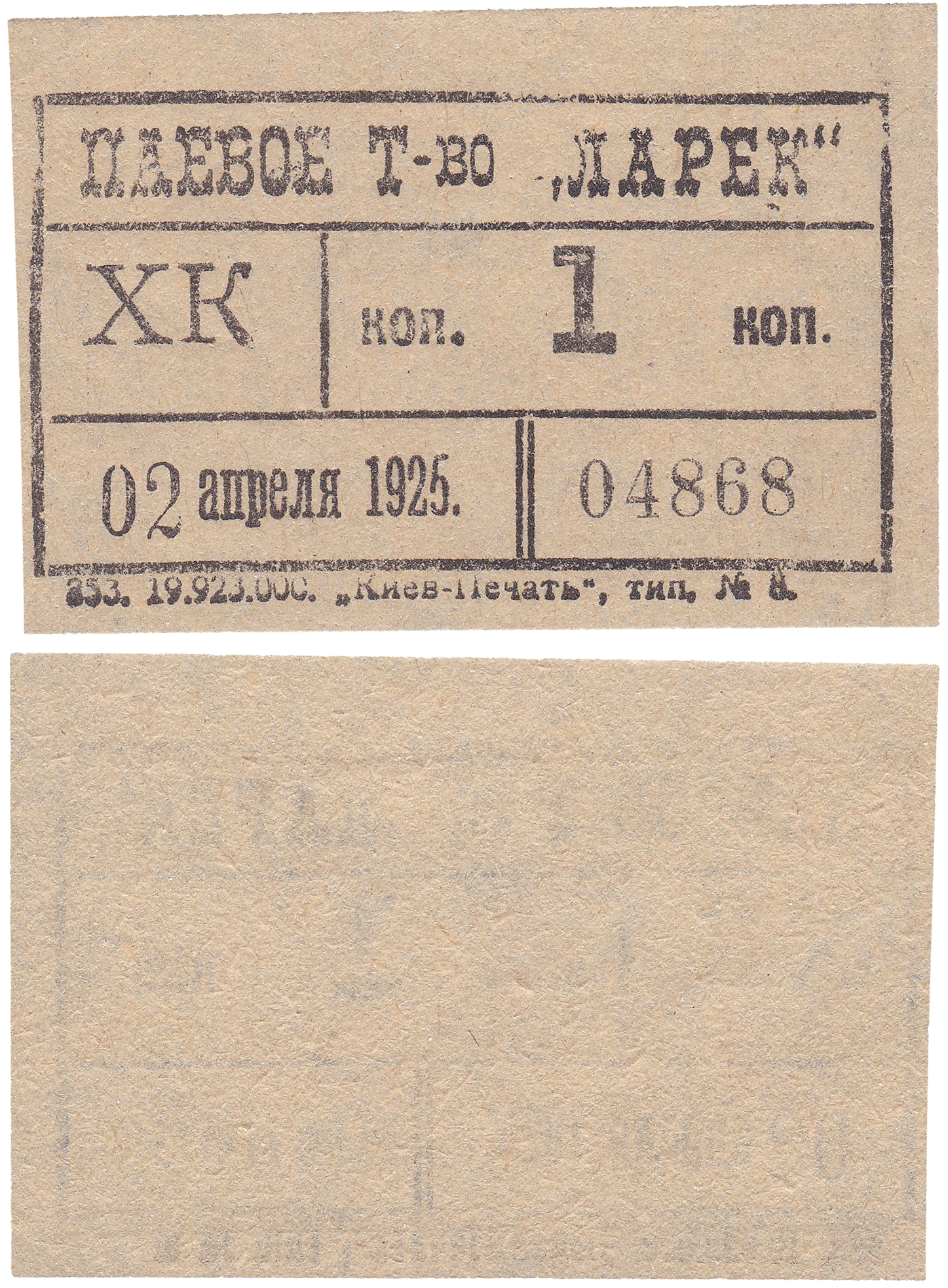
The Share Partnership “Laryok” issued in Kyiv several series of primitive-style money substitutes, like improved shop vouchers, but intended for repeated use.
Street trade is fully covered by “Laryok,” which has 35 kiosks, 15 shops, and several hundred tray stands in the city. In the very near future, the number of kiosks will be doubled and the number of shops tripled. Private stalls located near “Laryok” shops are being closed.”
There were several reasons for the appearance of private money substitutes in Ukraine. The main factor was the lack of sufficient nationwide currency in the denominations needed to serve the population’s cash circulation. The main one, but not the only one. Thus, during the Civil War, in the cities of Kyiv and Zhytomyr the system of власти changed no fewer than 11 times, and each new authority, as a rule, brought and introduced its own currency. At the same time, the money of the previous authority was considered canceled and was not recognized by the new authority. And the population lost trust in nationwide monetary issues of all types of authorities.
In addition, inflationary processes were constantly felt. In the early 1920s, when Soviet power had already been established, inflation was at the level of 100% per month, and money simply depreciated.
Moreover, three systems of state money existed in the country simultaneously. Wages were paid in large sums in sovznaks. But they were not enough: goods and food cost far more. Therefore, workers’ supply programs were organized for working people, where basic necessities and food cost only a few rubles. And the third type of money that appeared in 1922, with the start of the monetary reform, was gold rubles, each of which was equal to 50 billion sovznaks. In this regard, in order not to get confused by such triple accounting, hundreds of enterprises, organizations, shops, pharmacies, etc. within their areas of operation issued and used their own private money.