
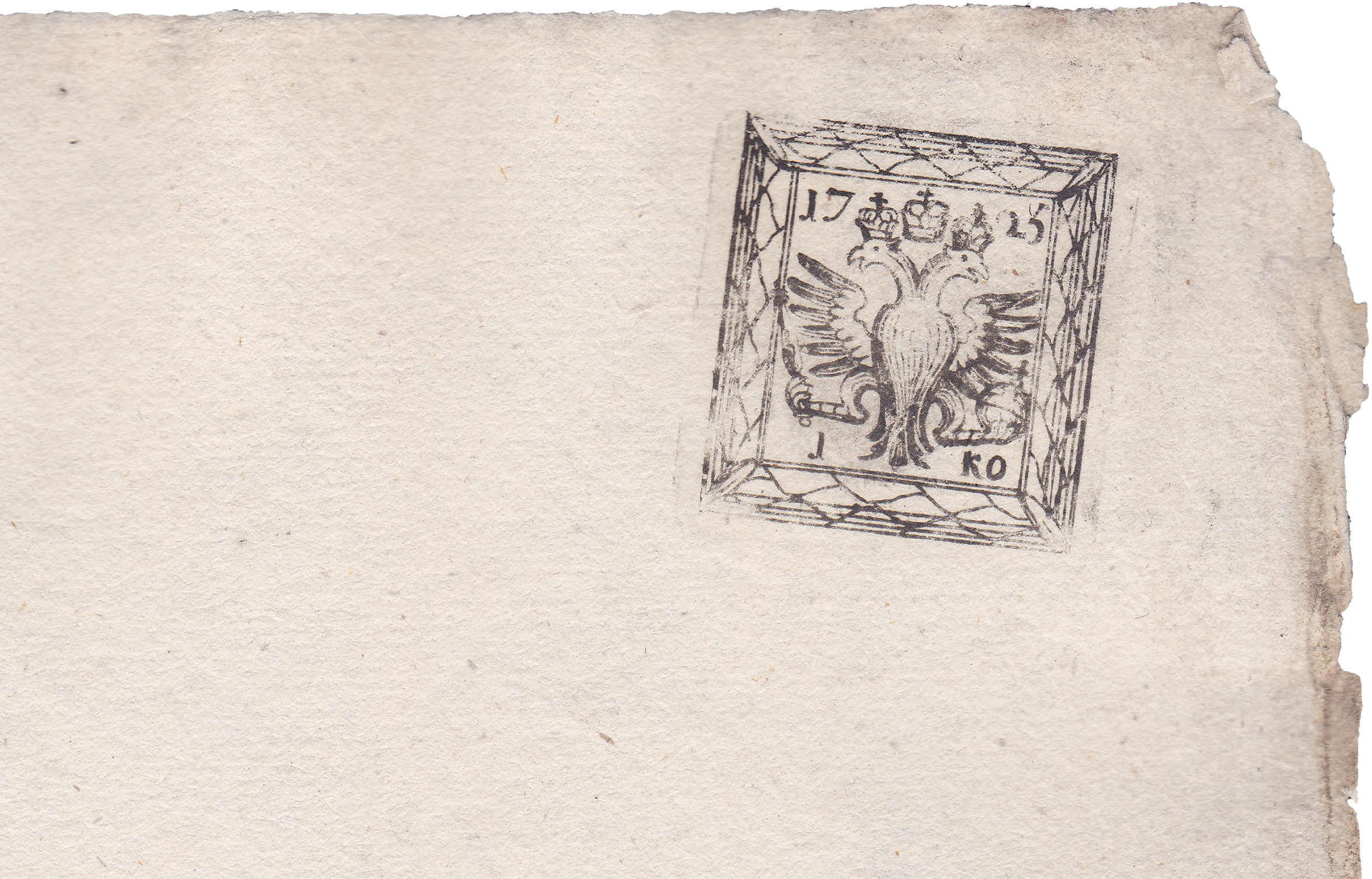
Stamped paper “for writing deeds of purchase” (for bonded acts) was introduced in Russia in accordance with the decree of January 23, 1699.
Russia owes the idea of the state issuing stamped paper to Alexei Alexandrovich Kurbatov (steward to Count B. P. Sheremetev), who, after traveling abroad together with the Count, submitted to Sovereign Peter Alexeyevich a proposal for “eagled” (stamped) paper “for the benefit of the treasury.” For his merits, A. A. Kurbatov was appointed “chief inspector of town-hall law,” and in 1711—vice-governor of the Arkhangelsk Governorate.
By the decree of October 17, 1723, stamped paper began to be produced with watermarks (filigree). The watermark was the State coat of arms (the double-headed eagle) placed on each half of the sheet. From 1724, the design of the corner stamps on stamped paper changed.