
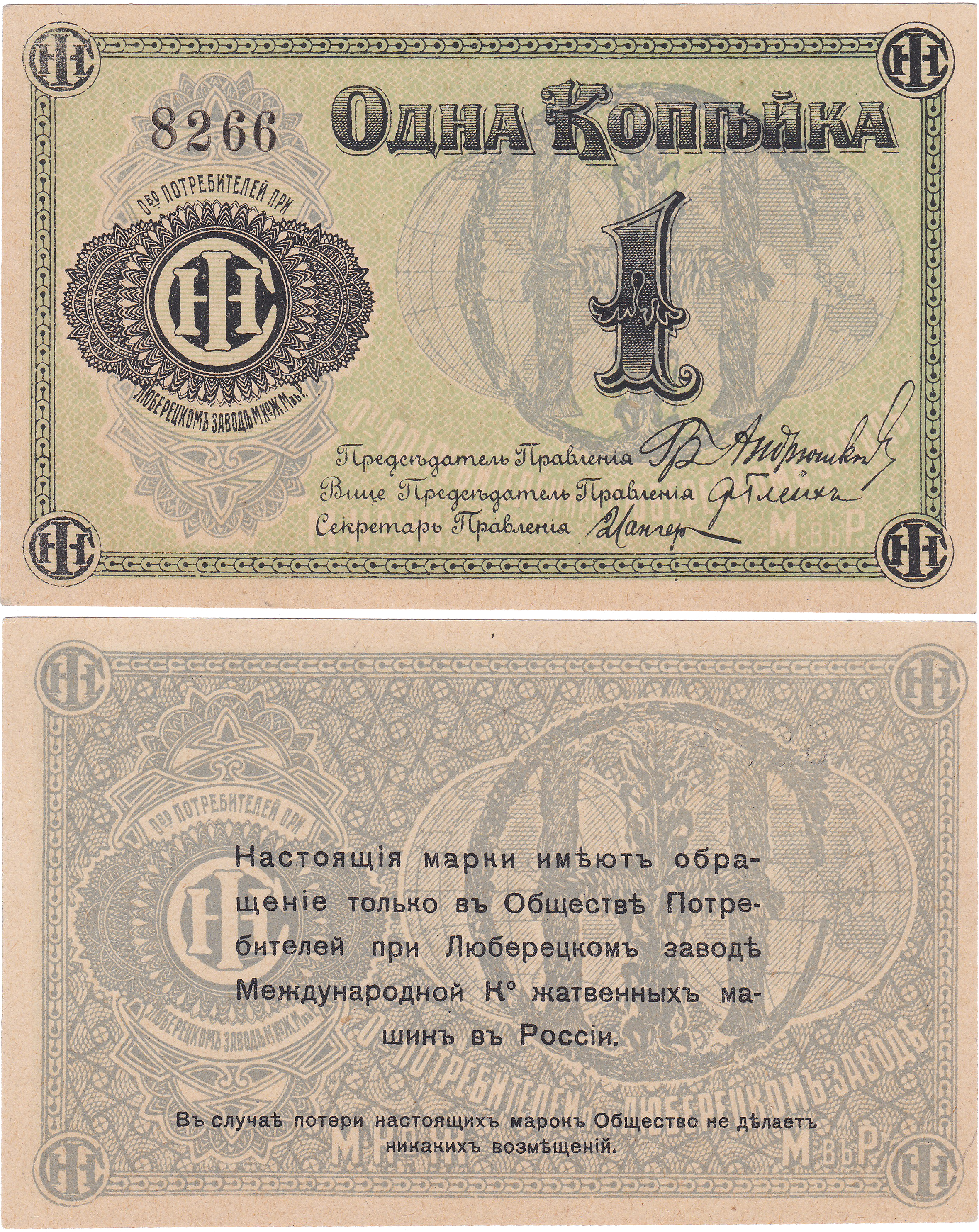
The Lyubertsy Plant of Agricultural Engineering was founded in 1902. A firstborn of the national machine-building industry, a truly veteran plant of epoch-making significance, it lived through the difficult periods of the Tsarist, revolutionary, Soviet, and post-Soviet eras, experiencing rises and falls, changes of ownership, changes in the profile of its output, and other cataclysms.
In 1909, according to reference data, of ten sellers of agricultural machines, seven were foreigners; of twelve sellers of equipment for dairy farming, nine were foreigners; of twelve offices engaged in the export of butter, seven were Danish, two were English, and only three were Russian.
Having begun operations as the first and only enterprise in Russia producing brakes for railway cars under the name "New York" and failing to obtain the necessary orders, the plant went bankrupt and in 1911 was purchased by the American "International Harvester Company in Russia"; it began producing reapers, header reapers, mowers, and binder machines, turning into an agricultural-engineering enterprise and becoming one of the centers for supplying equipment—mainly horse-drawn—to peasant farms.
In the first year of operation (1911–1912), more than 17,000 harvesting machines were produced. But during the First World War and the Civil War, machine production decreased by 4–5 times and then, after the war, gradually increased. However, the plant saw its strongest development after its nationalization (a third birth) in 1924, especially in the prewar period, by organizing the production and supply of machinery needed by agriculture.