
6 July — the future Emperor Nicholas I was born. He was the third son of Emperor Paul I and Empress Maria Feodorovna. He received a home education but showed no particular diligence in his studies. He did not recognize the humanities; however, he had an excellent command of military art, was keen on fortification, and was familiar with engineering.
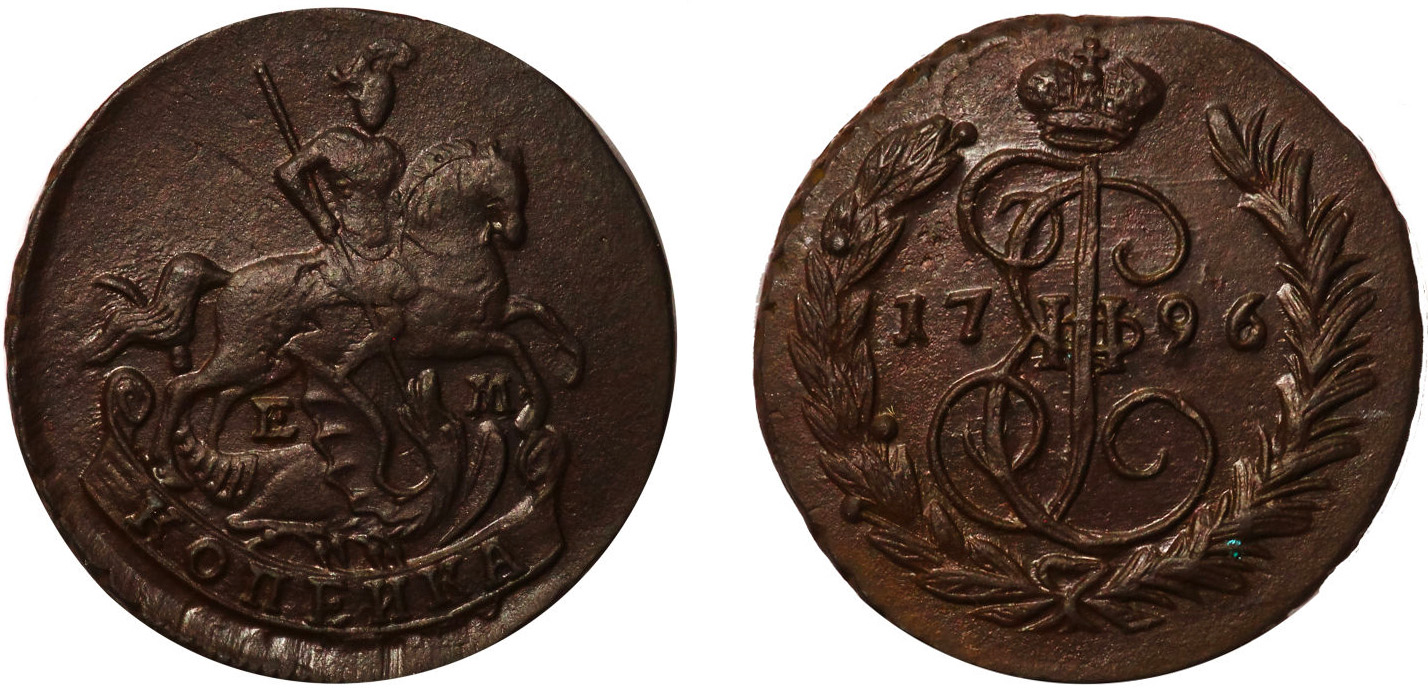
17 November — Empress Catherine II the Great died. During her reign, by 1796 the country had incorporated the Northern Black Sea region, the Sea of Azov region, Crimea, Right-Bank Ukraine, the lands between the Dniester and the Bug, Belarus, Courland, and Lithuania. The population increased from 23.2 million (in 1763) to 37.4 million (in 1796), and Russia became the most populous European country (accounting for 20% of Europe’s population). Catherine II created 29 new guberniyas and built about 144 cities.
17 November — Paul I became Sovereign.
10 December — an edict of Emperor Paul I was issued, releasing from Siberian exile all captured Polish insurgents.
9 March — Napoleon married Joséphine de Beauharnais, the widow of an officer executed by guillotine during the French Revolution.
The Italian Campaign of General Napoleon Bonaparte. In April 1796, the French army, crossing the Alps, defeated the Sardinian forces, forcing Sardinia to make peace. In May, French troops defeated the Austrians at Lodi and in June laid siege to the fortress of Mantua; then, after repelling four Austrian attempts to relieve the fortress, they forced it to capitulate in February 1797. Northern Italy was completely cleared of Austrian troops. In March, French forces invaded Austria and began an advance on Vienna. In April, the Leoben Armistice was signed. After the armistice, Bonaparte provoked a clash with the Venetian Republic and occupied Venice. In October 1797, the Treaty of Campo Formio was signed, under which Austria ceded to France the territory of the Austrian Netherlands and recognized the creation of the Cisalpine Republic (which included Lombardy).
14 May — English surgeon Edward Jenner successfully inoculated eight-year-old James Phipps against smallpox. The doctor had long noticed that people who had suffered the relatively harmless cowpox, which can be contracted from infected animals, did not later become infected. It took several years to prove the value of smallpox vaccination.
20 September — Nikita Mikhailovich Muravyov was born, a Decembrist, one of the founders of the Union of Salvation, a member of the Union of Welfare, and a leader of the Northern Society. He died in exile in 1843.
9 October — Sergey Ivanovich Muravyov-Apostol was born, a Decembrist. On 14 December, Muravyov was in Zhytomyr, from where he led about 1,000 soldiers and 17 officers to St. Petersburg. The authorities, having learned of the uprising, threw large military forces against them. Four squadrons of hussars and horse artillery with two guns decided the outcome: after six volleys, the defeat of the rebels was completed, and Muravyov himself was wounded in the head and captured. He was executed in 1826.
17 October — Yevgeny Petrovich Obolensky was born, a Decembrist, a member of the Union of Welfare, a participant in the uprising on Senate Square who wounded Count Miloradovich with a bayonet, and a Siberian enlightener.