
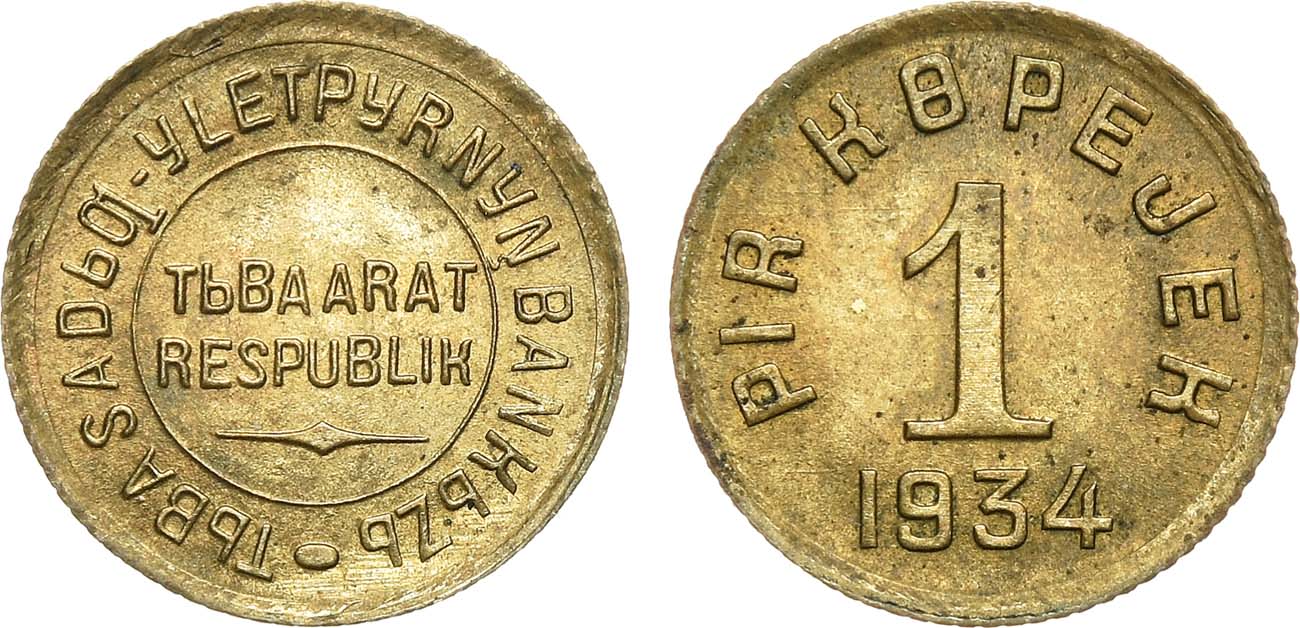
The Tuvan People’s Republic was a partially recognized state (by the USSR in 1924 and by the Mongolian People’s Republic in 1926) in Southern Siberia that existed from 1921 to 1944. In 1944 it became part of the USSR as the Tuva Autonomous Oblast within the RSFSR.
Aksha was the monetary unit of the Tuvan People’s Republic from 1934 to 1944. It was subdivided into 100 kopeks (Tuvan: kɵpejek).
On August 13, 1921, the All-Tuvan Constituent Khural proclaimed the formation of the People’s Republic of Tannu-Tuva (from 1926 it became known as the Tuvan People’s Republic, TPR). The Tuvan people firmly linked their fate with the Soviet people, and already in the first Constitution of the TPR it was declared that in international relations the republic acted under the protection of the RSFSR.
In September 1921, the government of Russia recognized the independence of the TPR.
Tuva’s banking system traces its history to July 1925, when, by decision of the TPR Government, with the support and active participation of the State Bank of the USSR, the joint-stock Tuvan Trade and Industrial Bank (Tuvinbank) was established.
In the early period of Tuvinbank’s operations, various monetary units continued to circulate in the republic: Chinese taels (yansha) and fens, Mongolian tugriks, Soviet currency notes, as well as bonds put into circulation by the TPR Ministry of Finance in 1923. The latter were pre-revolutionary-style notes, stocks of which had been kept in the Kyzyl bank since 1915; on their reverse side an overprint was applied with the stamp of the Tuvan government seal, and three signatures were affixed—those of the Chairman of the Council of Ministers, the Minister of Finance, and the Deputy Adviser to the Government on Finance.
From 1925, by agreement between the governments of the USSR and the TPR, Soviet money was issued into circulation in the republic: silver coins and later Soviet paper treasury notes and banknotes.
By 1929, Soviet money had become the only legal tender in Tuva; other currency issues were withdrawn from circulation. This step improved the economy of the young republic. However, a huge, uncontrolled money supply continued to be brought into its territory. As a result, prices for goods began to rise.
Therefore, from December 10, 1933 to January 15, 1934, an exchange was carried out of all available and circulating currency for banknotes bearing the stamp “Valid for circulation only in the TPR.”
As for Soviet small-change coinage, it was replaced with Tuvan coins minted in the USSR at the Leningrad Mint in denominations of 1, 2, 3, and 5 kopeks (bronze) and 10, 15, and 20 kopeks (nickel) of the 1934 type. In order not to complicate production, they were struck on the same blanks and using the same equipment as USSR coins of that period—the only difference was the dies. They remained in circulation until May 1, 1945.