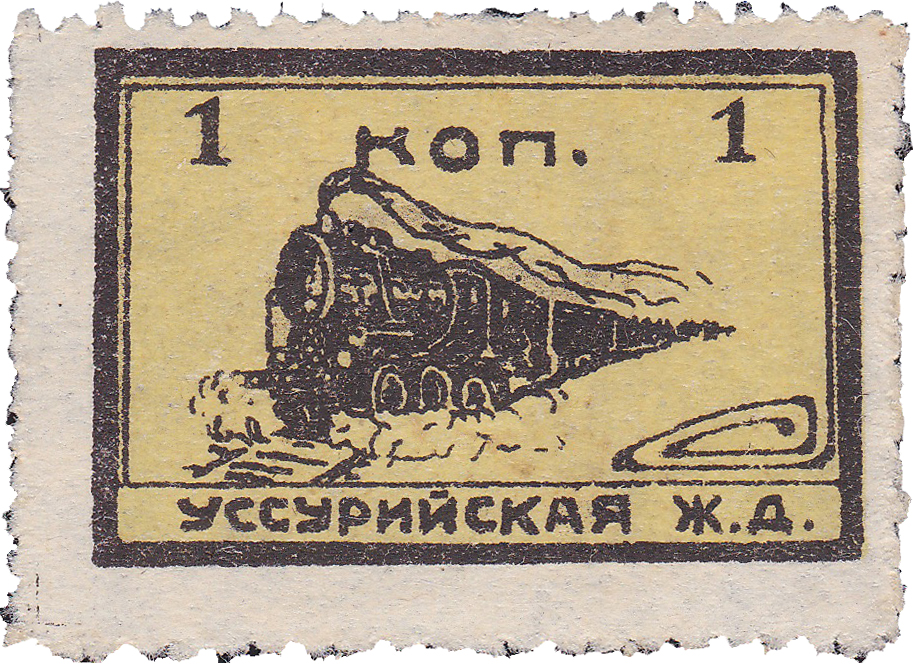
Presumably stamps for paying freight charges for large cargoes.
The birthday of the Great Siberian Route is traditionally considered to be March 30, 1891, when an imperial decree was issued to begin laying the railway. A historical fact few people know is that the official, “pompous” groundbreaking of the Trans-Siberian Railway took place in Vladivostok. That is, construction began from the Pacific Ocean. On May 19, 1891, Tsarevich Nicholas Alexandrovich (the future Emperor Nicholas II), who was present at the ceremonial event, was the first to wheel a barrow of earth to the site of the future trackbed. In fairness, however, it should be noted that several months earlier, in the Urals, seven thousand versts from Vladivostok, quite inconspicuously and as part of everyday work, construction began on the Miass–Chelyabinsk railway section, which later became the historic starting point of the main line to the Pacific Ocean.
In the first years after the annexation of the Amur region and the Ussuri territory to Russia under the Aigun (1858) and Beijing (1860) treaties with China, these lands were officially referred to as a colony of the Russian Empire. In view of the absence of reliable, properly developed routes of communication, there was no way to export local products to sales markets. The small population consisted mainly of military personnel and officials. They came to the Far East temporarily, for the term of their service. Because of the lack of normal living conditions, their main and natural desire was to return home to Russia as soon as possible.
The Ussuri Railway, a fragment of the future Trans-Siberian located at the edge of the world, was to connect the Pacific Ocean with the Amur. The 716-verst route between Vladivostok and Khabarovsk took as many as six years to build. On November 1, 1897, the line, comprising 23 stations and 7 passing loops, was put into operation. In essence, it was a unique case: a long line that was the most remote, “out of the way,” and completely isolated from the rest of the rail network of the Russian Empire. All materials and rolling stock for the line were delivered from “mainland” Russia via the Southern Sea Route.
In 1906, the line was leased to the Chinese Eastern Railway Company for a term of twenty-five years.
During the Civil War, loans for maintaining the Ussuri line gradually decreased, and from January 1920 the financing of its operations ceased altogether.
On March 20 of the same year, the Primorye Zemstvo Board terminated the contract with the CER, and the lease ended, ultimately lasting just under 14 years. This date became the second birthdate of the Ussuri (fully independent) railway, which in 1923–25 was extended across virtually the entire Amur region, as far as the borders with Chita Oblast. From 1925 to 1936, the boundary between the Transbaikal and Ussuri railways was the Skovorodino (Rukhlovo) station. The Ussuri line existed until 1936.
Today, all sections of the line are part of the Far Eastern Railway.
1 Kopeck 1920.
Ussuri Railway.