25 February — at a closed session of the 20th Congress of the CPSU, Khrushchev spoke with accusations against Stalin. The congress’s agenda had already been exhausted when N.S. Khrushchev presented to the participants his sensational report, “On the Cult of Personality and Its Consequences”.
In the report, Khrushchev set out facts exposing J.V. Stalin. The report was secret.
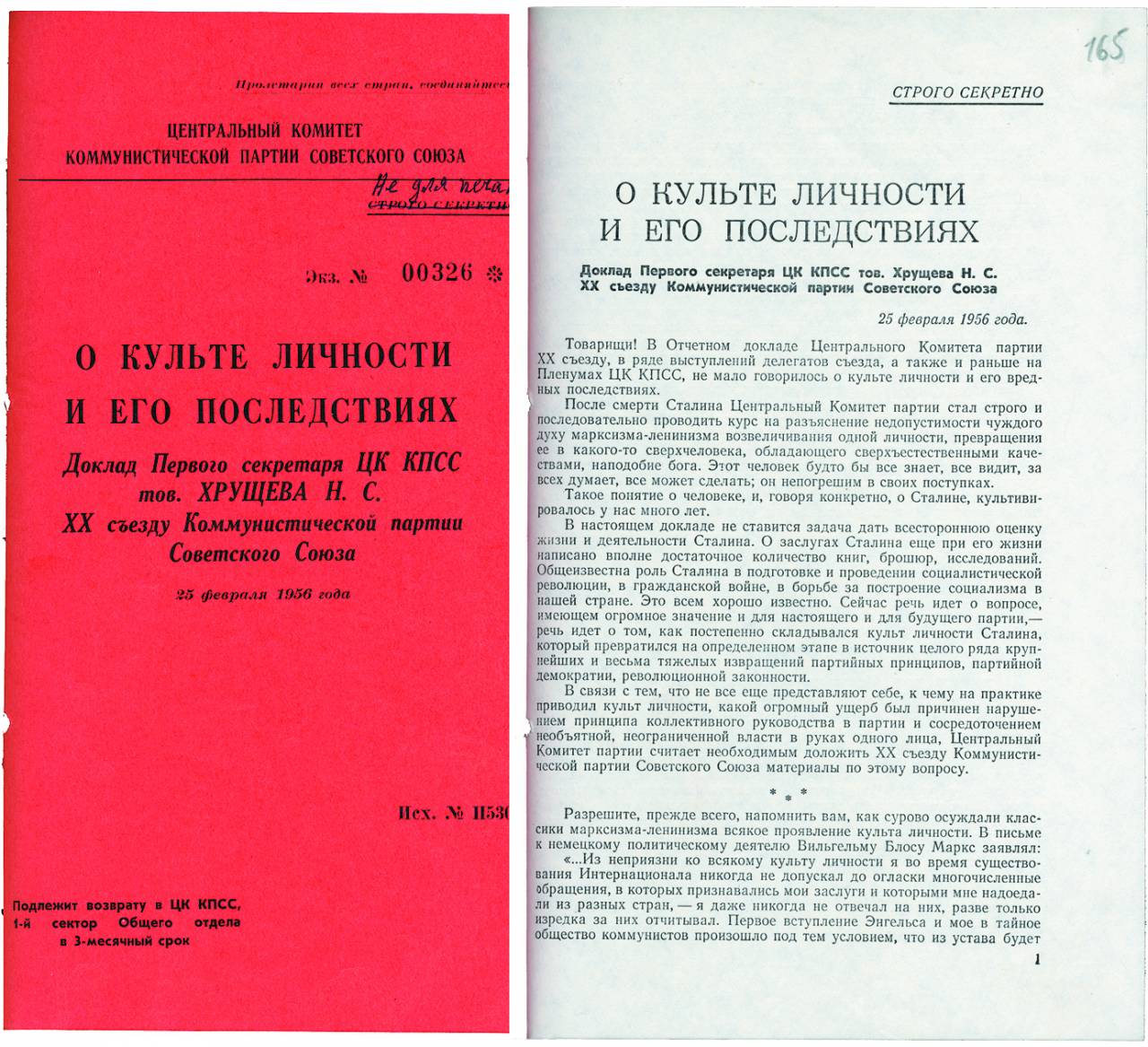
But already in early March, the brochure stamped “not for publication” was sent to all party organizations. Thus, the “closed” nature of the report was conditional, although officially it was published only in 1989. The report drew enormous attention worldwide; translations into various languages appeared, including ones circulated in non-communist circles. The New York Times of 16 March summarized the secret report. The U.S. State Department went even further: on 4 June it published the full text of the report.
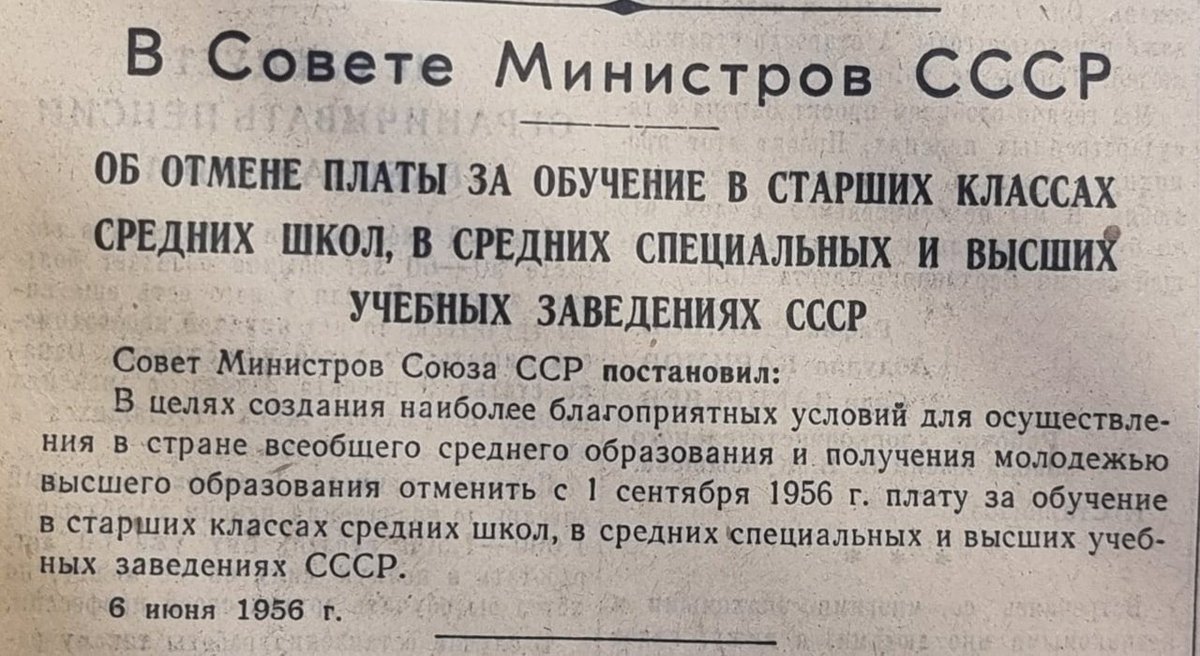
6 June — in the USSR, tuition fees were abolished for the upper grades of secondary schools. On 26 October 1940, Decree No. 638 “On Introducing Tuition Fees in the Upper Grades of Secondary Schools and in Higher Educational Institutions of the USSR and on Changing the Procedure for Awarding Scholarships” had been introduced.
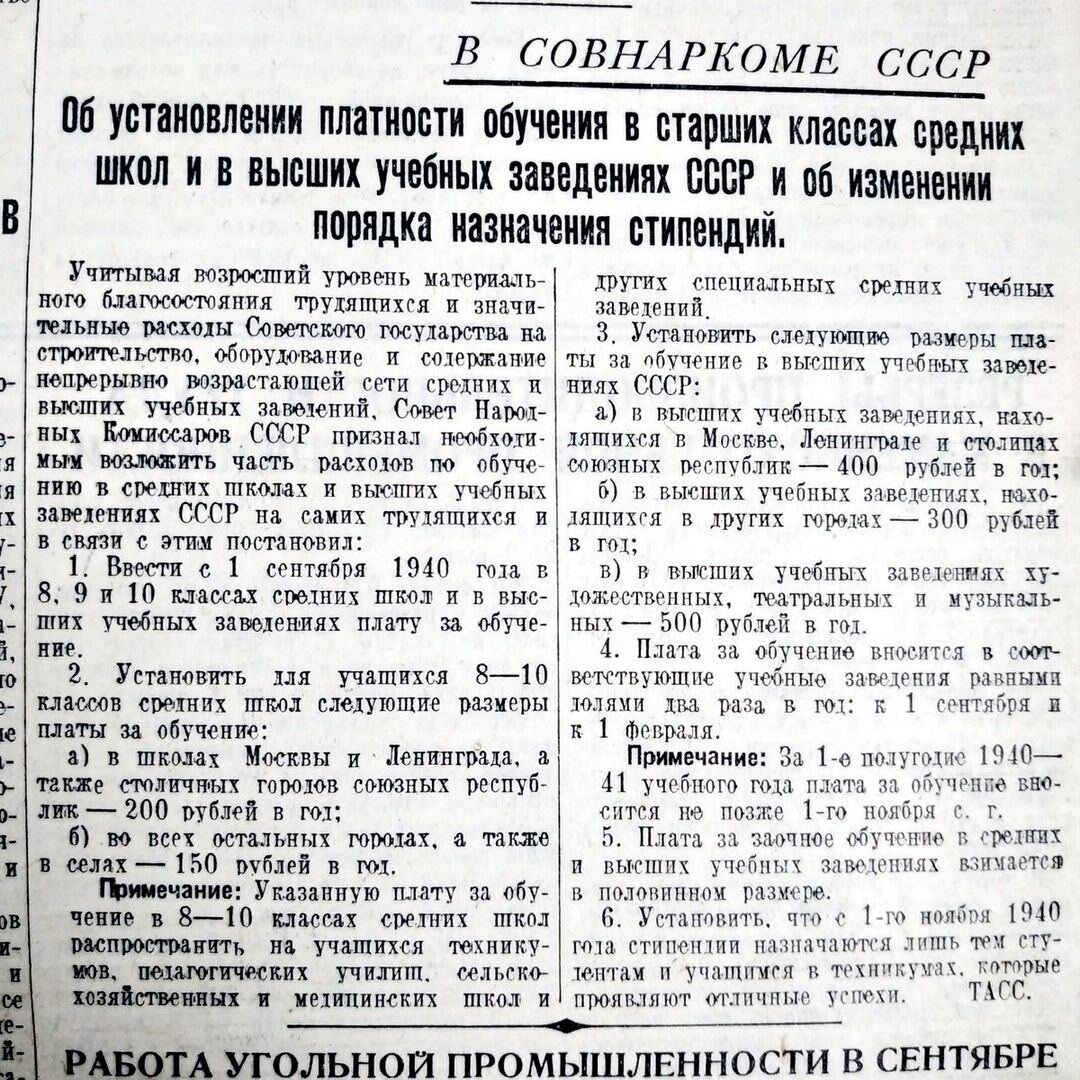
Paid education with a fixed annual fee was introduced in the upper grades of schools and in higher educational institutions. Schooling in the capital’s schools cost 200 rubles a year; in provincial ones, 150; and for study at an institute one already had to pay 400 rubles in Moscow, Leningrad, and the capitals of the Union republics, and 300 in other cities. The amount charged for school and university was not excessive; the annual fee roughly corresponded to the average monthly nominal wage of Soviet workers. However, the introduction of even such a modest fee for many Soviet citizens closed off the possibility of continuing education after the 7th grade. And collective farmers at that time did not receive wages at all and worked on the collective farm for workdays (trudodni).
As a result of the “reforms” carried out, the number of graduates of secondary schools (grades 8–10), secondary specialized educational institutions, and higher educational institutions was halved. During the war, the CPSU Central Committee held consultations with the governments of the Union republics and decided to abolish tuition fees on a national basis for students in grades 8–10 of secondary schools, technical schools, and higher educational institutions. By a decree of the USSR Council of Ministers of 6 June 1956, tuition fees in the upper grades of secondary schools, in secondary specialized and higher educational institutions of the USSR were abolished.