
Candies like “Goose Feet,” inserts and tiny toys hidden inside sweets, chocolate bunnies and Father Frost figures wrapped in foil—all these children’s delights were invented in the 19th century by a remarkably talented man and uniquely successful businessman, Russia’s “marmalade king,” Alexei Ivanovich Abrikosov. After the revolution, his name was unjustly forgotten, and his brainchild—an enormous confectionery concern—was given the name of Pyotr Akimovich Babaev, chairman of the Sokolniki District Executive Committee.
In 1879, Abrikosov appealed to Emperor Alexander II for permission to buy land from the merchant Tsaplya in Simferopol to build a confectionery factory there. The highest permission was granted, and Alexei Abrikosov purchased equipment for the new confectionery factory in France and also brought in from France a specialist in steam heating of products.
In 1880, in Simferopol, on the banks of the Salgir, the steam-powered factory of the “Partnership of A. I. Abrikosov and Sons” appeared. Twenty years later, Abrikosov’s Simferopol confectionery factory occupied one hectare of land, with half of its territory taken up by fruit orchards. The factory had three separate buildings. The main building housed the fruit, tomato, and steam departments, the office, and a grocery and dry-goods shop. The second building contained the fruit heat-treatment department, the caramel and chocolate departments, the steam-power installations, and the tin workshop. The third building contained a shop, a packaging department, and a loading-and-unloading area. All the buildings were stone, single-story, with slate roofs and stone floors, connected to one another by rail tracks. The automated production cycle was powered by two steam generators of 12 horsepower each.
After the October Revolution of 1917, workers’ control was introduced at Abrikosov’s confectionery factories. During the years of revolution and the Civil War, the Abrikosov factory in Simferopol was looted and ruined.
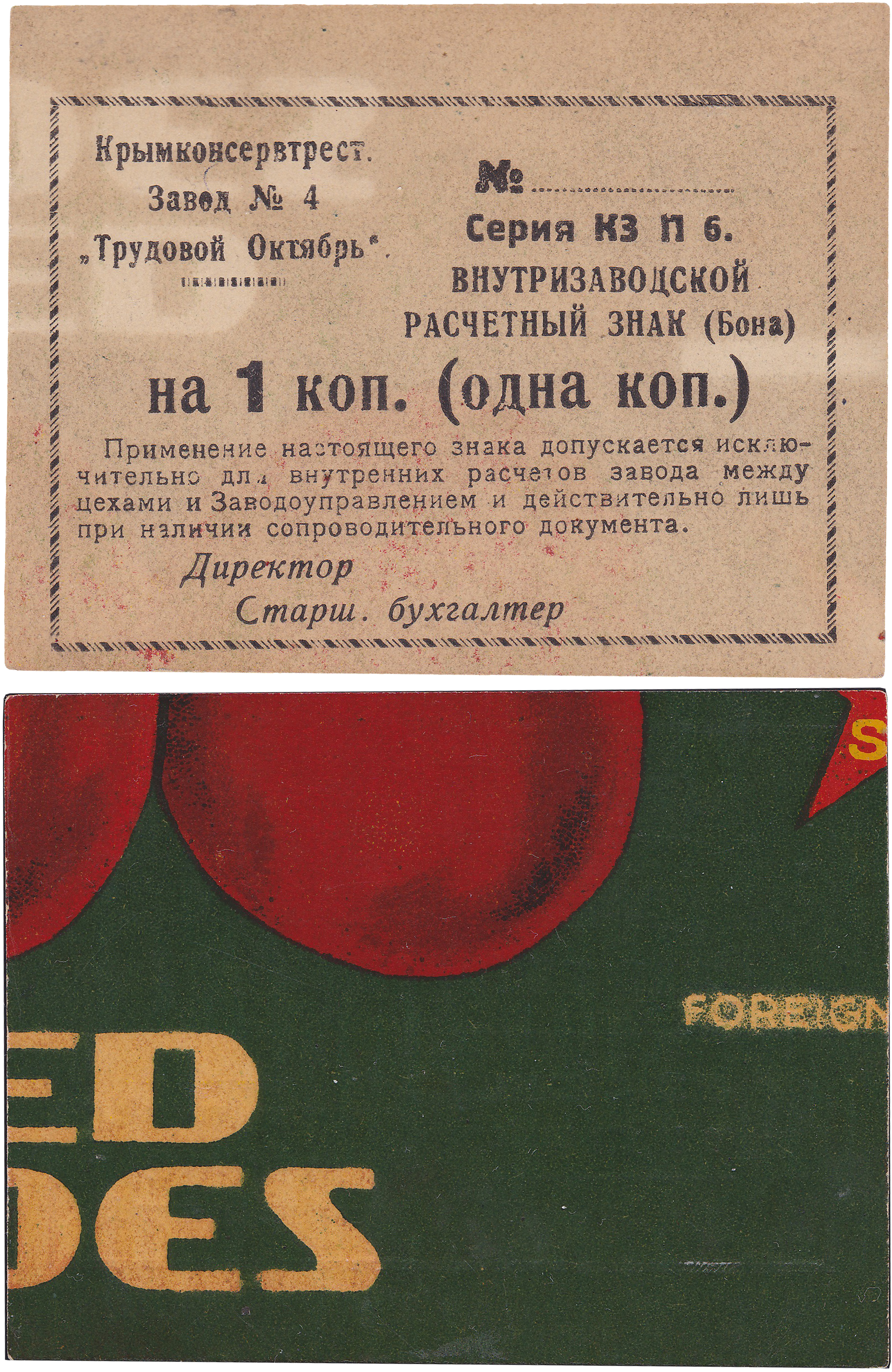
In 1920, the Abrikosovs’ Simferopol factory was nationalized; only 26 people worked there. It was then renamed Plant No. 4. In 1922, the plant was given the name “Labor October.”