
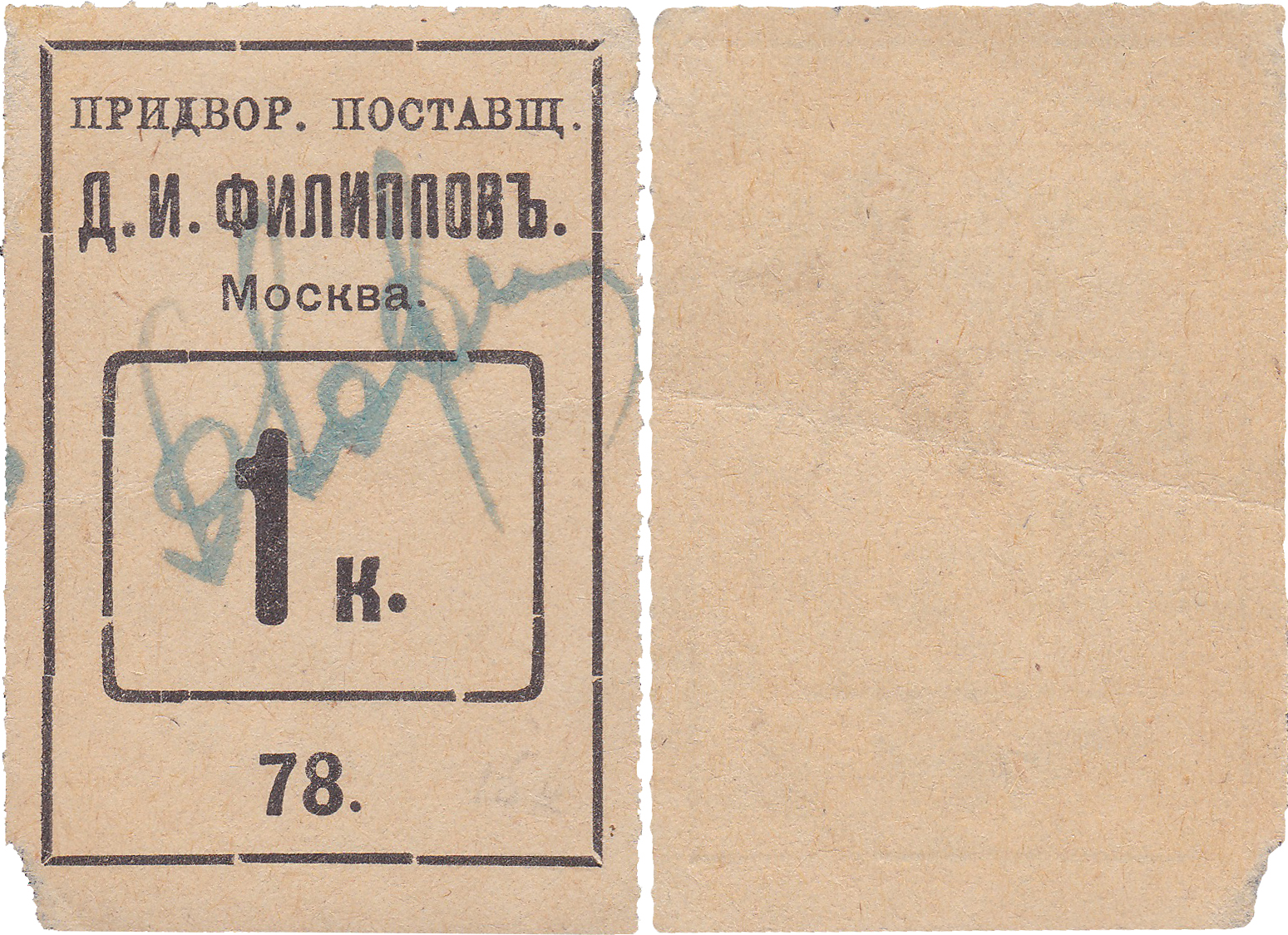
The Filippovs were a Moscow merchant family, founders of a famous baking enterprise. The progenitor was Maksim Filippov, a former serf from the village of Kobelevо in Kaluga Governorate, who came to Moscow in 1803 (1806). At first he worked part-time as a baker; then, having saved money, he became the owner of his own bakery at the corner of the Boulevard Ring and Myasnitskaya Street. Maksim Filippov, together with his family, baked and sold kalachi and pies with various fillings in the city’s trading rows.
After his father’s death, the business was continued by his son, Ivan Maksimovich (1824–78). By that time, the Filippov family had three baking establishments: one specializing in kalachi, one in buns, and one in baranki—on Tverskaya Street in Manukhin’s house, on Sretenka in the Spas house, and on Pyatnitskaya in their own house.
Ivan Maksimovich had strong commercial instincts and enterprise. He was among the first to revive in Moscow the “field-to-counter” production chain. A pound of well-baked bread in Moscow before the first revolution cost 1 kopek. This was the so-called “sour bread” (the black bread of the Russian countryside). Filippov was the first in Russia to organize a bread shop attached to a bakery. At the Sretenka bakery, the soon city-famous pies also appeared for the first time—filled with tripe, porridge, cabbage, viziga, and others.
In Filippov’s bun shops, loaves were checked for freshness as follows: the clerk placed the loaf on a perfectly clean counter, pressed it down with all his strength, and then released his hand. After 5–6 seconds, fresh baked goods, slowly exhaling air, regained their former shape. A spoiled loaf or round bread, saika, or krendel could not make it to the main counter—by established rule, a lopsided krendel was sold at half price.
From 1855, I. M. Filippov was a Supplier to the Court of His Imperial Majesty; he received the title for excellent quality and a broad assortment of products. In 1864, Filippov opened his first shop in St. Petersburg, on Nevsky Prospekt, 45. But Neva water was not suitable for Filippov’s kalachi. The court baker had to transport oak tubs of Mytishchi water on Nikolayevskaya Railway courier trains so that dough for court breads in St. Petersburg could be kneaded with it.
The story of how Ivan Maksimovich “invented” raisin saikas was described in a vivid and entertaining way by the journalist V. A. Gilyarovsky in his famous book “Moscow and Muscovites.” In 1848–1859, the “all-powerful dictator of Moscow” was Governor-General A. A. Zakrevsky, whose breakfast every morning included hot saikas from Filippov. Once, one of these saikas contained a baked cockroach:
“‘Wh-what is this filth?! Bring the baker Filippov here!’ the ruler roared over his morning tea.
The servants, not understanding what the matter was, dragged the frightened Filippov before their superior.
‘Wh-what is this? A cockroach?’ And he thrust the saika with the baked cockroach at him. ‘Wh-what is this? Huh?..’
‘It’s a raisin, sir!’
‘Lying scoundrel! Are there even saikas with raisins? Get out!’
Filippov ran into the bakery at full speed, grabbed a sieve of raisins and, to the great horror of the bakers, dumped it into the saika dough.
An hour later Filippov treated Zakrevsky to saikas with raisins, and two days later there was no end of customers.
‘And it’s very simple! It all comes by itself—just know how to catch it,’ Filippov would say when raisin saikas were mentioned.”
In his work, Ivan Maksimovich liked scale. The author of “Moscow and Muscovites” wrote that “when a cart drove out of the yard of the Tverskaya bakery with a name-day pie that wealthy people ordered from him, the gates had to be taken off, because the pie was so large that it would not fit through them. It was an amazing sight. All of Moscow would run to watch.”
According to the recollections of Filippov family members, “he was an unusual man.” It is known, for example, that his study was “papered with banknotes—‘katenki.’” Around the city, Filippov’s horses were recognized by the fact that they were shod, royally, with pure silver. Filippov was selective and did not seize every opportunity to make money. He had a peculiar honesty. Where other bun makers did not even consider it a sin to profit by cheating, Filippov acted differently.
The famous entrepreneur was also renowned for his charity. On holidays, he baked large batches of bread by order and sent these “bread gifts” to prisoners in Butyrka prison. At the same time, as V. A. Gilyarovsky testified, first, he “never sent slops to the prisoners, but always fresh kalachi and saikas; second, he kept a special account that showed how much profit these orders for alms brought, and he personally took that profit in full to the prison and donated it to improve the food for sick prisoners. And he did all this ‘quite simply.’ Not for gain or for medals or uniform distinctions from charitable institutions.”
In addition, Ivan Maksimovich was an “agent” of the first Sushchevsky branch of the Moscow guardianship for the poor, and a member of the Council of Moscow children’s shelters. It is known that he supplied baked goods to the Nikolayevsky home for the care of poor widows and orphans. All his life I. M. Filippov belonged to the Moscow merchant society, and a year before his death he was elected a member of the City Duma. For his charitable activity and achievements in entrepreneurship, he was awarded the Order of St. Anna, 2nd class, and became a hereditary honorary citizen of Moscow.
From 1877, I. M. Filippov was elected a member of the Moscow City Duma. For services in entrepreneurship he was awarded the Order of St. Anna, 2nd class.
In 1878, after the death of Ivan Maksimovich, the firm “Filippov, Ivan—Heirs” was created; it was first headed by his widow Tatyana Ivanovna, and from 1881 by his son Dmitry. From two marriages, I. Filippov had seven sons; three continued their father’s business. As they grew up, Ivan Ivanovich received his own shop on Sretenka, and Nikolai Ivanovich (where—unknown). The main shop remained the store on Tverskaya. After the brothers’ deaths, all the shops were again concentrated in the hands of Dmitry Ivanovich Filippov (by the late 1890s).
D. I. Filippov had bakery-confectionery shops on Tverskaya, Sretenka, Myasnitskaya, and in other prestigious locations. In the Tverskaya shop, by the beginning of the 20th century there was already a factory that included: rusk, baranki, and pastry-confectionery departments; two departments of German bread; departments for Starodub, Riga, St. Petersburg table bread, black, white, and Swedish bread; fried pies; and departments for kalachi and rastegai. The factory had caramel workshops and a marmalade section. In the basement they boiled fruit; the Filippovs did not use imported candied fruit. Back in Ivan Maksimovich’s time, it was customary to make agreements with owners of orchards near Moscow, Voronezh, and Kursk for the supply of fruit and berries.
At the beginning of the 20th century, D. I. Filippov rebuilt the building of the main shop on Tverskaya (architect N. A. Eikhenvald) and opened a fashionable coffeehouse in the corner part of the building—later the “Central” restaurant. The interior design involved the artist P. P. Konchalovsky and the sculptor S. T. Konenkov. In 1911, a hotel wing for the “Luxe” hotel with 550 beds was added to the left side of the building. (In 1920 it was converted into a Comintern dormitory; now it is the “Centralnaya” hotel.) By that year, D. Filippov already owned 16 shops and bakeries.
The length of the working day in the bakeries reached 16 hours, and for apprentices up to 18 hours a day. For penal labor from early morning until late at night, the owner paid 15–20 kopeks, more rarely 30–40 kopeks. Apprentices’ wages did not exceed three rubles a month at all. At the same time, almost no one received their full earnings because of the thriving system of fines. Working and living conditions did not meet even elementary sanitary standards or safety rules.
Filippov’s bakers went on strike for the first time back in 1903. The police were brought in; the strikers began to be pushed back toward the shop. They took up cobblestones—the old, reliable weapon of the proletariat. The troops, just in case, fired on the store. In 1904, a workers’ circle arose at the Tverskaya bakery, turned into a center from which overall leadership in preparing collective actions was carried out. In 1905, 650 workers of Filippov’s bakery organized a bakers’ strike in Moscow. On September 25, there was a clash between strikers and the police and Cossacks—there were killed and wounded, 197 people were arrested; by October, Filippov’s bakers created a combat squad, and later took part in the December armed uprising.
The consequences of the strike were very lamentable for the shop—the bakery became shabby, turning from a luxurious and respectable establishment into a place that was almost disreputable. Ivan Bunin, for example, wrote of a certain Kazimir Stanislavovich: “In Filippov’s coffeehouse he drank chocolate and looked through tattered humorous magazines.” Although only quite recently the administration would not have allowed in the coffeehouse either tattered, or especially “humorous,” periodicals. All sorts of dubious characters began to appear there. For example, Mayakovsky.
In July 1906, the situation escalated even more. The strike continued, and Filippov, like other bakery owners, suffered losses. Then he decided to make concessions to the workers, offering holiday rest, two-shift work, and higher wages, thereby provoking dissatisfaction among other entrepreneurs. However, he did not back down, taking an independent position based on sober calculation. As a result, his workers returned to their places and resumed baking bread. The daily turnover of Filippov’s shops increased. But by that time the firm already owed creditors about 3 million rubles.
To save the business, the firm declared itself bankrupt. By decision of the Moscow Commercial Court, from 1905 to 1915 the firm’s affairs were managed by an administration consisting of company employees and representatives of creditors. In 1913, a total of 2,951 people worked at the Filippovs’ enterprises: in Moscow—1,558; in St. Petersburg—943; in Tsarskoye Selo and Gatchina—189; in Rostov-on-Don—150; in Tula—97; in Saratov—114.
The opening of a new shop and bakery on Posolskaya Street in Tula was the last thing Dmitry Ivanovich managed to do in his life. A month after the housewarming—on December 9, 1908—the court baker died. After Dmitry Ivanovich’s death, his sons Nikolai, Dmitry, and Boris continued the business. In fact, the head of the firm became his stepson Nikolai. After the end of the administrative trusteeship in March 1915, he organized, as a general partnership, the “Trading House of the Filippov Brothers.”
The family firm existed until nationalization after the revolution. The owner of the firm was forced to emigrate to Brazil. Of the once famous Filippov empire, only the “bread” names of Moscow streets and lanes have survived to this day: Kalashny, Khlebny, and others.