
October 1 — in Vienna, the world’s first postage-paid postcard was issued. The idea for such an innovative communication system had been voiced nine months earlier by the professor of political economy at the Viennese Military Academy, Emanuel Herrmann, in the newspaper “Neue Freie Presse”. He also proposed making the mailing of a postcard cheaper than mailing a letter.
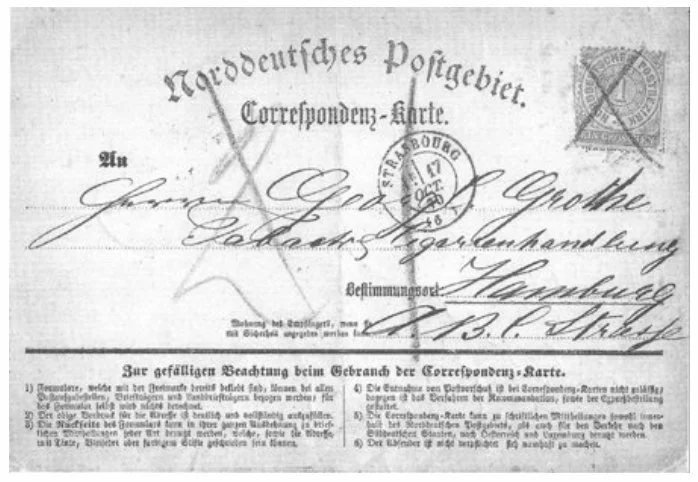
On sheets of thick paper the size of a standard postal envelope, with lines for the address and the Austro-Hungarian coat of arms, two-kreuzer stamps were simply “printed in”. The “Correspondenzkarte” became popular instantly: about 3 million were sold in the first two months.
November 17 — a ceremonial opening of the Suez Canal took place, linking the Mediterranean and Red Seas for navigation. The first vessel to pass through the canal was the yacht “Aigle”, carrying the French Empress Eugenie, wife of Napoleon III, and the chief builder of the canal—the French engineer Viscount Ferdinand Marie de Lesseps.
May 25 — the Vienna Opera House building was opened. In 1861, at the wish of Emperor Franz Joseph I, construction began on a dedicated building for the Vienna Opera, designed by architect von Siccardsburg; the interior was designed by van der Null. The theater building, which still houses the Vienna Opera today, was opened on May 25, 1869, with a production of Mozart’s “Don Giovanni”. For a long time it was considered one of the finest theater buildings in the world, and the Vienna State Opera itself (until 1918, the Vienna Court Opera) became Austria’s largest and leading opera theater, a center of the country’s musical culture.