
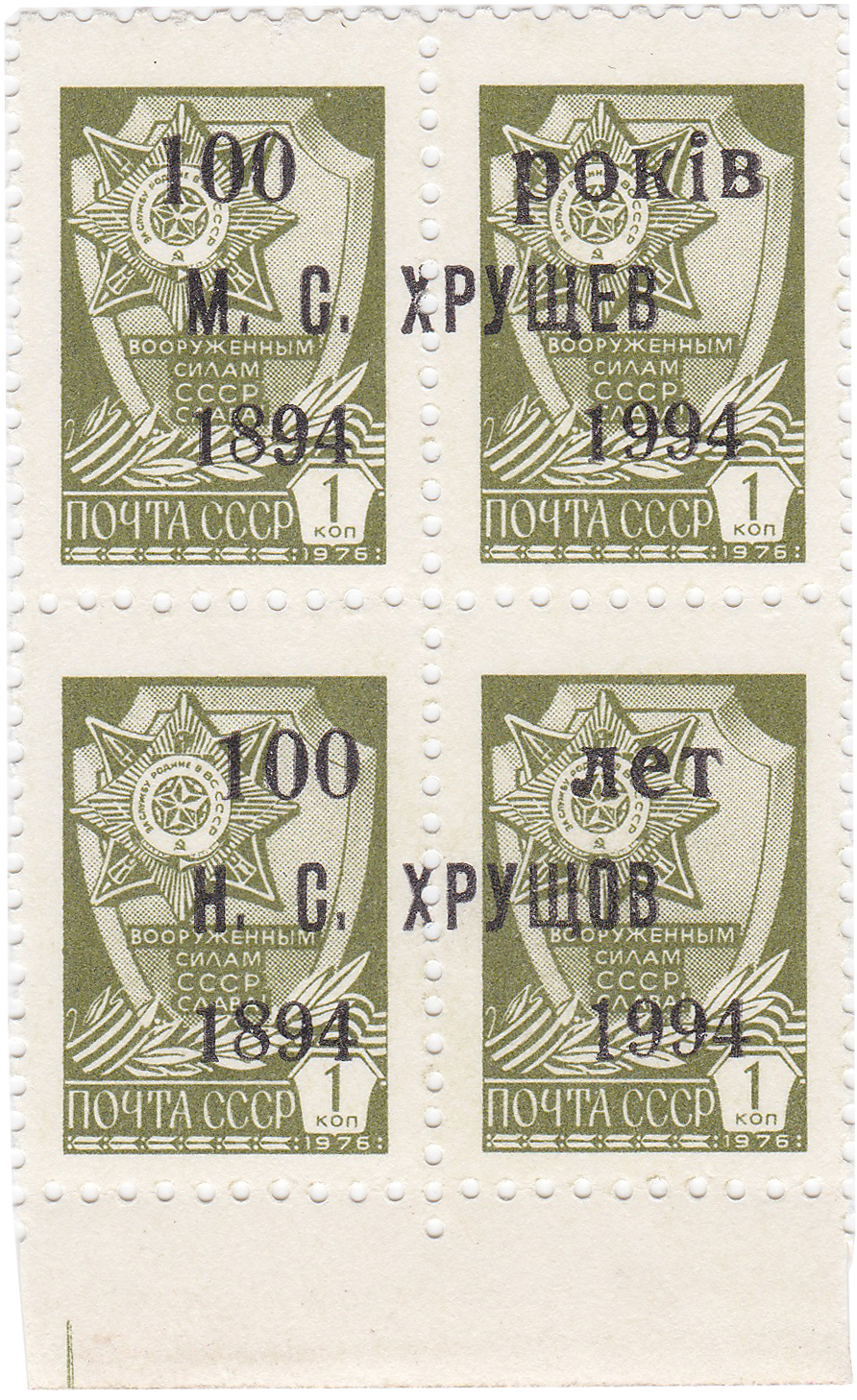
Speculative fiction.
Nikita Sergeyevich was born into the family of miner Sergei Nikanorovich Khrushchev (died in 1938) and peasant woman Kseniya Ivanovna Khrushcheva (1872–1945).
In winter, Khrushchev attended a parish school, where he learned basic literacy, and in summer he worked as a shepherd in Kursk Oblast. When Nikita Khrushchev turned nine, his father took him out of school for good and sent him to work in the fields. “I learned to count up to 30, and my father decided that was enough education for me,” Nikita Sergeyevich recalled. “All you need is to learn to count money, and in any case you’ll never have more than thirty rubles.”
For some time, Khrushchev was an apprentice to a cobbler and a shop clerk—learning a trade and arithmetic. In 1908, the Khrushchevs moved to the Uspensky mine near Yuzovka (present-day Donetsk), where fourteen-year-old Nikita Khrushchev became a metalworker’s apprentice at E. T. Bosse’s machine-building and iron foundry. He studied and, incidentally, was among the quickest learners. From 1912 he worked as a fitter at a mine, and it was specifically as a miner that he avoided mobilization to the front in 1914. After the Revolution, he joined the Bolsheviks. In the summer of 1920, he graduated with honors from the party school attached to the political department of the 9th Army. In 1922, Khrushchev enrolled in the workers’ faculty (rabfak) of the Don Technical School in Yuzovka, where he became the technical school’s party secretary. Finally, Nikita Sergeyevich went on to study at the Industrial Faculty of the Industrial Academy, established on the basis of the Moscow People’s Open University named after A. L. Shanyavsky. He attended lectures in the same year as Stalin’s wife, who introduced Nikita Sergeyevich to Iosif Vissarionovich. That is where his brilliant career began.
Khrushchev played a significant role in carrying out the 1937–1939 repressions in Ukraine, as detailed in a CPSU Central Committee memorandum dated December 25, 1988. In particular, it states that in 1938–1940, during Khrushchev’s tenure as First Secretary of the CP(b)U, 167,565 people were arrested in Ukraine (in 1938 alone, approval was given for the repression of 2,140 individuals from among the republic’s party and Soviet leadership). Thus, in the summer of 1938, with Khrushchev’s sanction, a large group of leading officials of the party and Soviet and economic bodies were arrested, including deputy chairmen of the Council of People’s Commissars of the Ukrainian SSR, people’s commissars, deputy people’s commissars, and secretaries of regional party committees. As a member of an NKVD troika, Khrushchev personally issued hundreds of execution sentences a day.