
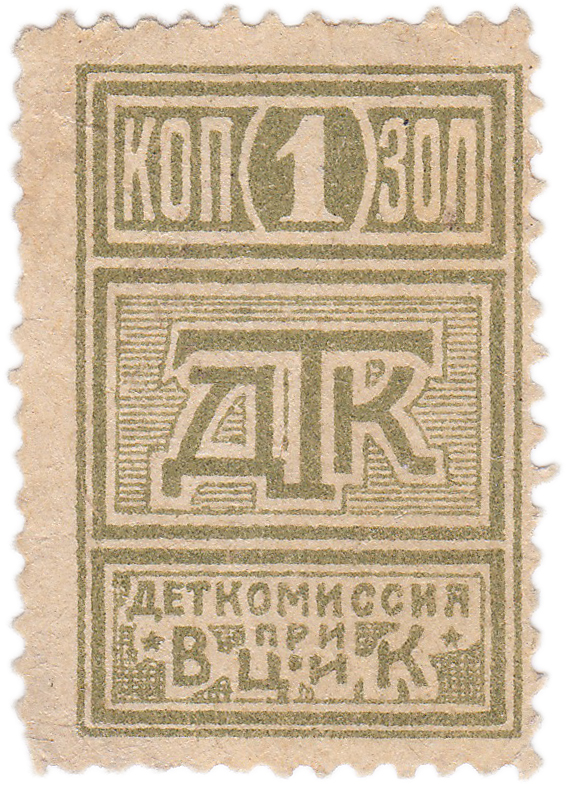
Issue 2. Olive Green.
The Commission for Improving the Lives of Children under the All-Russian Central Executive Committee (VTsIK). Established by a resolution of the VTsIK dated February 10, 1921, on the initiative of F. E. Dzerzhinsky, Chairman of the Cheka (Chairman of the VTsIK Children’s Commission in 1921–1923), in connection with the sharp rise in child homelessness that occurred as a result of the Civil War of 1917–1922. Its tasks included overall guidance of efforts to protect the lives and health of children, assistance to institutions responsible for these matters, and supervision over the implementation of resolutions of directive bodies on issues of child protection and the provision of everything necessary. The Commission’s funds were formed through special levies, lotteries, voluntary donations, etc.
On September 25, 1938, by a resolution of the Presidium of the Supreme Soviet of the RSFSR, the Commission was abolished in connection with the dissolution of the VTsIK, as well as with the overcoming of mass child homelessness.
MEMORANDUM from N. A. Semashko, Chairman of the VTsIK Children’s Commission, to the NKVD of the USSR
28/IX 1938
SECRET
No. 61/S
In August of that year, during an inspection of orphanages in Altai Krai, we uncovered an extremely unsatisfactory condition of Orphanage No. 7 in the city of Biysk.
This orphanage was organized specifically for children of repressed parents. There are 79 children there, aged 8 to 16, and 5 of them have been arrested by NKVD bodies and are in prison.
From the very first days of the orphanage’s existence, a group formed among the children that set itself the goal of “continuing the work of their parents.” The other children were gradually drawn into this group; and as an oath not to betray this organization, the entrant was required to drink a dose of manure liquid and eat half a glass of sand. Kolya Menshikova, who did not take this oath, the children attempted to hang in the stable (he was saved). As punishment, other children had nails driven into their heads. The children tore portraits of the Party leaders off the walls. On June 11, NKVD bodies took 5 pupils from this home, and subsequently, on August 30, educator Safronov was arrested, who together with the children participated in this group.
In the orphanage to this day, the political and moral condition of some of the children continues to remain hostile, anti-Soviet. It is impossible to hang portraits of the leaders in the home, because the children will tear them down—this is what the head of the orphanage, Comrade Ledolevich, states.
The organization of this orphanage exclusively for children of repressed parents was carried out erroneously, if not to say in a wrecking manner.
Reporting this, the Children’s Commission of the RSFSR asks that measures be taken for the immediate reorganization of this orphanage and that the Departments of Public Education be instructed on the inadmissibility of organizing orphanages exclusively for children of repressed parents.
Chairman of the Children’s Commission under the Presidium of the Supreme Soviet of the RSFSR
N. Semashko
GARF. Fond 5207. Inventory 3. File 42. Sheet 41.