
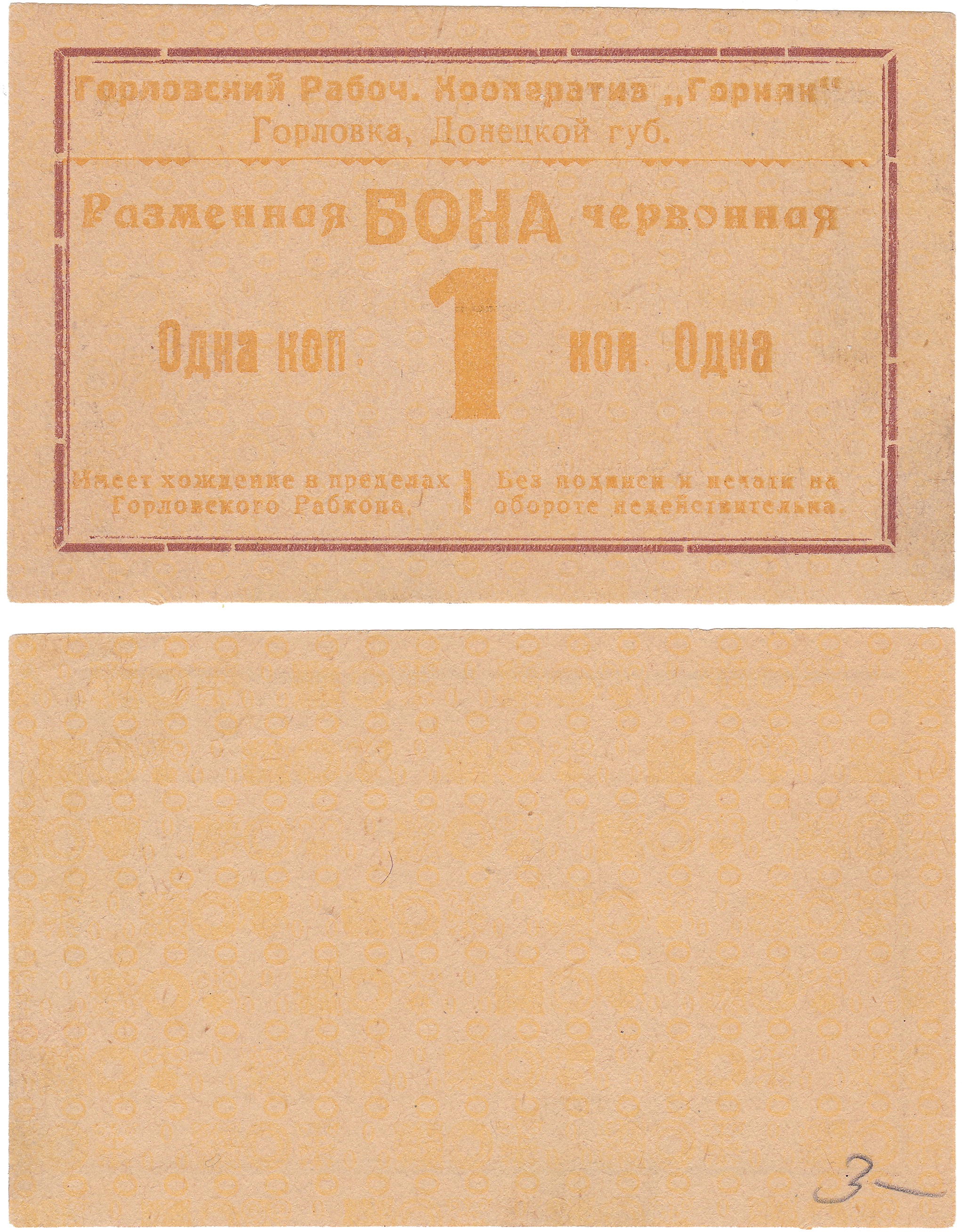
Horlovka Workers' Cooperative "Gornyak". Established in April 1918; membership as of September 1919 was 2,702 people. Turnover for 1918 was 2,132,445.48 rubles; share capital was 76,111.99 rubles. The cooperative's board was located at the Horlovka station. Board chairman: Tsarychenko.
As of July 1923, the cooperative's bakery was operating at a profit. In May, the cooperative purchased 1 railcar of sunflower oil, 1 railcar of soap, 1 railcar of sugar, and 5 railcars of white flour. As of January 1, 1923, the cooperative had 447.66 chervonets rubles in cash, 237.07 chervonets rubles in bonds and shares, and goods and materials worth 45,201.21 chervonets rubles. At the same time, the gold exchange rate was 17 rubles 40 kopecks.
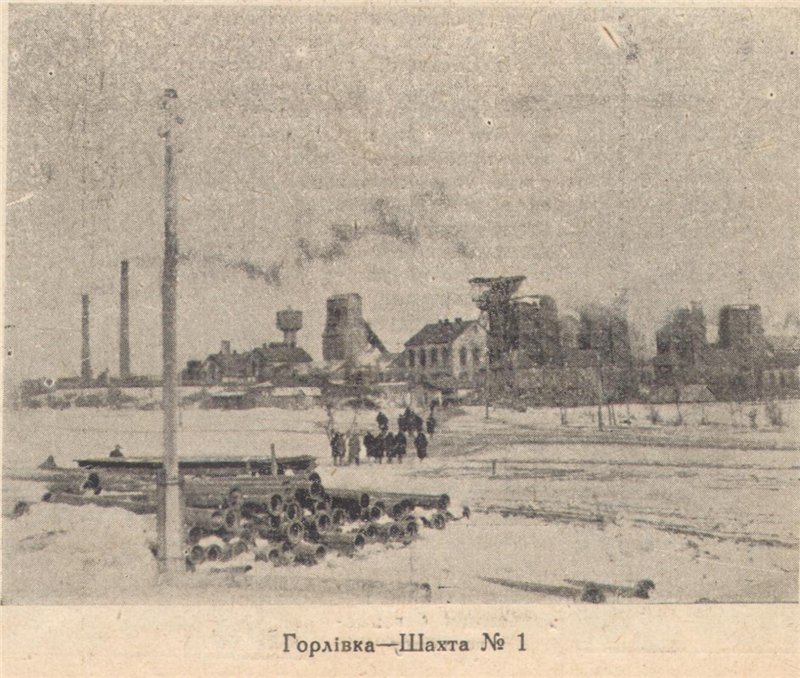
In mid-1923, the cooperative sought to absorb the neighboring Nikitovka EPO. The Organizational Department of the Provincial Union conducted an inspection and found that there were no objective prerequisites for a merger. By the end of 1923, 9,000 workers were members (shareholders) of the workers' cooperative.
In June 1924, the cooperative had 13 distribution shops with 7,978 members. Workers were offered credit for up to four months for shoes and clothing.
As of mid-1924, the cooperative's management was as follows: board chairman Makarov, chief accountant Ushakov, member of the audit commission Zyuzgin, board members Gurkov and Tkachenko.
In autumn, the cooperative found itself in a difficult situation. From March to August, the cooperative issued goods worth 1.3 million rubles. Of this amount, goods worth 300,000 rubles were sold for cash, and the rest on credit. The board of Donugol issued promissory notes to the cooperative for the credit extended, with maturities of 40–90 days. However, the bank accepted them with a 30-day maturity, as a result of which promissory notes totaling 300,000 rubles were protested, and all proceeds from sales were used by the cooperative to cover the debt.
In total, the number of people served by the cooperative in 1925 was 9,800; at the Kalinin Mine No. 2 the cooperative served 400 people. In the same year, each member was credited a 2% bonus on the amount accumulated through purchases. The bonus was issued in stamps. At the end of the year, these stamps could be used to obtain goods at the workers' cooperative.
In 1925, board chairman Dmitriev, accountant Ushakov, board members Makarov and Korobkov, chairman of the audit commission Zosima.
In 1926, board chairman Dmitriev, board members Makarov, Korobkov, and Zosima, chairman of the audit commission Karlov, chief accountant Ushakov. Turnover for 1925–1926: 4,065,980 rubles.