
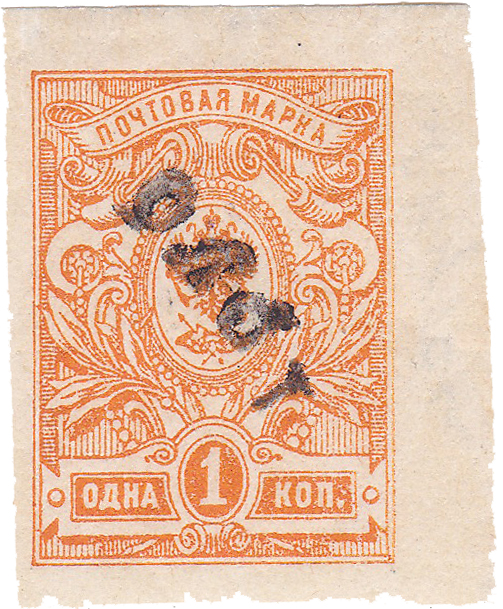
A local issue caused by the revaluation of stamps in circulation at a ratio of 1:100—hand-applied surcharge of the new denomination on postage stamps of the Russian Empire.
In September 1632, a small group of Russian servicemen under the command of the Yenisei Cossack Petr Beketov, on the right bank of the Lena River, on the land of the Nam Yakuts, built the Lensky ostrog (70 km below modern Yakutsk). It soon became clear that the site where the fort had been built was subject to flooding during the spring freshet. Therefore, after a long search, the ostrog was moved to a non-flooded location upstream—on the left bank of the Lena River, in the vicinity of Lake Saisary.
A significant number of provisional issues are associated with the Civil War of 1918–1922. At that time, there was no stable central government across most of the country, many regions became independent, and due to devastation and war there was substantial inflation. Frequent tariff changes and the inability to supply the postal network with stamps of the required denominations led to periodic revaluations of existing stocks in accordance with instructions of the People’s Commissariat of Posts and Telegraphs of the RSFSR, which did not provide for any overprints. However, in some places certain post offices still applied overprints to the revalued stamps being sold, or simply wrote on them by hand. All these stamps are characterized by an extremely simple overprinting technique.
A local issue of 1920 caused by the revaluation of stamps in circulation at a ratio of 1:100—hand-applied surcharges of various types in black ink, consisting of the letter “R” or the word “RUB,” as well as a handwritten “R” in light violet ink, on Russian postage stamps of 1, 2, 3, 4, 5, 10, 10/7, 15, and 20 kopecks.