
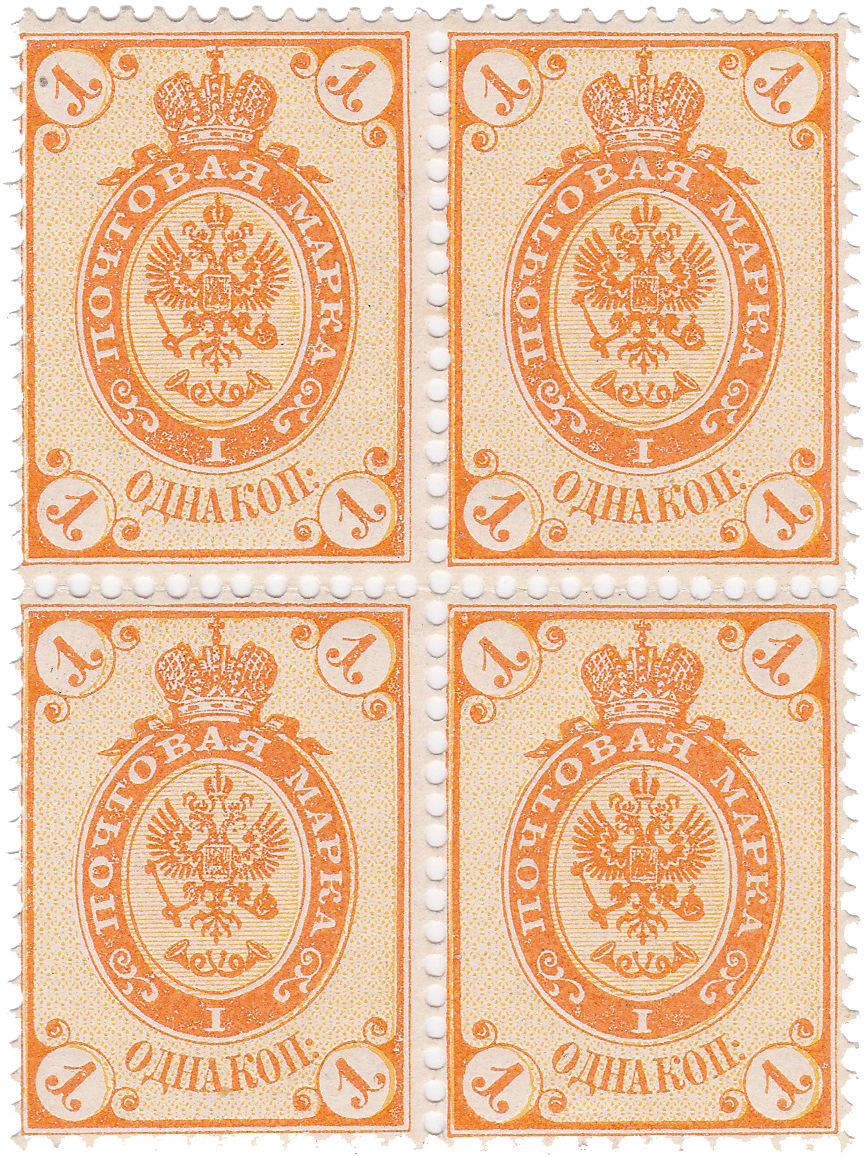
Issue of January 25, 1884.
To facilitate control of the correct prepayment of international correspondence, the postal administrations of the countries of the Universal Postal Union reached an agreement to introduce uniform colors for stamps used for the most common types of such correspondence. Three colors were adopted: for ordinary registered letters—blue stamps with a face value of 7 kopeks; for open letters (postcards)—red stamps with a face value of 3 kopeks; and for wrapper-band (printed-matter) items—green stamps with a face value of 2 kopeks.
At the same time as the introduction of these stamps, it was deemed useful to change the designs and colors of the current 1- and 5-kopeks stamps, and also to place into circulation stamps of higher denominations.
By Circular of December 14, 1883, No. 21,660, the Postal Department, through its IV Section, while announcing the issue of new stamps of the Ninth Definitive Issue of the Russian Empire together with their description, informed post offices that these stamps were to be dispatched to the localities following that circular, but that their sale was not to begin until stocks of stamps of the previous issue had been used up; it also stated that stamps of 1–14 kopeks were to be sold at all postal establishments; those of 35 and 70 kopeks only at the St. Petersburg and Moscow Head Post Offices, provincial post offices, the post offices of Odessa and Rostov-on-Don, as well as at district post offices assigned to Section A; and, finally, the 3 rubles 50 kopeks and 7 rubles stamps—only at the St. Petersburg and Moscow Head Post Offices. In conclusion, the circular set the period of validity for stamps of earlier issues through December 31, 1884.