
In 1807, the Russian Empire joined the Continental Blockade directed against Great Britain and its allies, which included Sweden, of which Finland was a constituent part at that time. At first, Russia tried by diplomatic means to force this country to join the Continental Blockade, but these efforts led nowhere. In 1808, the Russian army began a war against Sweden. In June of the same year, the Russian Emperor Alexander I issued a manifesto in which he promised the Finns the preservation of many previous legal provisions that had been in force since Swedish times. In March 1809, Russian troops took the Aland Islands, and soon the Swedish army capitulated. In September 1809, the Treaty of Fredrikshamn was concluded, under which Finland became part of Russia.
The Grand Duchy of Finland was an autonomous entity within the Russian Empire. In St. Petersburg, a Commission for Finnish Affairs was established (from 1891, a committee), and real power in this part of the country was in the hands of the Governor-General. The main administrative body of the duchy was the Imperial Senate. Finland had an autonomous customs and judicial system; its own bank was established; the Finnish markka was used as a means of payment; Finnish and Swedish were officially used in the duchy. For several years, the capital of the Grand Duchy of Finland was the city of Abo, later Helsingfors (Helsinki).
In 1890, all Finnish postage stamps were declared invalid for correspondence to Russia. For international mail they could be used until August 14, 1900, and within the country until January 14, 1901. A process began to unify the postal circulation of the Grand Duchy of Finland with that of Russia as a whole.
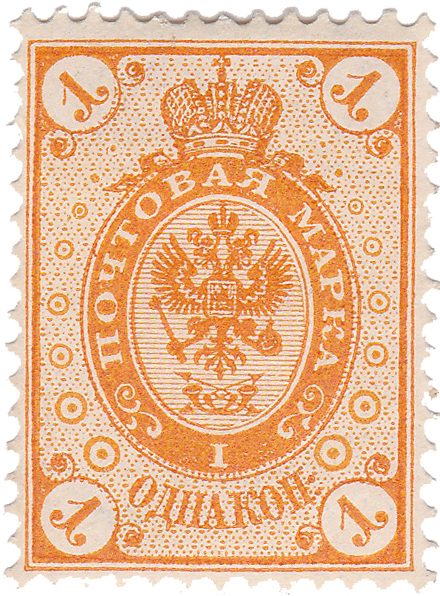
From May 1 (April 19), 1891, by order of the central administration, a postage rate equal to the nationwide rate was established, and new postage stamps denominated in Russian currency (from 1 kopek to 7 rubles) were introduced. Their design was based on the nationwide standard stamps of the eleventh and twelfth issues of 1889-1892, but with the addition, as a distinguishing mark, of circles with a dot inside, applied in various combinations.
From January 14, 1901, only Russian stamps were used for mail sent abroad and to Russia; they were sold in all post offices and remained in circulation until November 15, 1917.