
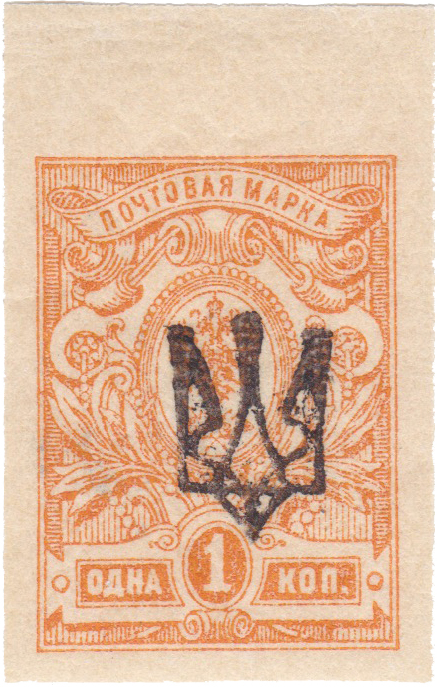
After the coup d'etat of 29–30 April 1918 and the rise to power of Hetman P. Skoropadskyi, the People's Republic was abolished, and Ukraine was proclaimed the Ukrainian State. The Ukrainian postal administration had substantial stocks of such stamps. To use them and to prevent stamps of the same type from other regions from entering circulation—which would have harmed the Ukrainian treasury—on 20 August 1918 the Hetman's Ministry of Posts decreed that all available stocks of Russian stamps be overprinted with the Ukrainian state emblem, the trident of Saint Volodymyr.
It was impossible to carry this out centrally under civil-war conditions. Therefore, the overprints were applied by local authorities simultaneously in all postal districts, using the technical means available, often by hand. This led to great diversity in the types and graphic execution of the overprints.
Research has identified 52 basic trident types, 68 varieties, and 13 printing errors—a total of 133 principal varieties. Overprints were produced in six postal districts: Kyiv, Poltava, Kharkiv, Katerynoslav, Odesa, and Podillia.
Ukrainian provisional postage stamps began to be forged as early as late 1918 in Southern Ukraine, and later forgeries were produced by speculators abroad. They counterfeited overprints and postal cancellations and even created non-existent denominations, so-called "fantasy" issues. The Union of Philatelists of Ukraine in Germany successfully detected these forgeries.