
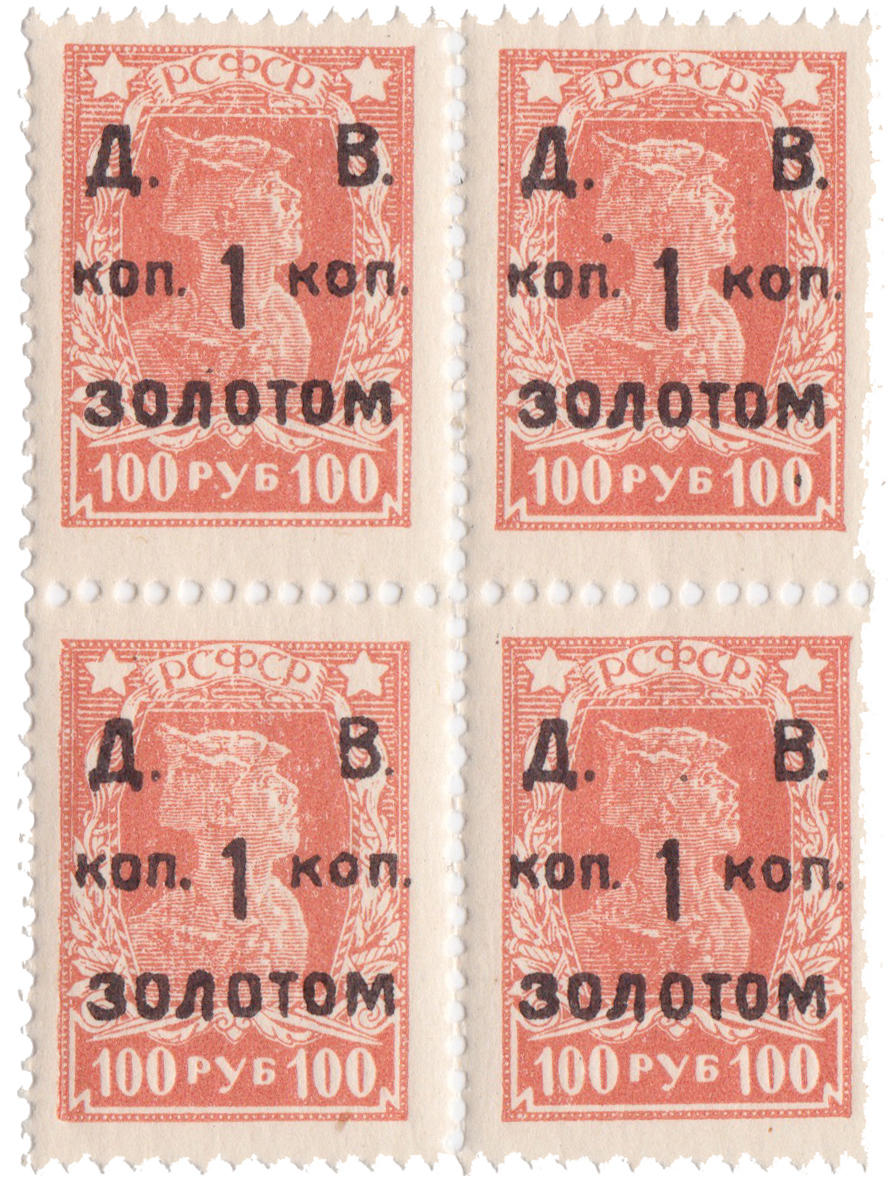
The Far Eastern Republic (FER) (6 April 1920 – 15 November 1922) was an independent and democratic state formation with a capitalist economic system, proclaimed in the territory of Transbaikalia and the Russian Far East. It served as a “buffer” state between Soviet Russia and Japan.
The postal history of the FER is limited to a short period beginning on 6 April 1920, when the republic was proclaimed by the Constituent Congress of the Working People of the Baikal Region. From October 1920, the republic’s main city was Chita. In practice, however, two centers operated—Chita and Vladivostok. In these same centers, postage stamps were issued for the republic’s postal needs. On 15 November 1922, the FER became part of the RSFSR; however, issues of its own stamps in the territory continued even after reunification, up to 1923.
In 1923, due to differences between the currencies of the FER and the RSFSR, definitive stamps were issued. On RSFSR stamps of the fourth (third) definitive issue, a lithographic overprint in black and red ink was applied in three lines: the abbreviation “D. V.” (Far East), the denomination numerals (1, 2, 5, and 10) between the word “kop.” and the word “gold.” These stamps remained in circulation in the territory of the Far Eastern Oblast until 1924, after which USSR stamps entered circulation.
Abklatsch (from German Abklatsch—copy, forgery), or a mirror offset, is, in philately, a mirrored image of the design on the back of a stamp, which can occur during the printing of typographed (stamp) sheets.
Abklatsch usually arises due to a malfunction of the printing press: an impression from the printing plate transfers to an intermediate cylinder and then, during the working stroke, onto the reverse side of the sheet. Another cause is the use of greasy, thick ink and porous, loose paper. The ink soaks through the paper and shows on the back. The same can happen during offsetting if a sheet with still-wet ink is “blotted” with another sheet. In all these cases, the term set-off is also used.