
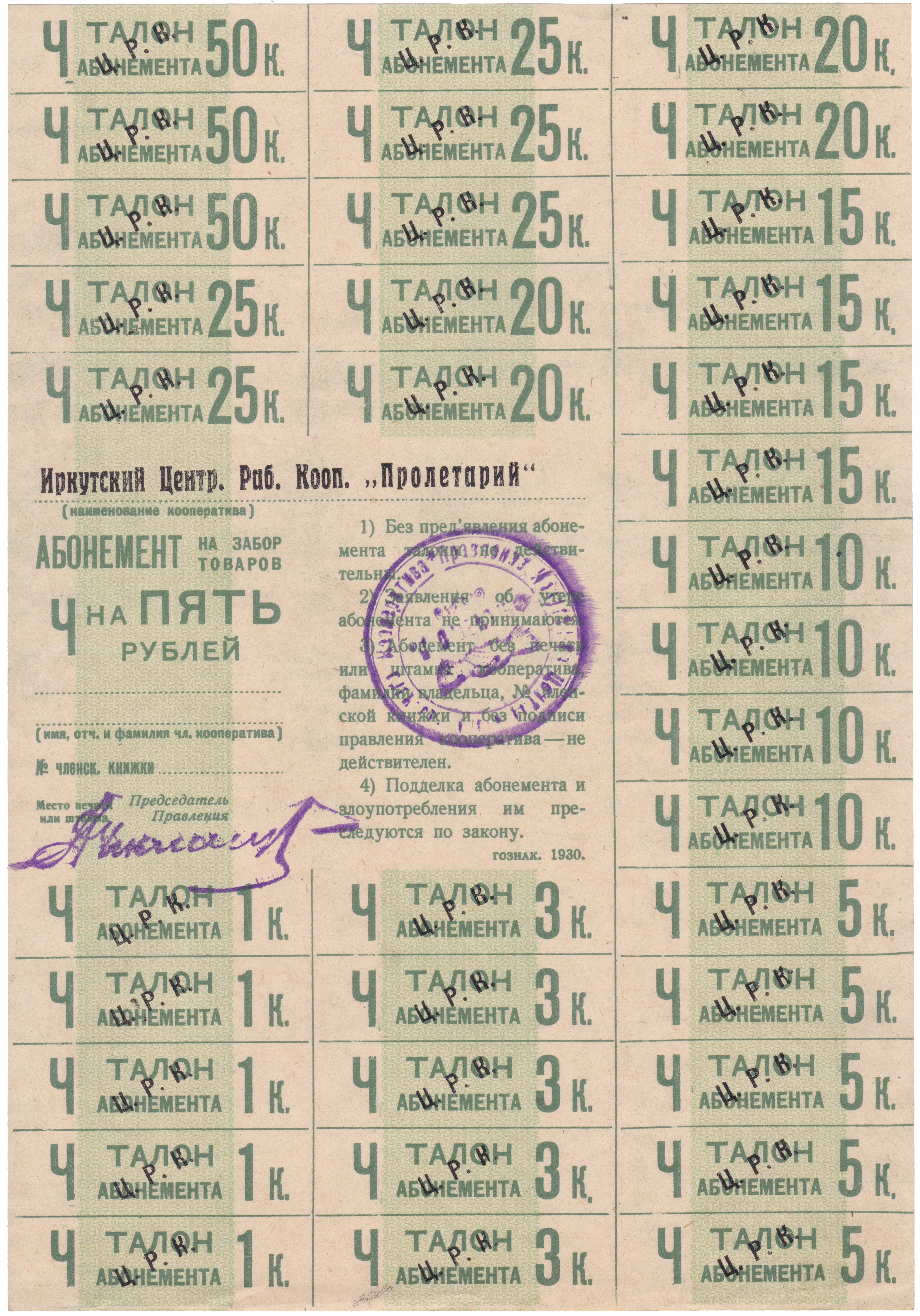
The Irkutsk Central Workers’ Cooperative "Proletary" was liquidated on March 5, 1931, due to its division into two new cooperatives: the Maratovsky "Proletary" and the Sverdlovsky "Angara".
In the development of cooperation and the improvement of the efficiency of cooperative production, a negative role was played by the class-based approach, since the most skilled and well-prepared small producers turned out to be "class-alien elements" and, in the course of various "purges," "inspections," and "self-purges," and later repressions, were removed from the sphere of production. In the Irkutsk District at the end of 1930, the number of expelled members in some artels reached 40%.
In the 1930s, state regulation of cooperative production intensified, and handicraft cooperatives’ enterprises were increasingly drawn into the system of command-and-administrative management, planned production, and distribution. This led to a distortion of the production structure. Priority development was given to industries using local, non-scarce raw materials (production of construction materials, woodworking, forest-chemical production), while output in leatherworking, footwear, felt-boot making, and other industries that relied on scarce raw materials declined.
From the end of the first Five-Year Plan, handicraft cooperation was oriented toward producing mass consumer goods. Expanding the output of these goods became the defining direction of its further production activity. The cooperative system substantially complemented state production. The range of industries and products of cooperative enterprises was very broad and diverse: from mineral extraction to the manufacture of consumer goods and foodstuffs, from transport services to household services for the population. More than 50% consisted of products of the food and garment industries.
An important role in the industrial development of the Angara region was played by the labor of special settlers (dekulakized peasants), exiles, and prisoners. By 1932, the Cheremkhovo commandant’s office included 10 settlements and 12,978 special settlers; the Tayshet commandant’s office, 17 settlements and 7,370 special settlers; the Kirensk commandant’s office, 6 settlements and 892 special settlers; and so on. Special settlers were forcibly assigned to logging for the Vostsibles trust and to coal mining. In addition, in 1932–1933, the OGPU was engaged in constructing a system of mobilization grain and hay depots in the East Siberian Krai.
In the late 1930s, for logging and mica extraction, the Tayshet corrective labor camp (ITL) of the NKVD’s Main Administration of Camps for the Forest Industry was established for 14,000–17,000 prisoners. For railway construction in the Tayshet area, the Western ITL, the Tayshet camp division, and the Southern ITL of the Far Eastern Administration of Camps for Railway Construction were also formed, with a combined total in 1938 of 32,500 prisoners. In addition, up to 10,000 prisoners were held in corrective labor institutions of the UNKVD for Irkutsk Oblast: a furniture factory in Irkutsk, Colony No. 3, an agricultural colony, and the "May 1" state farm.