
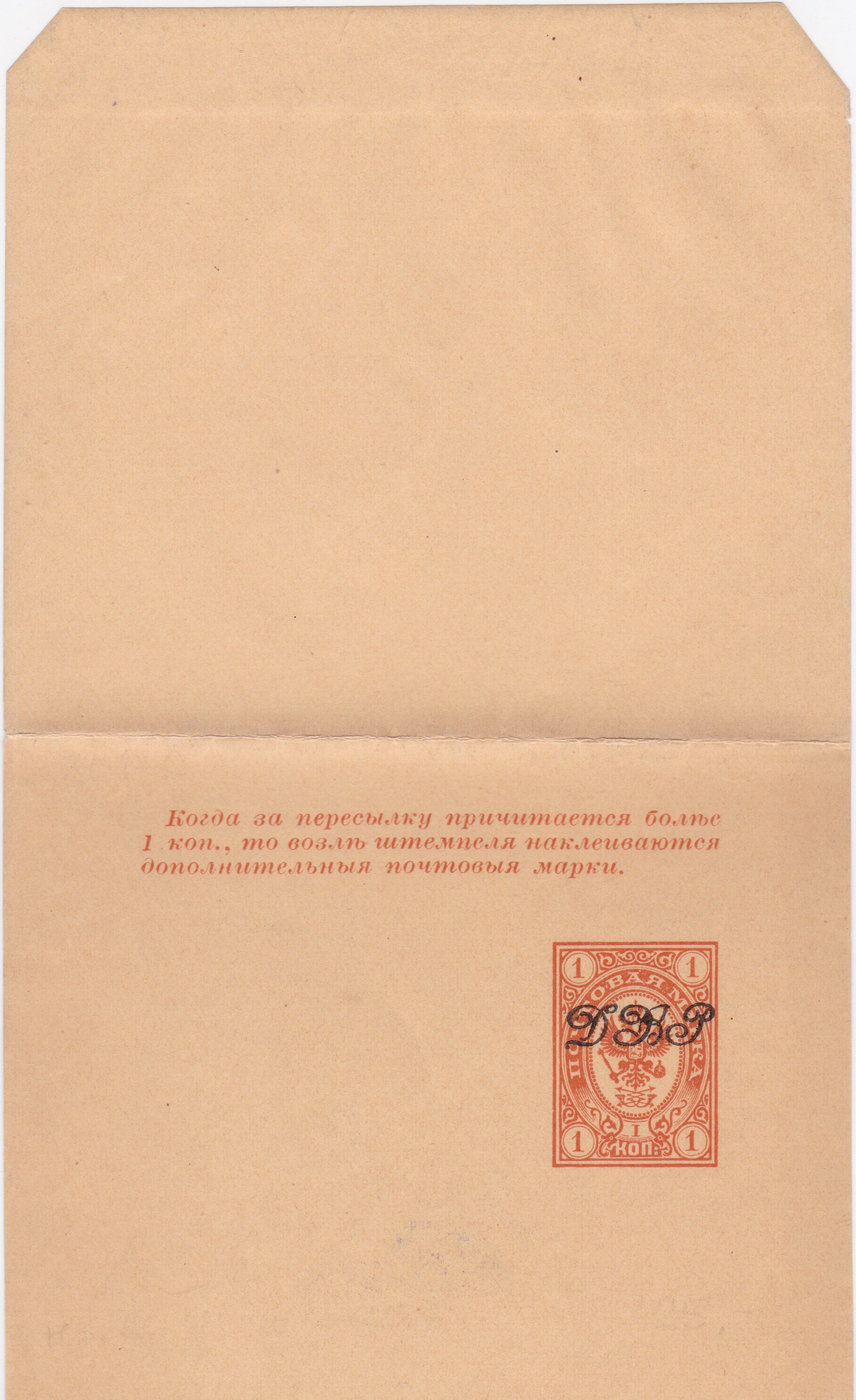
In the Far Eastern Republic, on September 26, 1920, a law was adopted requiring overprints on all postage stamps of Tsarist Russia that were in circulation in the region, as well as on Savings Bank stamps with denominations of 1, 5, and 10 kopecks, and also on stamps bearing overprints produced under Kolchak, of which only the stamp with the 35 k. overprint remained in circulation. The overprint of the letters FER was applied to prevent speculation in stamps in connection with the issue of new currency. At the same time, postal stationery cards and wrappers were also overprinted.
In Russia, stamped bands for wrappers were issued twice: in 1890-1891 and in 1913.
A type of postal stationery item is the wrapper band. These are paper bands of various widths and lengths with an imprinted sign of postage payment. Wrapper bands were intended for wrapping newspapers, books, and other printed matter. Unlike envelopes, wrapper bands did not fully protect the contents from damage, since the edges usually remained open.
Originally, "wrappers" referred to paper bands for packaging postal items which, in some countries, were issued with imprinted signs of postage payment. Such stamped wrappers are classified as postal stationery and are objects of collecting (philately).
In the Russian Empire, the maximum weight for wrapper mailings was significantly lower, not exceeding 4 pounds for printed matter and business papers (therefore lower than the maximum weight for sealed letters) and 20 lots for samples of goods. Wrapper mailings were charged, although at a much reduced rate (the minimum charge for out-of-town mailings was 2 kopecks (equivalent to 5 centimes) for printed matter, 7 kopecks for business papers, and 3 kopecks for samples of goods), but each weight unit, taken as 4 lots, was paid in full.