
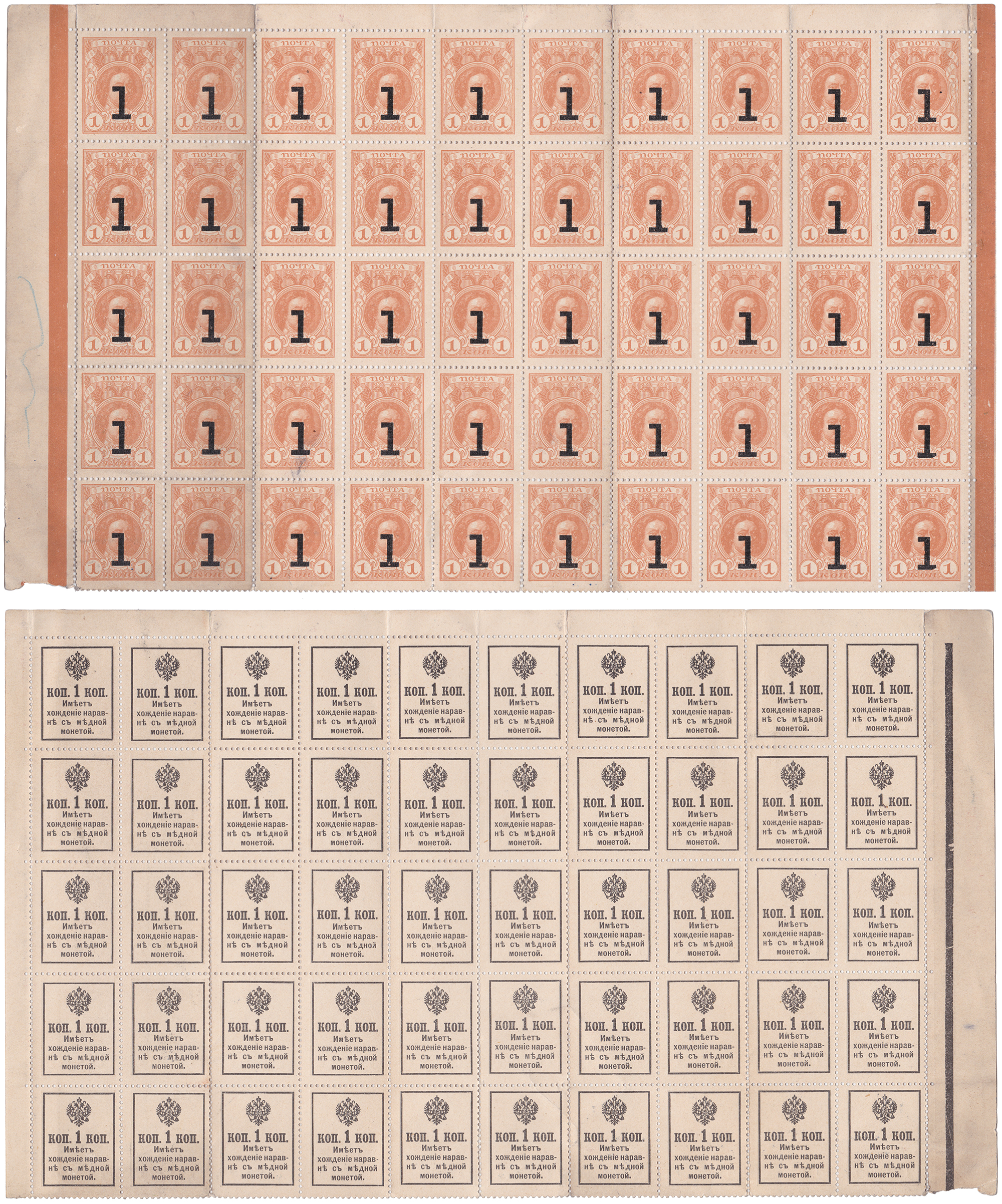
Third issue.
The outbreak of World War I brought enormous expenses for the Russian government. The blessed era of gold monometallism came to an end: the exchange of credit notes for gold was abolished. The reaction was the disappearance from circulation first of gold, and then of silver coins.
Pyotr Lvovich Bark, who held the post of Minister of Finance, proposed a simple solution in October 1915: to issue postage stamps into circulation instead of small change.
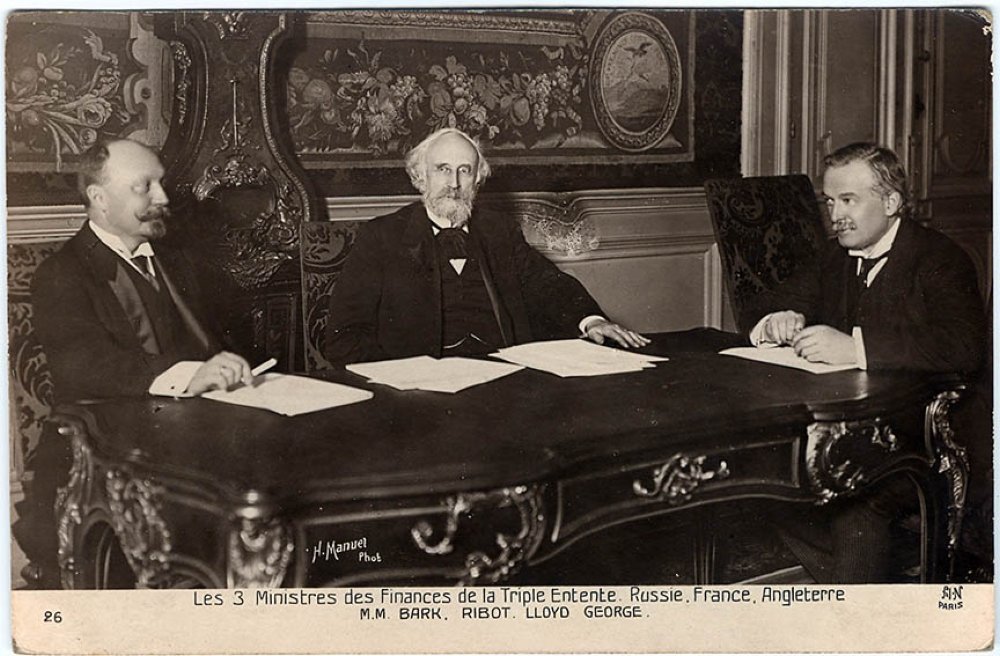
Bark seemed to foresee the future shortage of copper coin as well, so his project included denominations from 1 to 20 kopecks. To lend legitimacy to the miniature paper money, one side was to bear the inscription: “Circulates on a par with small-denomination silver /or copper/ coin.” Bark did not give much thought to the other side either, proposing to use the format and design of the Romanov Dynasty 300th Anniversary stamp series for these stamp-money issues.
By 1916, a shortage of copper coin had already become evident, although minting still continued in large runs. Therefore, the second issue aimed to smooth out the shortfall of copper coins.
The near-complete similarity of stamp-money to ordinary stamps implied that they could also be used to pay for postal items. Officially, this was not forbidden. Even before the first emission, an instruction to this effect was issued by the head of the Main Administration of Posts and Telegraphs. However, stocks of ordinary postage stamps at the time were enormous, and the post office did not experience any shortage of them. Therefore, postal workers were told to warn senders against sticking stamp-money onto letters. Nevertheless, some of the issue still ended up on envelopes. And yet, so that the temptation to replace regular stamps with the new money would not arise, the third issue received typographic overprints of the denomination on the front side. The portraits of Peter I and Alexander II were disfigured by black numerals.
The February Revolution led to the public getting rid of tsarist symbols en masse. The changes also affected stamp-money. They did not dare to change the design of the front side. But on the reverse, the symbol of autocracy in the form of the imperial coat of arms was removed, replaced with a large denomination numeral. The overprints on the front side of the 1- and 2-kopeck stamps were also retained. The portrait of Alexander III, however, did not suffer from an overprint. The Provisional Government’s emission of stamp-money served as small change for everyday transactions up to 1919. After that, hyperinflation and an abundance of large-denomination banknotes from all sorts of issuers pushed these miniature paper monies out of circulation.