
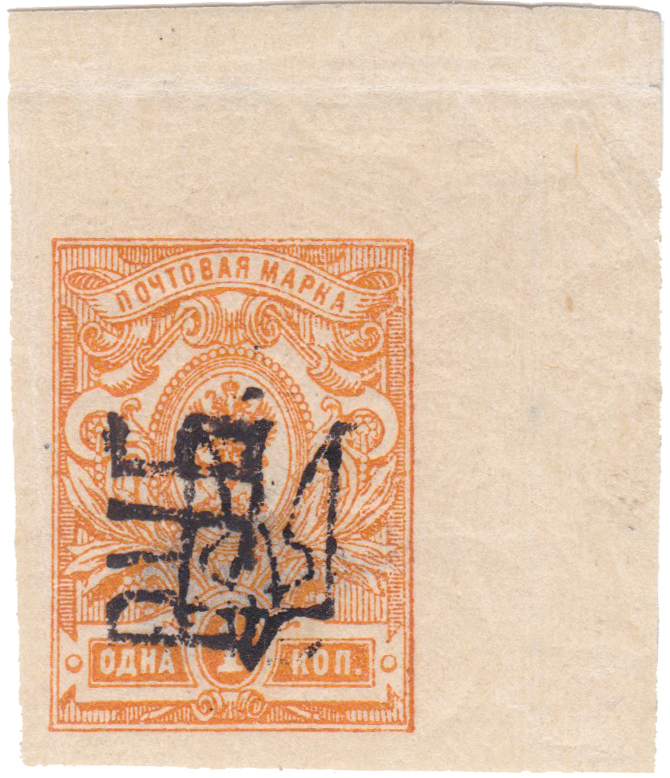
Type 3 of applying a surcharge at 100 times the face value, with the overprint “Trident Ukraine” on a 1917 Russian Empire stamp.
After the coup d’etat of 29–30 April 1918 and the coming to power of Hetman P. Skoropadskyi, the People’s Republic was liquidated, and Ukraine was proclaimed the Ukrainian State. The Ukrainian postal administration had substantial stocks of such stamps. In order to use them and to prevent identical stamps from other regions from entering circulation—which would have harmed the Ukrainian treasury—on 20 August 1918 the Hetmanate Ministry of Posts resolved to overprint all available stocks of Russian stamps with the Ukrainian state emblem, the Trident of Saint Volodymyr.
It was impossible to do this centrally under civil-war conditions. Therefore, the overprints were applied by local authorities simultaneously in all postal districts, using whatever technical means were available, often by hand. This led to great diversity in the types and graphic execution of the overprints.
Research identified 52 main trident types, 68 varieties, and 13 printing errors—133 principal varieties in total. The overprints were made in six postal districts: Kyiv, Poltava, Kharkiv, Katerynoslav, Odesa, and Podillia.
Ukrainian provisional postage stamps began to be counterfeited as early as late 1918 in Southern Ukraine, and later forgeries were produced by speculators abroad. They forged overprints and postmarks and even created non-existent denominations, so-called “fantasy” issues. The Union of Philatelists of Ukraine in Germany successfully identified these forgeries.
Money was losing value, and there arose a need to raise postal rates. A decree of the Council of People’s Commissars, signed by V. I. Lenin on 5 March 1920, provided that “postage stamps with denominations of 1, 2, 3, 4, 5, 7, 10, 14, 15 and 20 kopecks are to have their value increased, for sale and for payment of correspondence, by 100 times.” But the public held a significant number of stamps previously bought at the old price, as well as stamps from the stocks of post offices that had been looted during changes of власть in the years of the civil war.
In the markets, rag-and-bone dealers sold stamps to the public in sheets for household needs (pasting windows, etc.), and we, then beginning collectors, used them for stickers. They were of no philatelic interest at that time.
In a telegram from the head of the provincial postal administration of Kharkiv Governorate dated 16 February 1920, addressed to the heads of postal-telegraph and postal institutions of Kharkiv Governorate, it was proposed to immediately stop selling to the public low-denomination postage stamps from 1 to 20 kopecks inclusive, and to store the stamps themselves until further notice. Stamps in the hands of the public were to be accepted without hindrance for payment of correspondence.
A subsequent telegram ordered that all the said low-denomination signs of postal payment be sent to the Kharkiv post office for the application of a surcharge at one hundred times the value and, if necessary, to apply to the post office for the dispatch of stamps already bearing the surcharge. It further indicated the withdrawal from sale of 1, 5, 7 and 10 ruble stamps and the cancellation of cash payment for correspondence from the moment the institutions were supplied with signs of postal payment.