
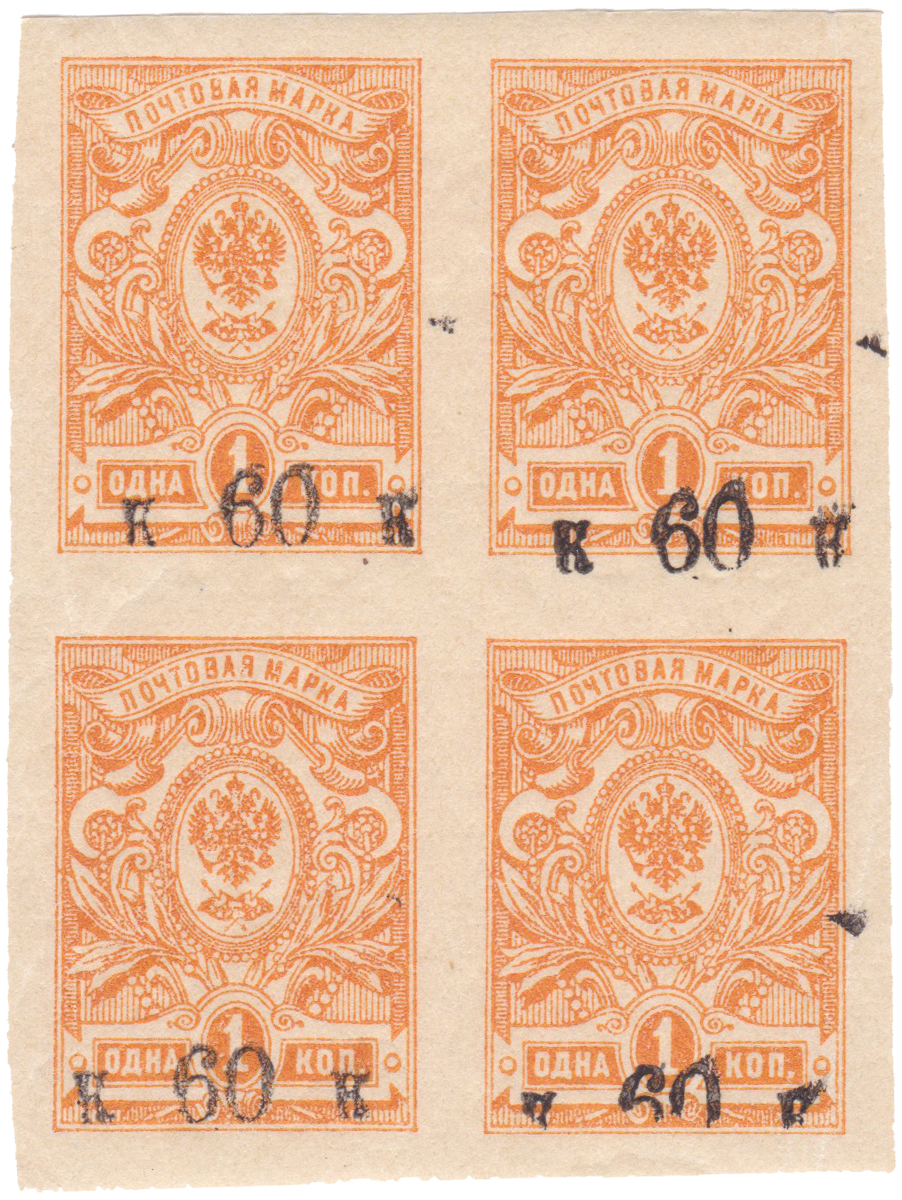
Armenia's 1st issue of postage stamps. Type 1.
Due to increased postal rates, postage stamps were revalued. Russian kopek-denominated stamps of the 1909–1917 issues, perforated and imperforate, were revalued to a new denomination of 60 kopeks by applying an overprint using single, hand-held rubber stamps of two types: "k 60 k" (without periods) and "k. 60 k." (with periods).
Kopek-denominated stamps were chosen for revaluation because, after the rate increases, they had long not been used at face value, and therefore survived in sufficient quantities. In addition, the light color of the stamps ensured the clarity and sharpness of the overprint of the new denomination.
The revaluation was carried out centrally at the Erivan post and telegraph office. One of the two stamps remained at the office until September 16, 1924, when it, together with other stamps, was transferred by formal record to the Organization of the Authorized Representative for Philately and Paper Money in the USSR.
A significant number of provisional issues is associated with the Civil War of 1918–1922. During this period, there was no stable central authority in most of the country, many regions became independent, and, amid devastation and war, there was substantial inflation. Frequent rate changes and the inability to supply the postal network with stamps of the required denominations led to periodic revaluations of available stocks in accordance with instructions of the People's Commissariat of Posts and Telegraphs of the RSFSR, which did not provide for any overprints. However, in some localities, certain postal institutions still applied overprints to the revalued stamps sold, or simply wrote the new value on them by hand. All these stamps are characterized by an extremely simple overprinting technique.