
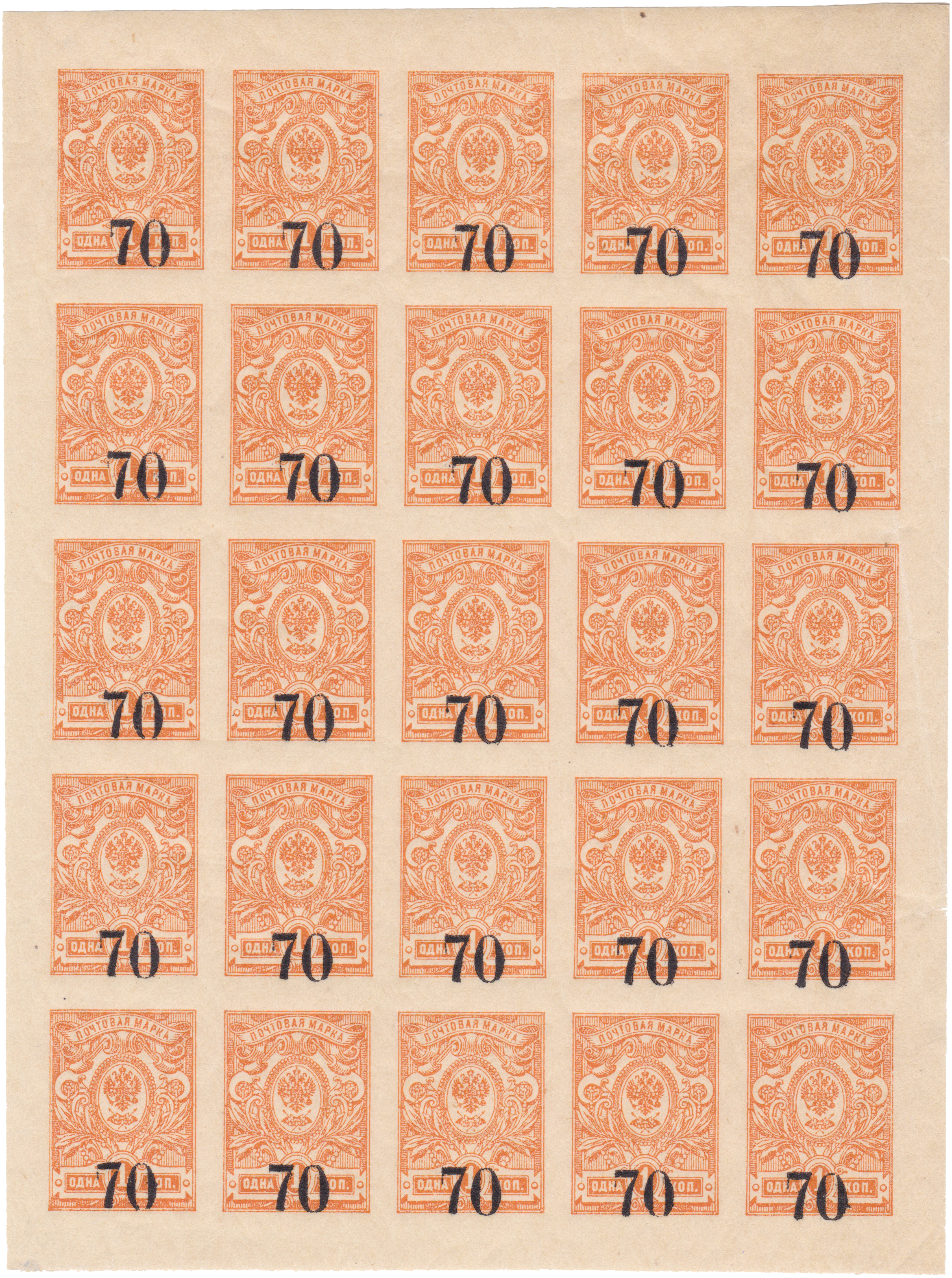
In September or October 1919, the Omsk government of Admiral A. V. Kolchak issued a set of six perforated stamps and four imperforate stamps on Russian Empire stamps of the 17th and 21st issues, overprinted with a new denomination.
The stamps remained in circulation throughout Siberia until the end of 1920.
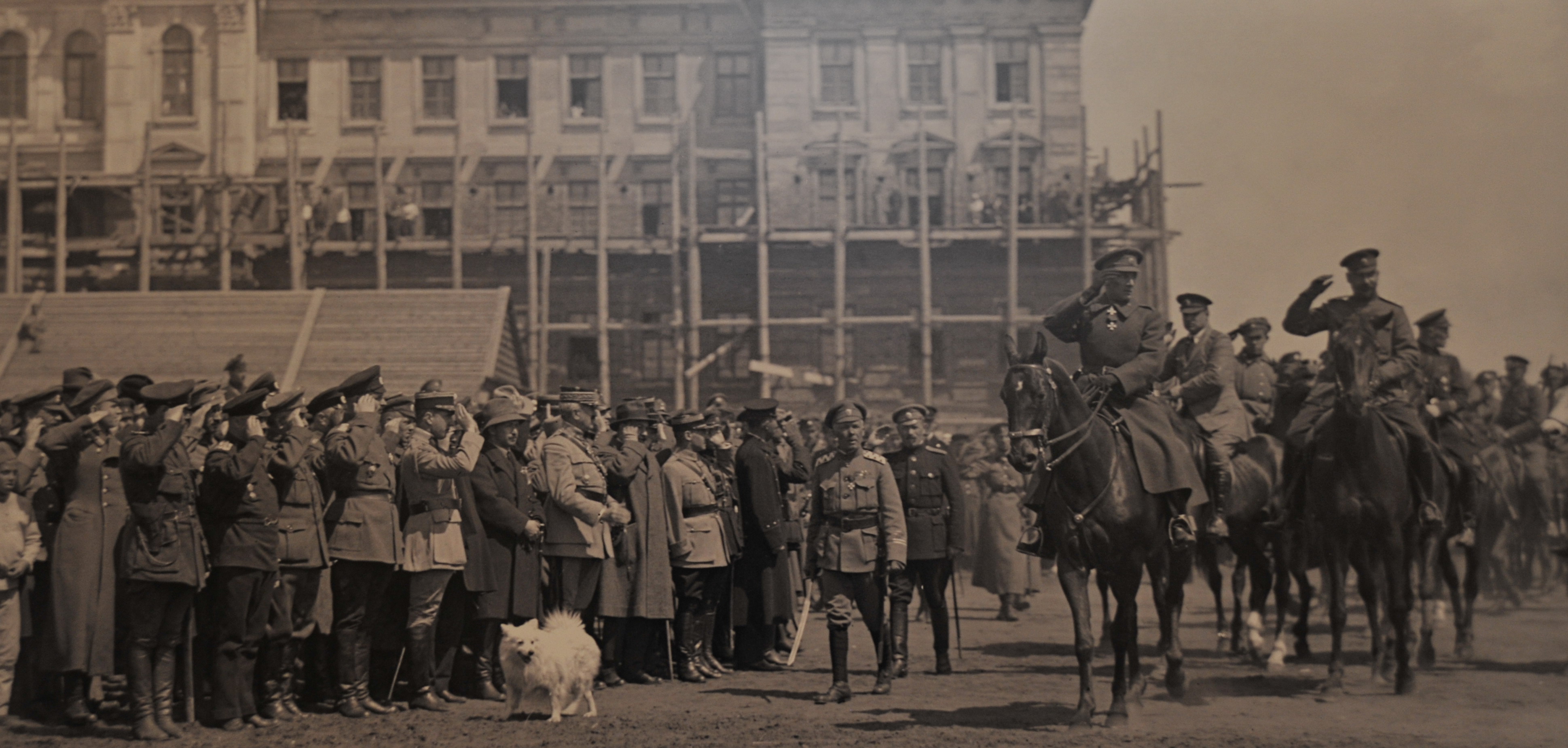
In July 1918, after the Bolsheviks were driven out, Omsk was proclaimed the capital of Siberia. For almost a year and a half, the new authorities did everything to make the city a center not only of the Siberian but also of the all-Russian White movement.
Almost immediately after receiving capital status, political Omsk came alive. Various ministries and agencies of successive governments were concentrated here: the Provisional Siberian Government, the Directory, and the All-Russian Government headed by Kolchak. Contemporaries noted that although Omsk was large, there were still not enough good houses to accommodate an entire army of officials. Often, up to three government institutions were crowded into a single building. The most prominent were the ministries, of which there were 13 in the “White” capital.
In 1918, the State Bank building housed the main part of Russia’s gold reserve transported from Ufa. In April 1919, an exhibition was organized there where residents of Omsk and visitors could view the precious metal in bars, coins, and jewelry.
The city council and duma plunged into municipal concerns. There was plenty to do, since as a result of forced migration the population of Omsk grew to 600,000 people. Overcrowding became one of the main problems: there was neither enough living space nor enough food for such a number of residents.
The city authorities managed to obtain from the government a loan for the purchase of grain and flour, as well as priority rights to transport food and coal by rail. In addition, the municipal administration took care to supply the city with medicines and essential goods, which became especially important during outbreaks of typhoid fever and epidemic typhus that raged in the city in the autumn of 1918.
On November 18, 1918, in Omsk, after the fall of the Directory, Admiral Kolchak was proclaimed Supreme Ruler of the Russian State. In his speech, the head of “White” Russia promised to restore the fighting capability of the volunteer army, defeat Bolshevism, and ultimately return the country to its former greatness. The key principles Kolchak intended to follow were “law and order.”
The ruler’s residence was located in Batyushkin’s former residential house, which present-day residents of Omsk know as the civil registry office. Kolchak lived there with his common-law wife Anna Timiryova; he also worked there, signed decrees, and received delegations. An attempt was made on his life in this house: only by a coincidence of circumstances was the admiral not harmed.
Kolchak’s immediate priorities were aimed at solving the army’s supply problems; economic issues got stuck somewhere at the stage of drafting programs. The absence of effective measures to improve the lives of working people led to mass discontent among the population of Omsk and other cities. Punitive measures only made the situation worse. This created a favorable environment for the growing popularity of underground Bolshevik organizations.
The capital of Kolchak’s Russia became a magnet for foreigners of every kind, primarily military personnel. British rifle units, the French Colonial Corps, as well as Polish, Serbian, Romanian, and Italian garrisons were stationed there. The Czechs held a special position as the liberators of Omsk from the Bolshevik regime.
In particular, a Czech commandant was installed at the Omsk railway station, controlling the movements of all rolling stock. Czech soldiers wandered the city streets with nothing to do, showing off sturdy greatcoats and new boots. Their well-fed, satisfied faces caused extreme irritation among ordinary citizens.
A diplomatic corps was also widely represented in Omsk. Foreign missions gave the city a special international flavor; ceremonial receptions, parades, and balls were organized in their honor. Cars around town with foreign flags and respectable overseas guests drew crowds of onlookers.
On Lyubinsky Prospect—the city’s main promenade—there was a Japanese military mission; the residence of the British emissary was on 2nd Vzvoz Street; in November 1918 the Americans approached Kolchak’s government with a request to be allocated premises; Swedes, Danes, French, and Chinese also established themselves in Omsk.
Filled with officials, soldiers, and foreigners, Omsk could not be dull. Cafe-chantants, restaurants, and brothels opened in the city; the circus and the cinema were in operation; eateries and small shops sprang up like mushrooms. From morning till night, Omsk streets rang with all kinds of singing and military marches. Literary circles were active in the city, and exhibitions were organized, including those of the then-fashionable Futurists.
A special pride of Omsk was the city theater, which became the focal point of the city’s cultural life and a gathering place for the capital’s beau monde. Classical works were performed there by Russian and foreign celebrities, and drama productions were staged—“Anna Karenina,” “Tsar Fyodor Ioannovich,” “Children of the Sun.” From the governor-general’s box, Kolchak himself often addressed the audience, trying to instill confidence in the revival of Russia.
By the end of 1919, Omsk’s vibrant political and cultural life began to decline; the reasons were the worsening situation at the front and the failed work of Kolchak’s government, which found no support among the people. Inflation had by then reached alarming proportions. For example, if at the beginning of 1918 a pood of flour in Omsk cost 2 rubles 40 kopecks, then in May 1919 more than 60 rubles were already being asked for it. The government was forced to introduce ration cards, and huge lines formed at shops.
The White movement suffered one defeat after another, and Kolchak never received the promised support of the Allies. From mid-summer 1919, the front began to rapidly approach Omsk. Kolchak tried to hold the capital to the very end, but in early November he was forced to decide to abandon it. On November 12, the Supreme Ruler left Omsk, and two days later the first units of the Red Army entered the city.