
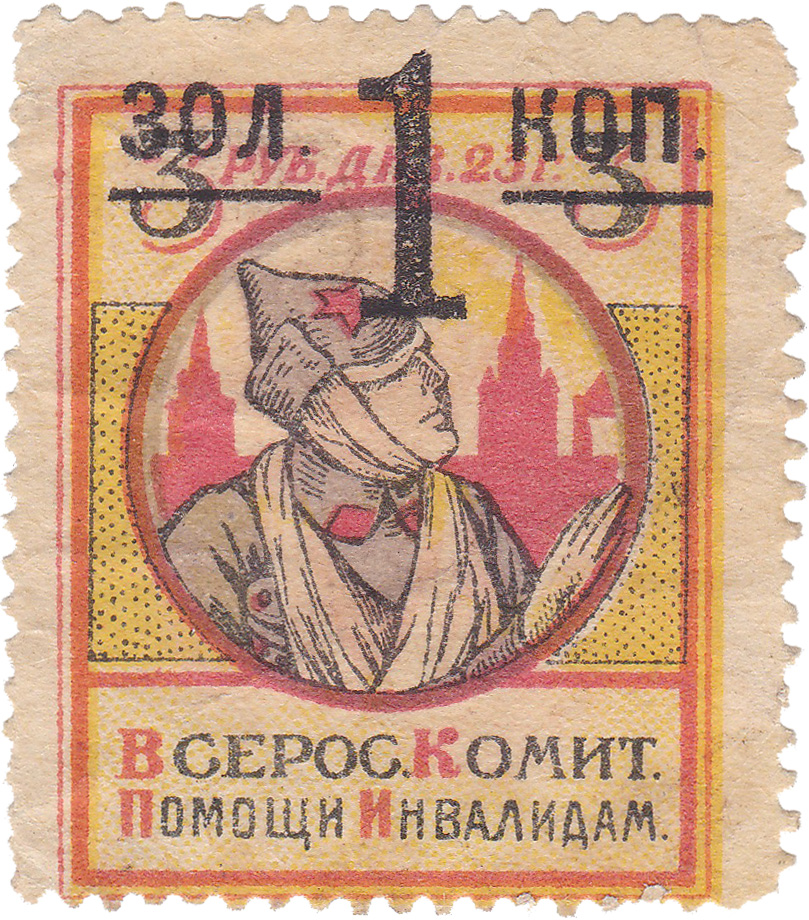
July, August. Fourth all-Russian issue. Type 2.
The All-Russian Committee for Assistance to Sick and Wounded Red Army Soldiers and War Invalids under the All-Russian Central Executive Committee of Soviets (Vserokompom) existed from October 1919 to March 1930. Under the decree of the All-Russian Central Executive Committee (VTsIK) of January 11, 1922, Vserokompom became the central public organization collecting donations, organizing various charitable campaigns, and mobilizing the public to care for the wounded.
From the summer of 1922, the publishing section under the Central Trade Administration (TsTU) of Vserokompom began issuing postcards, portraits, badges, and labels.
One of the initiators of issuing charity stamps for the benefit of war invalids was the All-Russian Committee for Assistance to Sick and Wounded Red Army Soldiers and War Invalids under the All-Russian Central Executive Committee of Soviets (Vserokompom), which existed from October 1919 to March 1930. Under the decree of the All-Russian Central Executive Committee (VTsIK) of January 11, 1922, Vserokompom became the central public organization collecting donations, organizing various charitable campaigns, and mobilizing the public to care for the wounded.
Starting in April 1923, three nationwide mass campaigns took place in the country, the so-called “All-Russian Weeks of Aid to War Invalids.” Vserokompom printed and distributed across the country a large number of charity stamps: from May to October 1923 alone, 40 million copies. Revenue from stamp sales in Vserokompom’s 1923 budget amounted to 34%.
A common distinguishing feature of the stamps of these issues was the mandatory presence of the words “denz. 23 g.”, “dzn. 23 g.”, or “dnz. 23 g.” on them, i.e., the denomination in the monetary signs of 1923. A characteristic feature of the stamps of the August 1922–April 1923 issue is the presence of the abbreviation “Ts.T.U.”
From mid-1923, due to inflation, it became necessary to revalue the stamps. The corresponding overprints were applied in different cities, so there is no uniformity in their application, fonts, color, or wording. There are several hundred such varieties. The 1923 issues conclude with stamps of large denominations—250, 500, and 1,000 rubles. They were intended for the payment of collective contributions. On the stamps of this series, the denomination in the 1923 monetary signs is indicated for the last time.
In March 1930, the committee was reorganized into a society (Vseroobpom)—the All-Russian Society for Assistance to War Invalids, the sick, the wounded and demobilized Red Army soldiers, and the families of persons killed in the war and those called up into the ranks of the Red Army and the Navy.