
In March, under the slogan of peace and the introduction of a constitution in the country, Emperor Napoleon once again ascended the throne in France. He appealed to Russia, England, Austria, and Prussia with a proposal for peace on the terms of the status quo. However, the members of the Congress of Vienna did not accept them, and on March 13 the heads of European governments adopted a Declaration declaring Napoleon an outlaw. For France, this meant an inevitable war with all of Europe. On March 25, the Seventh Coalition was formally established. The military forces of the French army had been exhausted in the previous campaigns.
The Emperor had only about 130,000 men and 344 guns at his disposal. The Allies decided to encircle and crush his troops with their numerical superiority. Napoleon, however, concluded that it would be better to defeat the enemy armies on their own territory. On June 11 he set out to join the troops, intending to defeat separately two enemy armies: the Anglo-Dutch army under Field Marshal Wellington and the Prussian army under Field Marshal Blucher. On June 16 he defeated the Prussian army at Ligny and ordered Marshal Grouchy’s corps to pursue it. However, Grouchy acted indecisively and did not come to Waterloo to assist the French army. Napoleon directed his main forces to Waterloo against the English army.
But all attacks by the French troops were repelled.
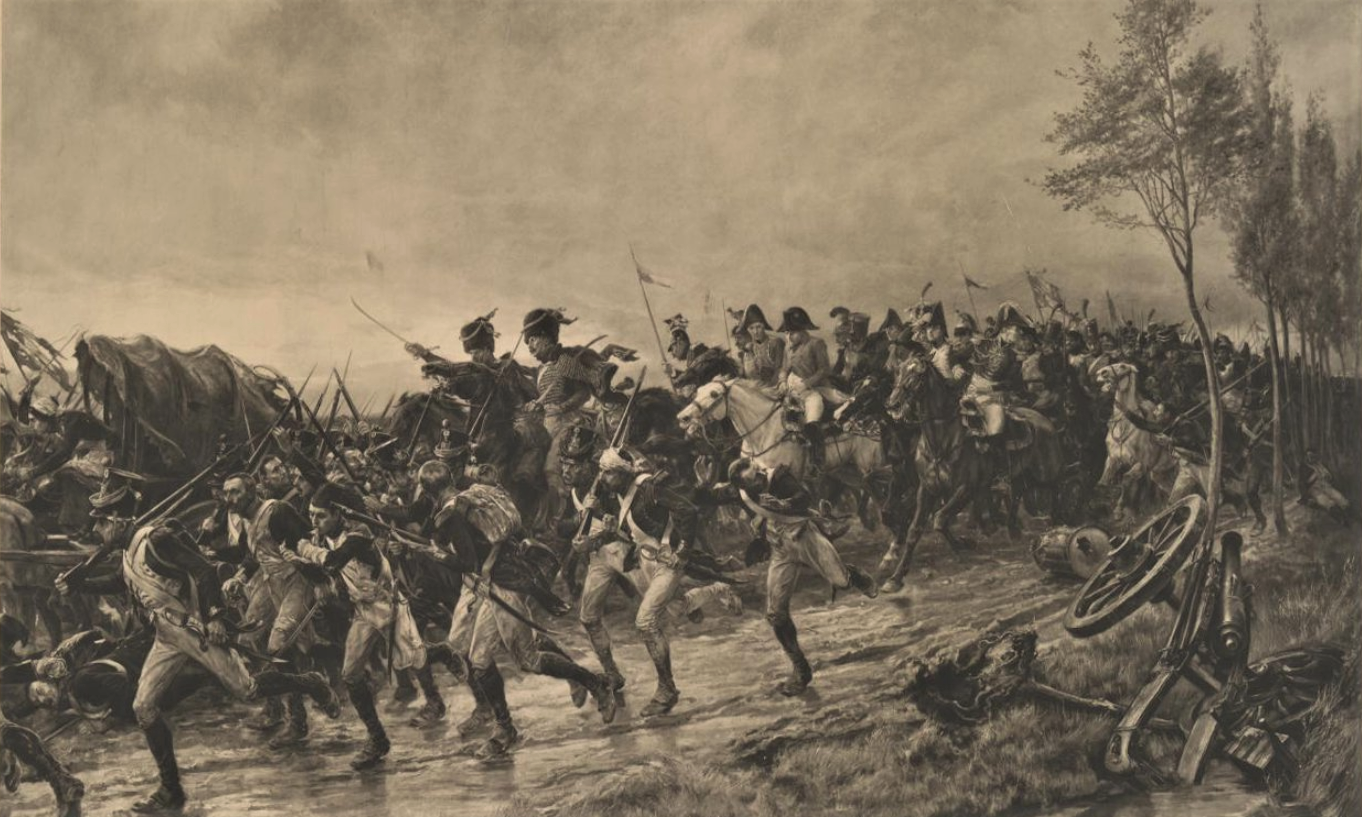
At the height of the battle, Prussian corps approached from the east and, with a flank attack, decided the outcome of the engagement. Almost all the artillery was lost, and the army’s spirit was broken. Thus, in the Battle of Waterloo on June 18, Napoleon’s army ceased to exist. Four days later, Napoleon abdicated the throne again and was exiled to the island of Saint Helena, and the Bourbon dynasty returned to political power in France.
On September 26, in Paris, Emperor Alexander I, Austrian Emperor Francis I, and Prussian King Frederick William III, in confirmation of the outcomes of the Congress, concluded the Holy Alliance and signed an Act confirming it.
The main provisions of the Act stated that the monarchs intended to be guided by the “precepts of this holy faith, love, truth, and peace”; that they would “remain united by the bonds of true and indissoluble brotherhood”; and that, “regarding themselves as it were as foreigners, in any case and in any place, they will render one another assistance, support, and help.” Soon the King of France, Louis XVIII, joined the Holy Alliance, and then most of the monarchs of Europe, except the Prince Regent of Great Britain and the Pope.
But Great Britain nevertheless supported the Alliance’s policy on a number of issues and took an active part in the congresses. The Turkish sultan was not admitted as a member, as a non-Christian sovereign. The form of the Alliance’s action became pan-European meetings at the level of monarchs, and less important ones at the level of foreign ministers. Its practical significance was expressed in the resolutions of a whole series of congresses, at which the principle of interference in the internal affairs of other states was developed, for the violent suppression of all national and revolutionary movements. Nevertheless, the geopolitical and moral contradictions between the participants in the Alliance proved so great that it did not last long. The Crimean War (1853-1856), in which European states opposed Russia in alliance with Muslim Turkey or refused to provide assistance, buried all hopes for the possibility of an alliance of Christian monarchs.