
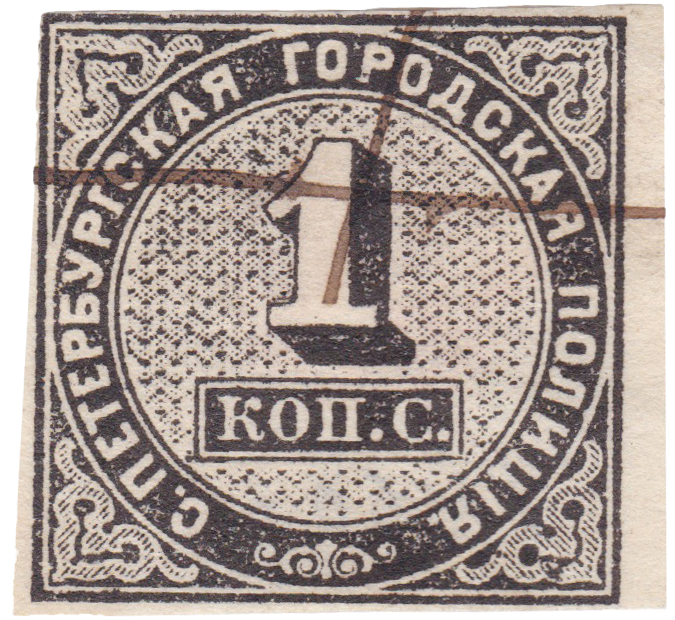
In 1719, in connection with the introduction of the poll tax and the recruitment obligation, travel certificates were introduced. In 1724, rules were established on peasants’ leaves of absence, and feeding letters and passage letters were introduced; these described the height, face, and distinguishing marks of the person released. The first were issued to peasants leaving villages to earn wages within their own uyezds, and also to landowners and stewards. The second were issued to persons traveling to other uyezds. The movement of the population was supervised by local administrative bodies and the police. Peasants found without documents were subjected to corporal punishment and sent back to their owners.
From 1763, the passport acquired significance as a means of collecting the passport fee. Passport fees were introduced in 1763: for one-year and shorter-term passports—10 kopeks; for two-year passports—50 kopeks; for three-year passports—1 ruble. At the beginning of the 19th century, for townspeople and peasants the passport fee for a one-year passport was already 6 rubles, and for 5 years—70 rubles in assignation rubles. In 1825 and 1894, passport fees were significantly reduced; in 1894 they were also introduced for the privileged estates; in 1897 they were abolished completely.
From 1803, instead of feeding letters and passage letters, printed passports valid only within Russia were introduced for merchants, townspeople, and peasants.
From 1809, in St. Petersburg, address offices were established within the city police. All persons working for hire in the capitals were required to register at the address office and obtain an address ticket there. When changing employment or place of residence, as well as when the ticket expired, registration was required; moreover, a ticket was not issued without a favorable reference from the previous place of work. Persons suspected of being unreliable could be expelled from the city by the police.
In 1837, the Address Office was reorganized into the Address Expedition, and an address desk was opened under it, “to provide to any and all who wish the necessary information about the place of residence of a person staying in the capital.” A similar address desk appeared in Moscow as well, but only in 1861, “following the example of St. Petersburg.”
From the 1830s until the end of the 19th century, the principal law defining the rights and duties of the police in enforcing the passport regime in the empire was the “Statute on Passports and Fugitives.” The main rule of the Statute (Art. 1) stated that no one may leave their place of permanent residence without a legally established permit or passport. The law required all persons to present passports when moving from one province to another at the outposts established in cities, and upon arrival— to the police. Nobles not serving in state service could have no passports; for them, the document was the charter of noble status. For peasants and townspeople, three categories of passports were established, issued depending on the person’s distance from their primary place of residence and the period of validity (up to a maximum of 3 years).
The passport register book was compiled by district police officers; for peasants—by volost administrations. It recorded travel certificates, route sheets, passports, residence permits, and other documents. It contained the following information: surname, given name, patronymic, rank/status, age, religion, marital status—the composition of the family. Other variants of passport register books are also found, listing such data as: house number, surname, given name, patronymic, rank/status, where the person arrived from, when the passport was issued, in whose house the person lives, a permit for trade or craft, when and where the person departed. They are kept in regional archives: in the fonds of district police officers and volost administrations.
The system of issuing passports changed; what remained common were the short periods of their validity.
From 1883, householders were required to notify the police of all arrivals and departures in all cities, posads, and townlets, submitting their passports to the police for registration.