
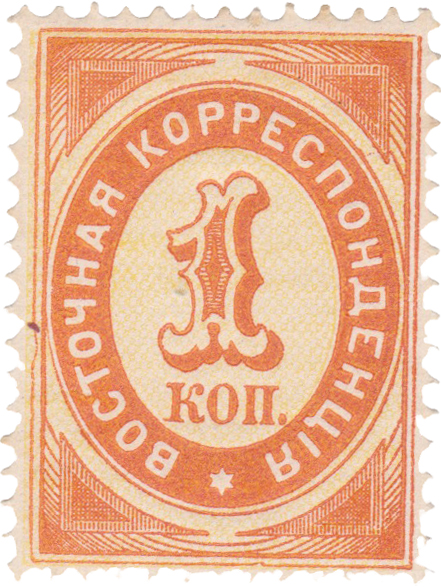
The 4th issue was printed in 1884–1888.
Russian Post in the Ottoman Empire was a postal service of the Russian Empire that operated in various cities of the Ottoman Empire from the 18th century until September 1914. According to L. L. Lepeshinsky (1967), a total of 73 postage stamps of the Russian Post in the Ottoman Empire were issued; according to the Scott catalogue, 231 stamps. The postage stamps of the Russian Post in the Ottoman Empire bore the inscriptions “Wrapper mailing to the East,” “ROPiT,” and “Eastern Correspondence.”
In the mid-19th century, Russia conducted brisk trade with Turkey, which needed light-industry goods. Turkey was supplied with various textiles, sugar, matches, and the like. In return, it sent to Russia so-called “colonial goods”—coffee, tobacco, spices, etc. Because there was no direct railway route, cargoes were transported across the Black Sea. But Turkey had almost no merchant fleet. Therefore, the Russian Steam Navigation and Trading Company (abbreviated ROPiT) was organized. In 1856, this company was also entrusted with the functions of the Russian post in Turkey.
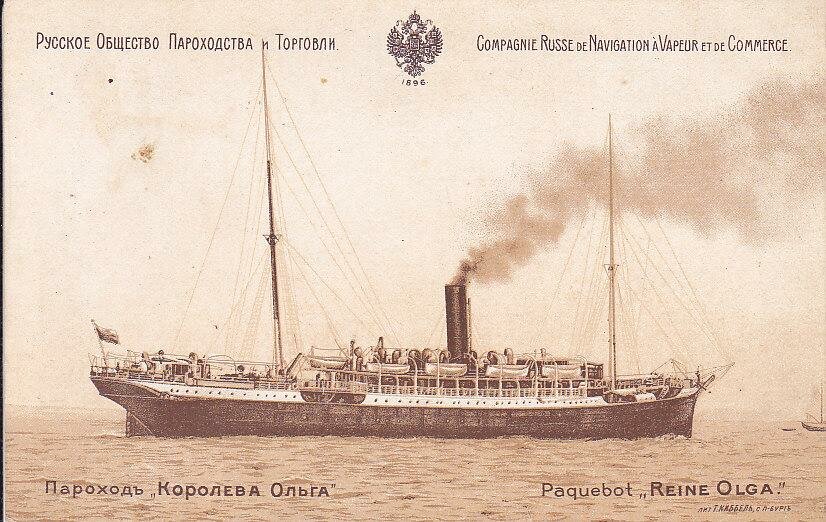
ROPiT carried mail between various branches and also forwarded correspondence destined for Russia via Odessa. In 1863, ROPiT branches received a status similar to ordinary Russian post offices.
Postal agencies were opened in 20 cities of this country, through which the mail was routed. All postal items (wrappers, letters, parcels, money orders, etc.) were paid with special stamps, the revenue from which went to Russia. Special stamps were also issued for sending mail to Turkey. They are called Levant stamps (for eastern correspondence).
The first stamp, with a denomination of 6 kopecks per 1 lot (1/32 of a pound, or 12.797 g), was intended for sending printed matter—newspapers, magazines, books—to Turkey as a wrapper mailing. It was issued in 1863. In the center of the rectangular stamp was a double-headed eagle, and around it in a circle the inscription “wrapper mailing to the East.” The same stamp, printed in a different color, was issued a second time in 1866.
Several stamps were issued for sending letters from Turkey. Thus, in 1865 two small stamps of original designs were issued depicting a steamship and the Tsar’s eagle. Instead of the words “postage stamp,” which appeared on all all-Russian stamps, “ROPiT” was printed. Stamps with this inscription were issued two more times in 1866 and 1867. They were sold for Turkish currency, but their value was not indicated.
From 1868, the Tsarist government took full control of Turkey’s mail and issued the first state stamps with the inscription “Eastern Correspondence,” but without the Tsarist emblem. These postage stamps were sold in the Russian postal agencies of ROPiT and came in different colors. They received an overprint with a new price. They remained in use until 1900. In that year, all-Russian postage stamps were issued with an overprint showing the new price in paras and piastres. In 1909, similar overprints were applied to ROPiT jubilee stamps issued in Russian currency, but they did not enter postal circulation.
In 1909–1910, in addition to the overprinted new price, additional overprints were made on these postage stamps with the names of 13 Turkish cities where these stamps were sold.
Later, Turkish-currency overprints were applied to the then-current general-issue stamps of Russia.
Russian post offices were closed due to the outbreak of the World War in 1914, in which Turkey sided against Russia.