
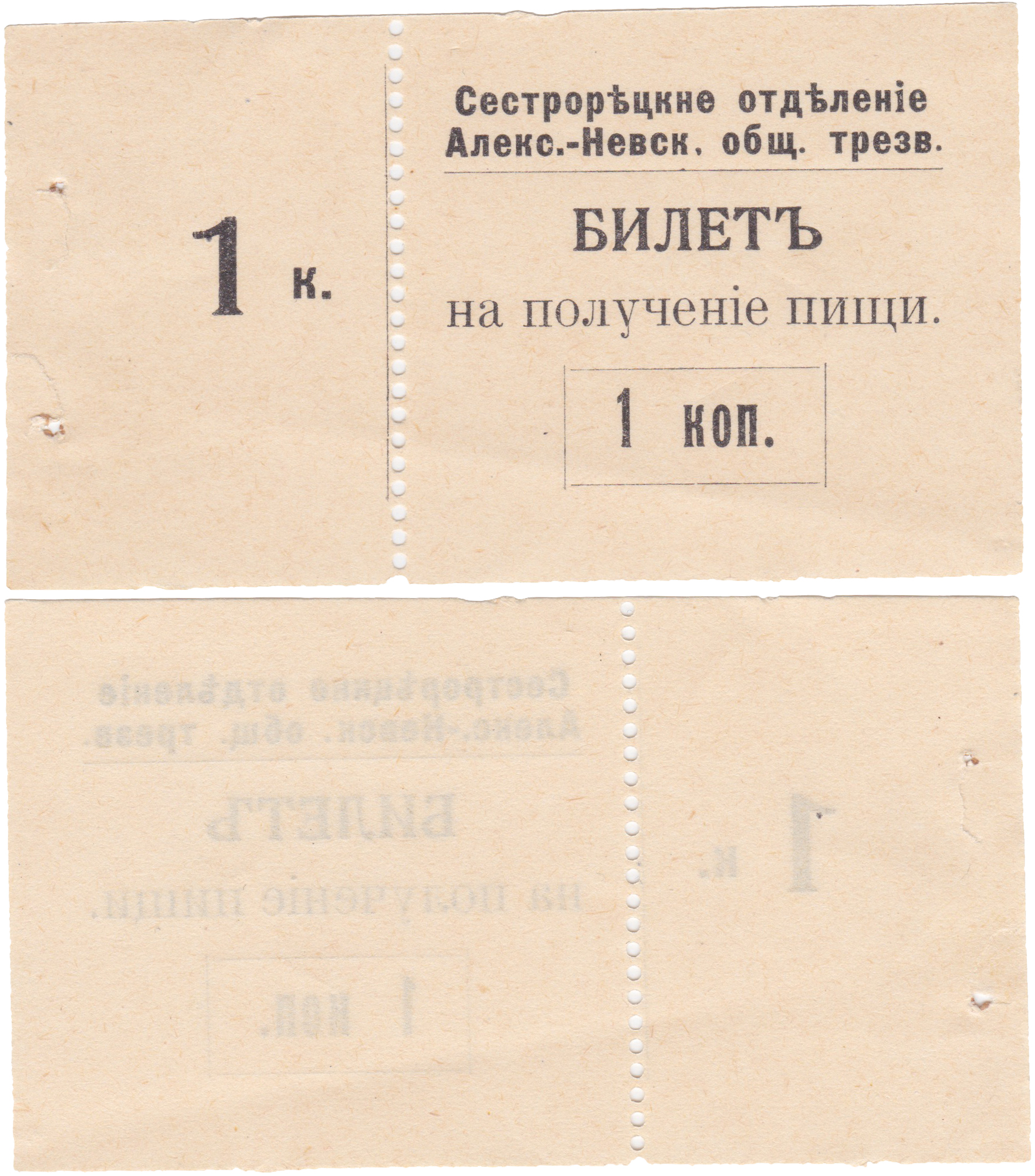
The Alexander Nevsky Society in Saint Petersburg was founded in 1898 by a great champion in the struggle for popular sobriety, the “apostle of sobriety,” as he was called, the priest Alexander Vasilyevich Rozhdestvensky. The Society operated at the Resurrection Church on the Obvodny Canal—on the basis of the Society for the Dissemination of Religious and Moral Enlightenment, which had existed since 1881. How broadly the work in this association was organized can be seen from the fact that over the years of its existence it registered more than 100,000 members, built several churches, and held thousands (according to the 1910 report—12,000) of liturgical and extra-liturgical talks.
In the Sestroretsk branch of the Alexander Nevsky Society of Sobriety, checkbook-style coupon booklets were introduced and readily taken up by local residents who, when giving alms to beggars, would hand out coupons from the booklets instead of money, knowing that the beggars would receive hot food at the branch’s tea room and that the money spent would bring real benefit.
The Tatevo Society of Sobriety served as a model for thousands of similar societies and gave rise to a major sobriety movement in the Russian Orthodox Church.
On August 10, 1889, a circular decree of the Synod was issued in which, among other things, diocesan hierarchs were asked “to report to the Holy Synod whether there currently exist Societies of Sobriety, how many persons they consist of and in what localities, and in what the influence of these societies has manifested itself on the religious and moral condition both of their members and of the surrounding population.” After the decree was issued, the number of parish societies of sobriety in Russia began to grow rapidly.
In 1906–1910, 997 societies were opened (as against 770 in the preceding period), of which more than 709 (75%) were established in 1909–1910. By that time, about 499,000 people were enrolled in 1,767 societies.