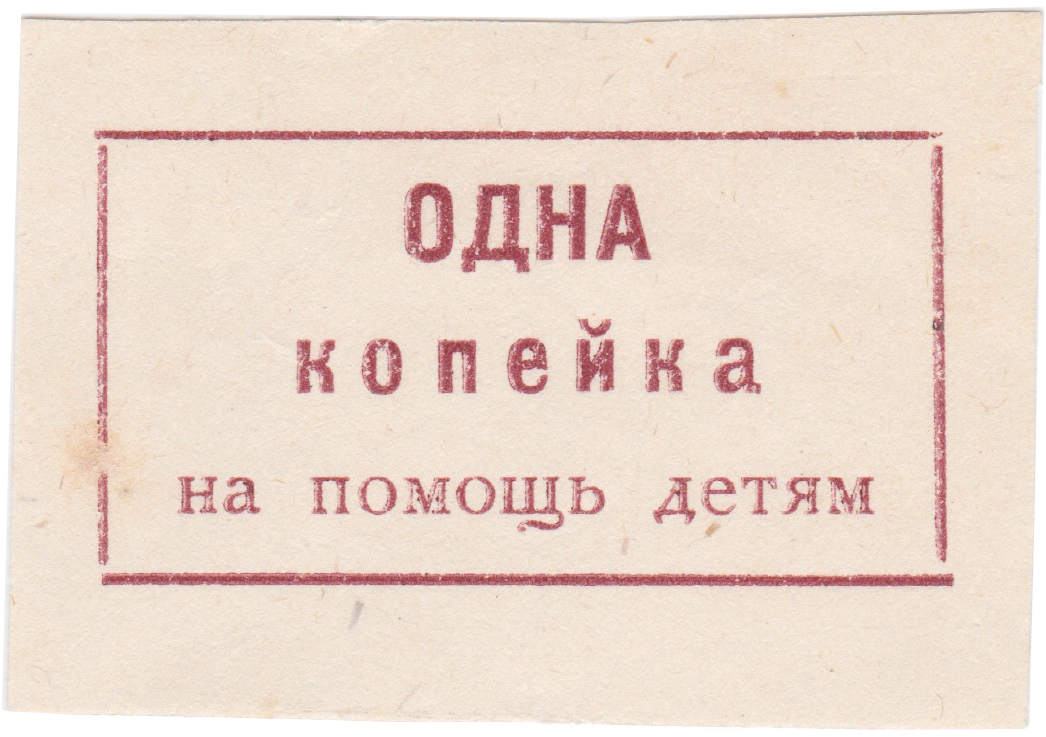
According to some sources, they were used as a compulsory levy and were affixed to bottles of wine.
From 1914 to 1921, Russia lost about 16 million people; many families fell apart, and mass child homelessness emerged. In 1913, full orphans made up no more than 25% of homeless children; by 1918, 40–45%, with most being workers’ children. Children of the urban petty-bourgeoisie were more often taken in by relatives or friends of the deceased. The number of peasant children increased as families were ruined by the war.
In 1918–1920, orphanages were under the jurisdiction of the People’s Commissariat of Social Welfare.
At the end of 1917, the People’s Commissariat of State Charity and the People’s Commissariat of Social Welfare were established and were granted all authority in the field of public charity. By decrees and resolutions of these commissariats, almost all charitable organizations that had operated in Tsarist Russia were abolished, and new Soviet bodies were created in their place: the Board for the Protection of Motherhood and Infancy, the Fund for the Support of Red Army Soldiers’ Children, and others.

The decree of January 17, 1918, on commissions for minors abolished imprisonment and courts for children of both sexes under 17. They now fell under the jurisdiction of commissions on minors. All court cases involving children, even those already concluded, were subject to review by these commissions. The commissions for minors were under the People’s Commissariat of Public Charity and included representatives of three departments: public charity, education, and justice. The commissions could release minors from punishment or send them to one of the “shelters” of the People’s Commissariat of Public Charity (depending on the nature of the act). Orphanages were under the People’s Commissariat of Social Welfare (children were equated with incapacitated members of society entitled to full state support). A significant part of them was consolidated into so-called children’s towns in Malakhovka (16 orphanages), Bolshevo, and others. The Moscow children’s receiving center was housed in the Danilov Monastery.
In February 1919, the Council of People’s Commissars created the State Council for the Protection of Children, chaired by A. V. Lunacharsky. It included representatives of the commissariats of labor, social protection, and food supply. At the same time, the Children’s Rescue League, created in 1918 by public figures, teachers, and cooperators, was active; it used healthcare institutions, former shelters that had belonged to the department of Empress Maria, and created its own labor colonies.
In 1920, orphanages were transferred to the system of public education bodies. By that time, orphans among homeless children accounted for more than 60 percent. A decree of March 4, 1920, instructed the People’s Commissariat of Justice to hold minors separately from adult offenders and to create special institutions for adolescents. In the 1920s, closed children’s colonies and labor communes were formed (under the NKVD). As an educational measure, minors could be placed in reformatories.
Famine began. Over two years (1920–22), the number of homeless children increased by an order of magnitude. Orphans made up 70–80% of the total, and most came from peasants (up to 40%). There were more children from well-to-do families among the homeless—kulaks, engineers, and nobles. The main ways children obtained food became criminal: theft, robbery, speculation, prostitution. From 1921, information about orphaned children should be sought in the materials of the Children’s Commission under the All-Russian Central Executive Committee.
On January 26, 1924, a Special Lenin Fund was created under the Central Executive Committee of the USSR to help starving and homeless children. In 1925, the country had 200,000 homeless children, 90,000 of whom needed immediate assistance. There were 241,000 children in orphanages, which was 55% of the total number of orphans. Societies of “Friends of Children” were created in 17 губерниях; they had their own clubs, canteens, tea rooms, and shelters. In 1930, these societies received even more authority as well as all-Union support—on November 30, the All-Russian Society “Friend of the Child” was established under the All-Russian Central Executive Committee and the Council of People’s Commissars of the RSFSR.
On January 27, 1921, a special Commission for Improving Children’s Lives (the Children’s Commission under the All-Russian Central Executive Committee) was established. It included representatives of the All-Union Central Council of Trade Unions (central trade-union bodies), the People’s Commissariats of Education and the Workers’ and Peasants’ Inspectorate, Public Health, the Central Committee of the Komsomol, the Women’s Department, the Agitation and Propaganda Department of the Central Committee of the RCP(b), and the All-Russian Extraordinary Commission for Combating Counterrevolution (Cheka). In the State Archive of the Russian Federation, record group 5207 contains the materials of the Children’s Commission under the All-Russian Central Executive Committee. In the same year, a decree was issued on organizing the Children’s Social Inspectorate, tasked with combating child homelessness, juvenile offenses and crime, and protecting children from exploitation and mistreatment. Children were transferred under guard to less affected provinces; sent to hospitals and other emerging children’s institutions; and actively placed under guardianship with families of “party Soviet workers and candidates,” and even with families of foreign comrades, in particular in Slovakia and Moravia. In Moscow alone in 1920–1921, 24,000 homeless children were settled with families. Some adolescents were assigned to Red Army music units. In 1921, 150,000 children from the starving Volga provinces were evacuated through the Children’s Commission to more prosperous areas; more than 200,000 were taken into care by Red Army units, Cheka подразделениями, trade unions, and peasant organizations. That same year, the Children’s Commission under the All-Russian Central Executive Committee cooperated with the relief fund of Norwegian polar explorer Fridtjof Nansen, as well as with the American Relief Administration (ARA), but at the end of 1921 it was stated that the ARA was being actively used for разведка and subversive activity, which led to the curtailment of its work in the RSFSR.
Special children’s institutions were created: receiving-and-distribution centers (for temporary stays); orphanages; “communes” and children’s “towns.” Orphanages were intended for children up to 12–14 years of age. Labor communes accepted older adolescents. Children’s towns were an объединение of several orphanages, schools, factory training schools (FZU), with the supporting infrastructure and auxiliary institutions. Through 200 receiving-and-distribution centers created in 1921, designed to take in 50 to 100 children at a time, more than 540,000 children passed over the course of a year.
In March 1922, an additional oversight body was created—the Children’s Social Inspectorate under the Department for the Legal Protection of Children of the People’s Commissariat of Education. It handled not only homelessness issues, but also the protection of minors in families, at workplaces, and in children’s institutions.
On January 26, 1924, a Special Lenin Fund was created under the Central Executive Committee of the USSR to help starving and homeless children.
In 1925, the country had 200,000 homeless children, 90,000 of whom needed immediate assistance. There were 241,000 children in orphanages, which was 55% of the total number of orphans. Societies of “Friends of Children” were created in 17 provinces; they had their own clubs, canteens, tea rooms, and shelters. In 1930, these societies received even more authority as well as all-Union support—on November 30, the All-Russian Society “Friend of the Child” was established under the All-Russian Central Executive Committee and the Council of People’s Commissars of the RSFSR.
A quote from Makarenko’s work: “The homeless children of 1921–1924 have long since disappeared... Our present-day homeless child is not a product of class disintegration... The present-day homeless child is прежде всего a child who has lost a family. There are many reasons for this: a freer form of family, the absence of forced cohabitation, a more intense movement of people in society, a heavier workload for father and mother, the woman’s departure from family constraints, material and other forms of contradictions.”
From 1918 to 1926, it was impossible to adopt a child. In 1926, the ban on adoption introduced in 1918 was lifted. A campaign began to place children through adoption and to relieve orphanages. The 1926 RSFSR Code of Laws on Marriage, Family, and Guardianship legalized de facto marriage. Sufficient conditions for its recognition were cohabitation, running a shared household, and jointly raising children. The Code gave the court the right to decide to remove children under 14 from their parents and transfer them to guardianship authorities, and it allowed the adoption of minors.
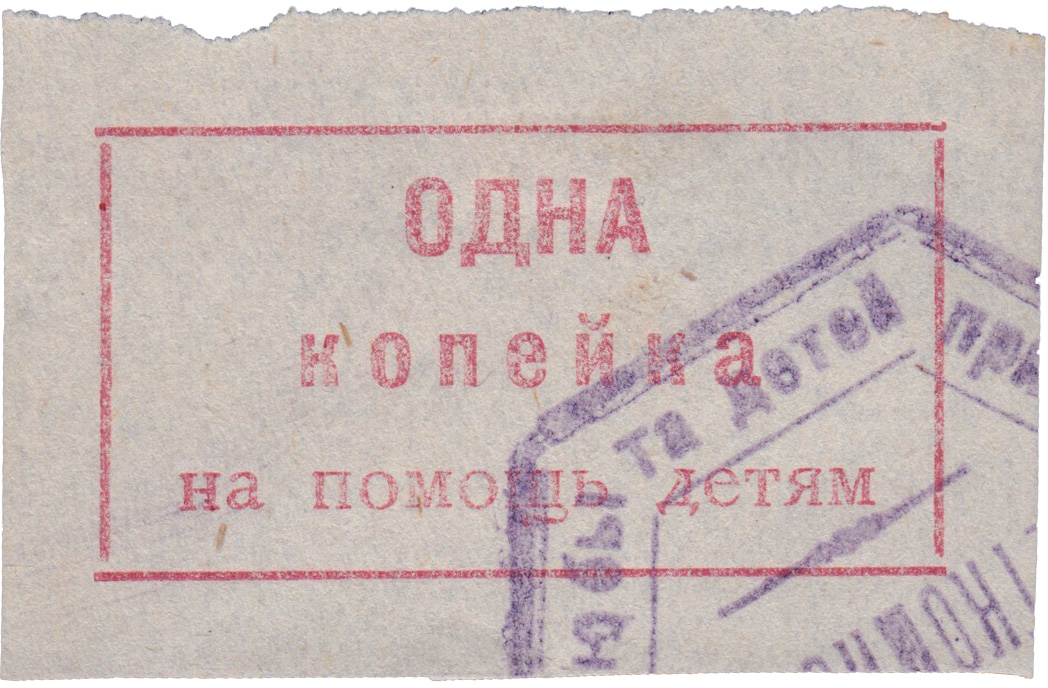
1 Kopeck to help children 1924.
Administration of the Republic of Crimea, Simferopol.