
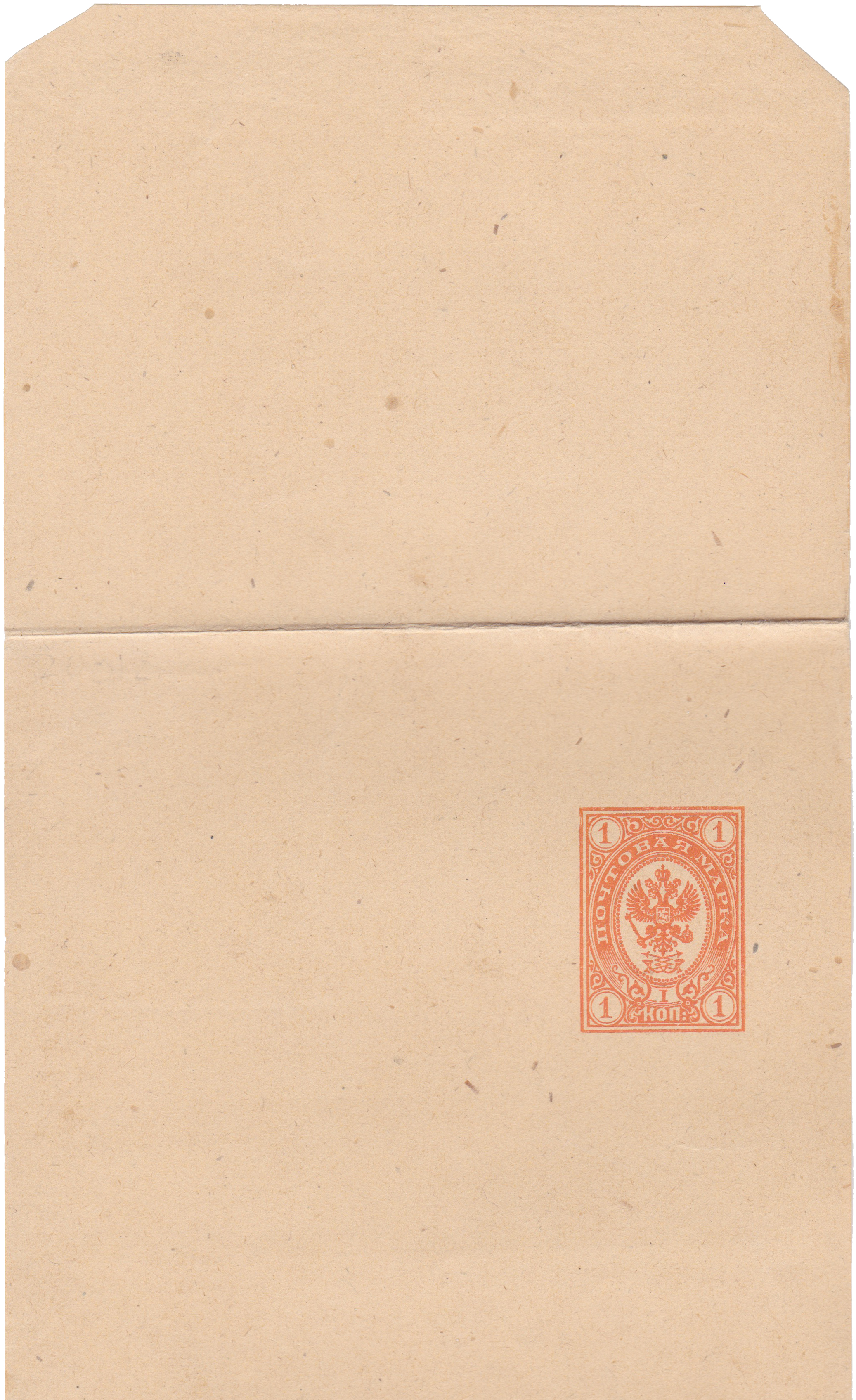
In Russia, stamped wrapper bands for printed matter were issued twice: in 1890–1891 and in 1913.
A type of postal stationery: wrapper bands. These are paper strips of various widths and lengths with a printed sign of postage payment. Wrapper bands were intended for wrapping newspapers, books, and other printed items. Unlike envelopes, wrapper bands did not fully protect the contents from damage, since the edges usually remained open.
Originally, “banderoles” referred to paper strips for wrapping postal items which, in some countries, were issued with postage payment signs printed on them. Such stamped banderoles are classified as postal stationery and are collectibles (philately).
In the Russian Empire, the maximum weight for banderole mail was significantly lower: not exceeding 4 pounds for printed works and business papers (therefore lower than the maximum weight for sealed letters) and 20 lots for samples of goods. Banderole items were paid for at a much reduced rate (the minimum charge for out-of-town items was 2 kopeks (equivalent to 5 centimes) for printed works, 7 kopeks for business papers, 3 kopeks for samples of goods), but each weight unit—set at 4 lots—was paid in full.
In December 1863, the head of the Postal Department, Count I. M. Tolstoy, submitted a report to the Tsar in which he proposed reducing the rate for shipping books. Until then, printed publications had been sent at the parcel correspondence rate. The proposal was accepted, and in early May 1864 Alexander II approved the State Council decision “On the introduction of a preferential rate for parcels containing books.”
At first, the reduced rate applied only to books, which had to be packed in canvas sacks or wooden boxes (given the poor condition of Russian roads).
In 1866, the preferential rate was extended to other printed publications (announcements, catalogs), which were permitted to be sent in canvas or strong paper wrapping (under a banderole), and from 1870 banderole mail was allowed to include individual issues of periodicals published in Russia and abroad.
In September 1874, the Bern Postal Congress took place, with representatives of Russia participating. At this congress, the treaty establishing the Universal Postal Union was concluded, unifying a number of postal rates. The treaty was ratified by Alexander II and the Senate and came into force (with respect to international mail rates) on 19 June 1875.
In 1889, the Main Directorate of Posts and Telegraphs placed an order with EZGB for the manufacture of postal banderole wrappers with face values of 1 and 2 kopeks.