
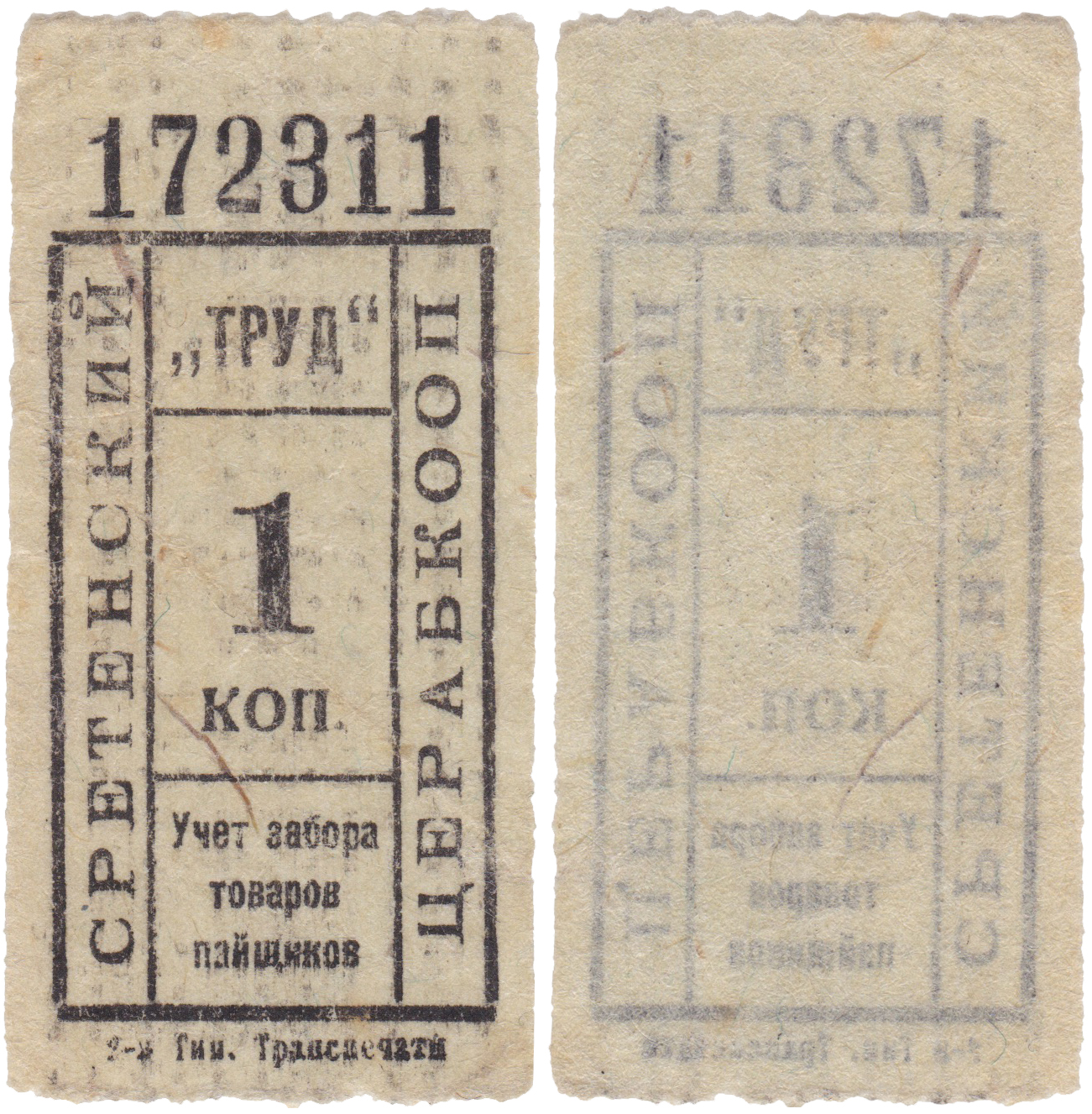
The spontaneous decline in the exchange rate of paper money that began in March 1920 had a negative impact on the work of the Sretensk cooperative organizations and consumer societies. Their assets gradually decreased, and along with them the amount of working capital and the stock of goods on hand. Under these conditions, the need arose to unite the city consumer cooperatives into a single organization. In the first half of 1921, as a result of the merger of several cooperative organizations and the Sretensk Consumers’ Society “Econom,” the central workers’ cooperative “Trud” was formed.
By the Law “On the Regulation of Monetary Circulation in the Far Eastern Republic” of May 16, 1921, circulation was established for Russian gold, silver, and copper coinage, as well as paper banknotes at an exchange rate set by the Minister of Finance. The cooperative’s board began its duties in late May 1921 and, first of all, decided to transfer all monetary settlements to the gold ruble, as it had the most stable rate under the circumstances. For this purpose, the stock of all goods and property was audited. Seeking new ways to bring funds into the cooperative’s cash desk, as well as methods of settlement in trade, the board decided to issue its own small-change monetary notes backed by a special gold fund. In June 1921, the cooperative received the ordered notes—premiums in denominations of 1/2, 1, 2, and 4 kopecks. They were printed on thin colored paper, designed uniformly on the front side except for the frames, and were approximately the same size.
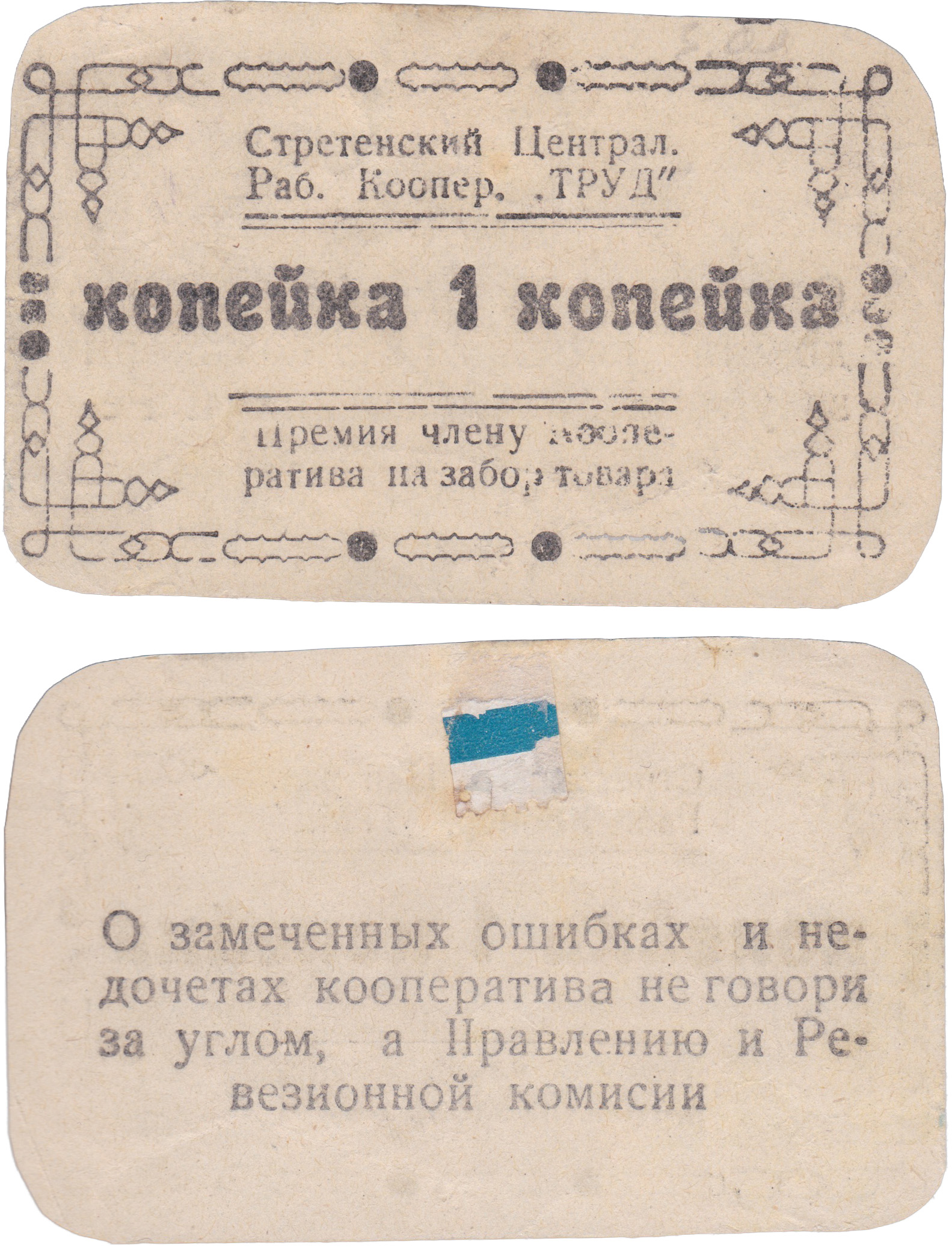
On the reverse side of the premiums, various propaganda texts were placed:
- “Audit and shop commissions, intensify the blow, fight mismanagement, slackness, and embezzlement in the cooperative”;
- “Paying a share and being a shareholder in the cooperative is not enough—you must work actively and strengthen the cooperative”;
- “Cooperative worker, much depends on you in the cooperative’s work; be an exemplary worker”;
- “Buying on credit heavily affects the cooperative’s work and your budget; buy goods with cash”;
- “Do not talk about noticed mistakes and shortcomings of the cooperative in whispers—report them to the board and the audit commission”;
- “Youth, through study and active participation in the cooperative’s work, prepare the next generation of cooperators.”
Specifically for inventory accounting, in the 2nd printing house of Transpechat, roll-form numbered one-sided scrip was printed, which was also used for settlements.