
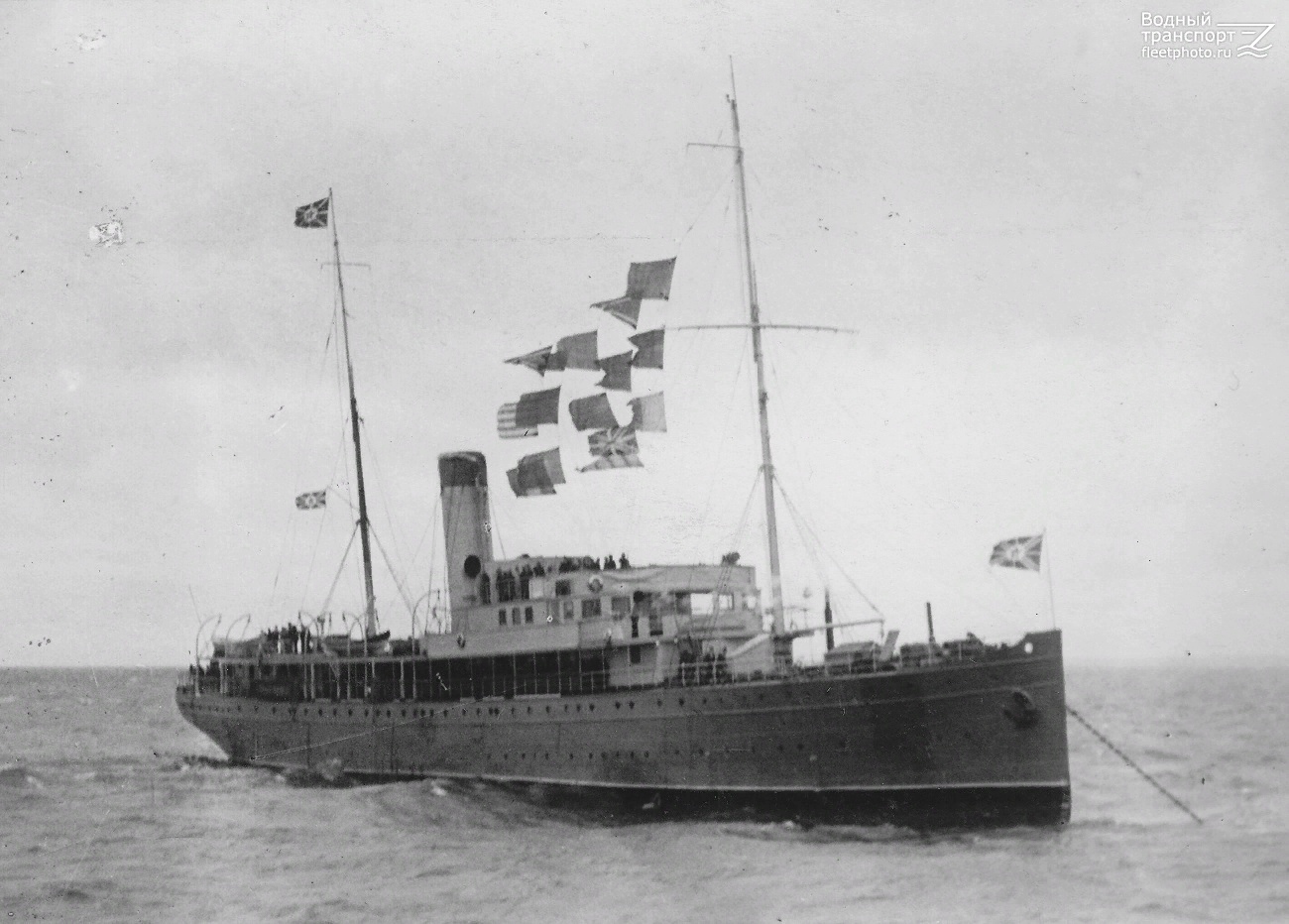
The cargo-passenger steamship "Polaris" was built for the Finnish shipping company "Finska Angfartygs Aktiebolaget" of Helsinki, delivered to it on March 26, 1899, and operated as a passenger vessel under the Finnish flag until 1914. The main cargo-passenger route on which the ship sailed connected the ports of Finland with Copenhagen and the city of Hull on the east coast of Great Britain’s main island. Despite its modest size, "Polaris" was nevertheless a fairly comfortable vessel compared with other ships operating cargo-passenger services in the Baltic and North Seas at that time.
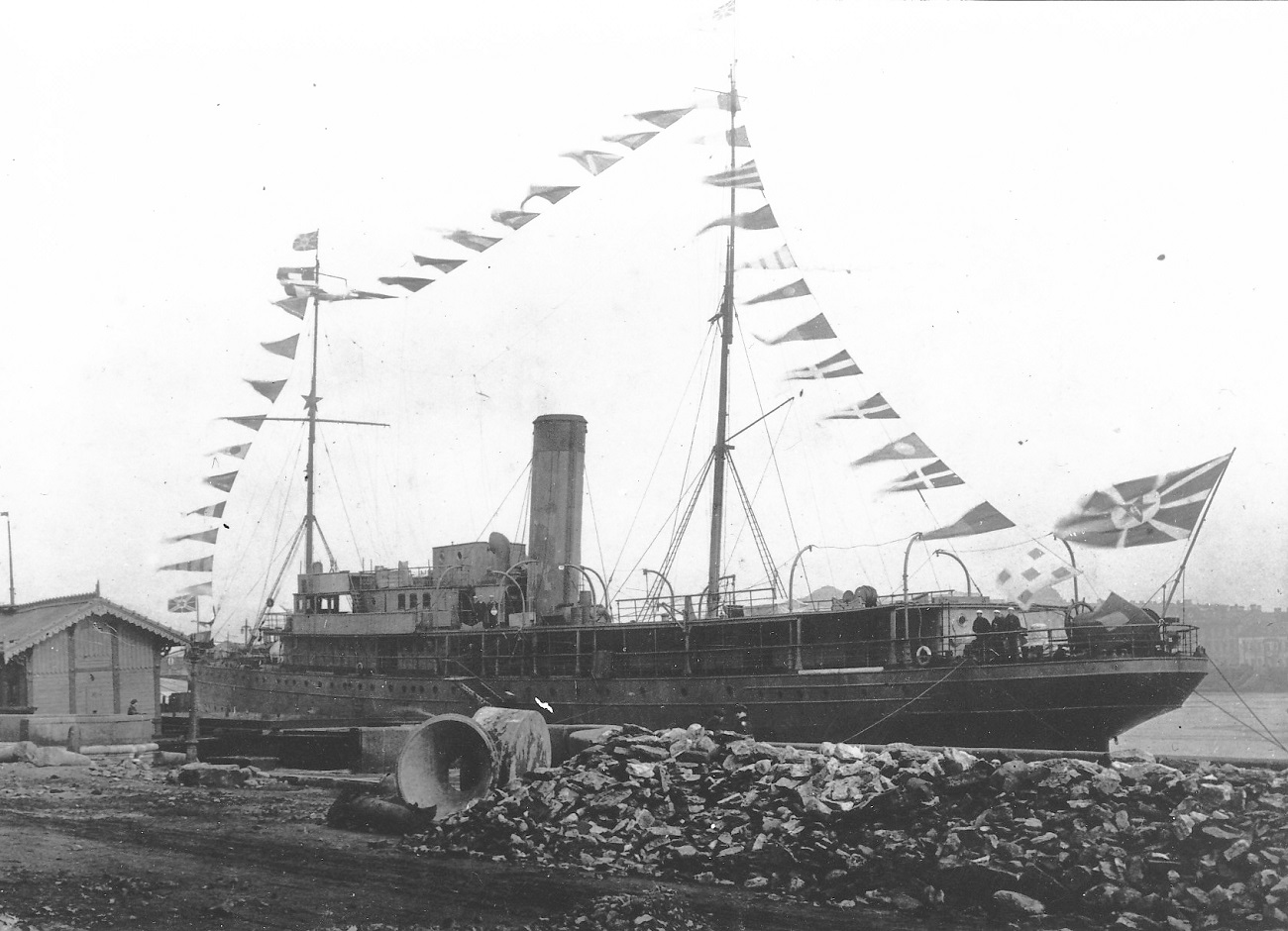
In 1914, with the outbreak of World War I, "Polaris" came under the control of the naval authorities of the Russian Empire (at that time Finland was part of the Russian Empire as a separate administrative-political entity). "Polaris" began to perform the functions of a military transport. On April 5, 1915, the steamship was compulsorily purchased by the Imperial Russian Navy from the original owner, and the vessel received a new name—"Krechet". From August 12, 1915, "Krechet" officially became a dispatch vessel. A number of sources report that the ship was also used as a staff ship; in any case, "Krechet" was based in Helsinki and served as quarters for personnel of the Imperial Russian Navy.
Probably on October 25, 1917, the crew received news of the successful uprising in Petrograd and, inspired by it, decided to side with the new Bolshevik власти, while the ship still remained stationed in Helsinki. On December 31, 1917, Finland officially gained state independence. On April 11, 1918, "Krechet", among a number of other ships of the former Imperial Russian Navy, sailed from Helsinki to Kronstadt a few days before German troops entered Helsinki. The passage was very difficult: there was much confusion, the fleet’s actions were largely uncoordinated, and this was further complicated by the fact that there was still ice in the Baltic Sea. All of this led to incidents and even accidents. As a result of poor navigational support in the Baltic Sea, "Krechet" ran aground on a shoal near the Ranke lighthouse, receiving a breach below the waterline and a severe leak. However, the loss of the vessel was avoided, and it reached Kronstadt.
Upon arrival in Kronstadt in 1918, "Krechet" was officially declared property of the new Soviet government. Apparently the necessary repairs were carried out and it returned to service. "Krechet" remained a naval dispatch vessel and was based in Kronstadt.
In February–March 1921, a naval uprising broke out in Kronstadt against communist rule; a Resolution was adopted calling for the restoration of civil freedoms, recognition of political parties, and new elections to the Soviets. On March 2, a meeting of the crew of the military steamship "Krechet" took place. A decision was made to support the fair demands of the uprising and the general Resolution. The "Krechet" crew also adopted its own resolution, which in its drive for democracy went even further than the general Resolution. On March 17, 1921, the Kronstadt uprising was brutally suppressed.
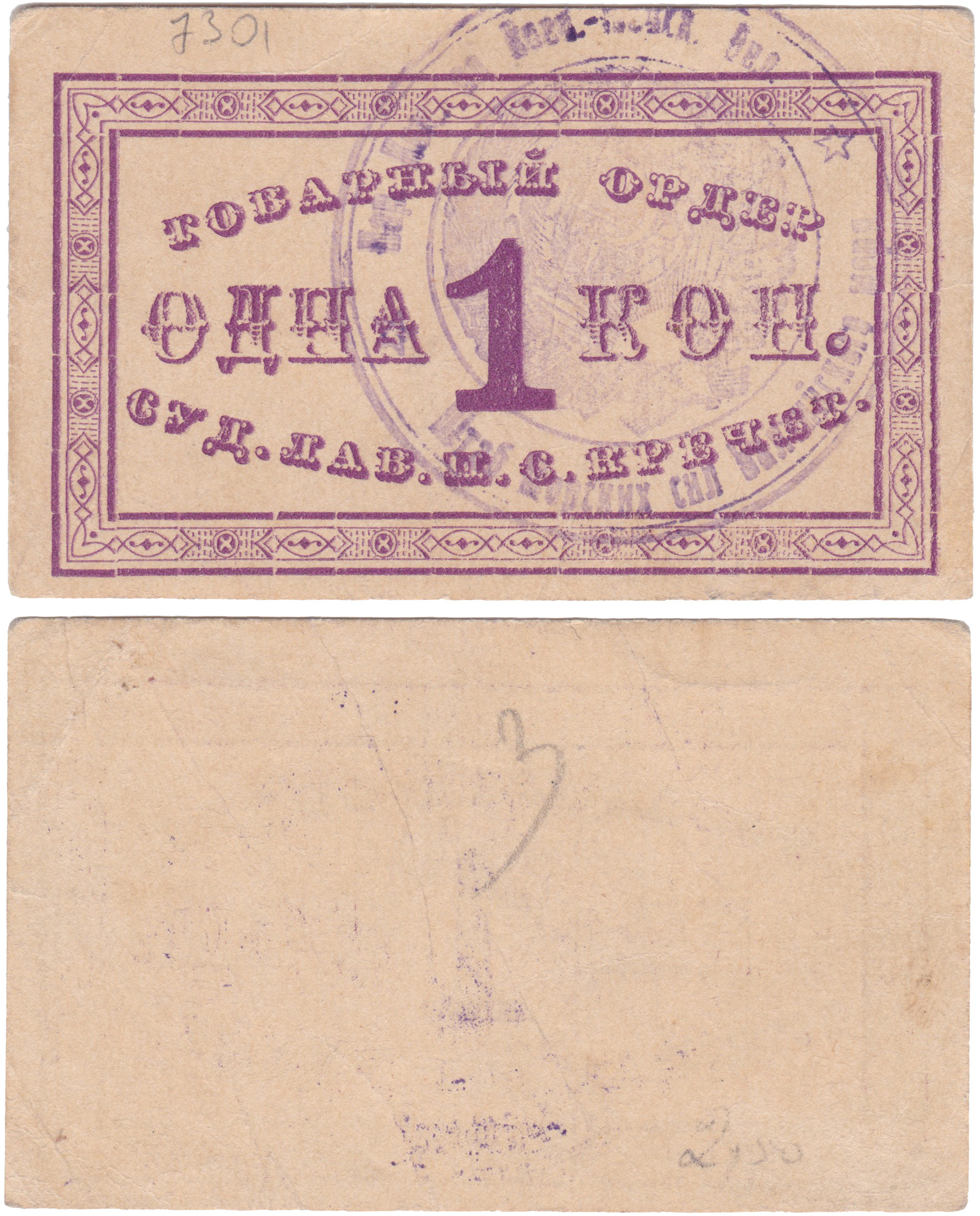
After the USSR was formed at the very end of 1922, "Krechet" became a Soviet vessel. From this moment, "Krechet" was a dispatch vessel of the Baltic Fleet of the USSR. Apparently throughout this time (1918–1927) the steamship remained in the Baltic Sea, in Kronstadt or in Petrograd/Leningrad. Gradually the foreign-policy situation in Europe normalized; the Civil War and World War I were behind, peaceful life returned to its former course, the need for a large military transport fleet disappeared, while demand for a civilian cargo-passenger fleet increased. According to official data, at the end of 1926, "Krechet" was demobilized and transferred from the Navy to "Sovtorgflot" (as the Soviet state merchant marine was officially called at that time).
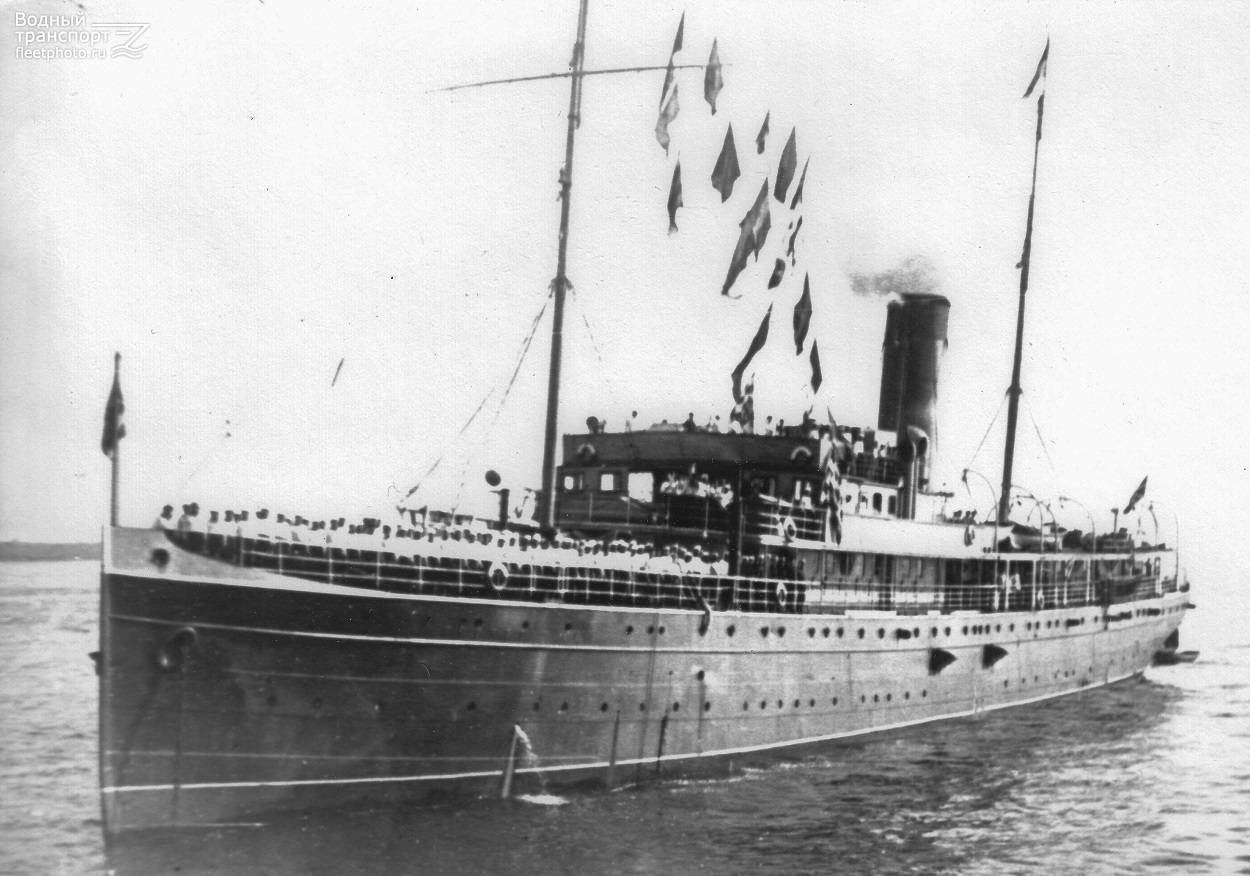
In 1927, "Krechet" was transferred to "Sovtorgflot-Odessa" (later this company became known as the Black Sea Shipping Company). The ship’s name did not change; its home port became Odessa, and it made a voyage around Europe to its new home port on the Black Sea—Odessa. Here "Krechet" again became a cargo-passenger vessel. There is information that the steamship "Krechet" operated on the Crimean–Caucasian line (Odessa–Batumi). In addition, in those years it also ran cargo-passenger voyages on the Middle Eastern line (Odessa–Alexandria).
In 1931, "Krechet" was transferred to the Far East and sent to its new home port—Vladivostok. The new owner became "Sovtorgflot-Vladivostok" (later this company became known as the Far Eastern Shipping Company), while the vessel’s name also remained unchanged. Until the beginning of World War II, "Krechet" was in operation in the Far Eastern regions of the USSR. The steamship "Krechet" worked both on cargo-passenger lines and on various one-off special voyages. It is known, for example, that in the 1930s the vessel also sailed the line between Vladivostok and Petropavlovsk-Kamchatsky. It is also known that in this period (early 1930s) the vessel was in fairly good condition, was considered quite comfortable, and the passage, for example, from Vladivostok to Petropavlovsk-Kamchatsky (one way) took 1 week.
Only a few details have survived about one such cargo-passenger voyage of the steamship "Krechet" from Petropavlovsk-Kamchatsky to Vladivostok, which took place from October 12 to 19, 1931. From literary source No. 1:
October 12.
We spent two weeks in Petropavlovsk, packing our things for departure and waiting for the steamship. I mostly sat in the room, drafting, drawing, writing, and never once even went down to Nikolskaya. Today is embarkation. I liked "Krechet". Decent cabins, a good saloon, and a cozy upper deck for отдых. Only it is small—in a storm it will probably roll quite a lot, and everyone will get seasick. All ten of us are traveling in first-class cabins. This makes me especially happy.
October 19.
We are approaching Vladivostok. On October 14 we passed by Paramushir and Onekotan. On October 16 we sailed past Sakhalin Island or, rather, Japanese Karafuto. The Sea of Japan is much richer in colors than the Sea of Okhotsk or the Pacific Ocean off the coast of Kamchatka. Vladivostok from the sea does not make a very vivid impression. Along the shore and hills are daubed low gray buildings of a dark, official color.
On June 25, 1934, the cargo-passenger steamship "Krechet" delivered to Sovetskaya Gavan a battalion and the first three survey parties of the Special Corps of Railway Troops. This became an important milestone in the surveys and the start of construction of the Baikal-Amur Mainline.
Gradually the international situation worsened again, and in 1941 large-scale hostilities were unfolding in the Pacific region.
In July–August 1941, "Krechet", among several other vessels of the Far Eastern Shipping Company, was sent for major overhaul to Hong Kong to British ship repair yards. In December 1941, hostilities began between Japan and Great Britain. On December 8, 1941, the Japanese 23rd Army launched an offensive from the Chinese coast against Hong Kong (Great Britain), and the defense of the city began. Repairs to the ships were halted. The steamship "Krechet" was anchored in the narrowest part of the strait. On December 11, Japanese forces captured the Kowloon Peninsula. Having reached the shoreline, Japanese units began an artillery bombardment of the port and roadstead waters. On December 14, Japanese artillery, firing at close range with direct lay, shelled the steamship "Krechet". After several dozen direct hits, the vessel caught fire, and after some time the fire engulfed the entire ship. Before morning, the cargo-passenger steamship "Krechet" sank. The crew safely made it ashore using their own small craft.
At first, the crew from the steamship "Krechet" found themselves on Victoria Island with the British. On December 25, 1941, Japanese forces captured Hong Kong, the defense of the city ended, and the crew of "Krechet" found themselves in territory occupied by Japanese troops. In December 1942–1943, all Soviet sailors, with great difficulty but nonetheless, were able to return to Vladivostok.
On December 21, 1941, in connection with the loss of "Krechet", the Soviet government lodged a protest with Japan’s Ministry of Foreign Affairs; the Japanese side was held responsible for the shelling of the vessel that led to its sinking. After the end of World War II, Japan bore material responsibility for the sinking of "Krechet".
The vessel lay on the bottom throughout the war. After World War II ended, work was carried out in the waters of Hong Kong harbor and the roadstead to clear the seabed of many sunken and partially sunken ships. Among other vessels, the steamship "Krechet" was also raised. It was cut up for scrap metal. This occurred in the late 1940s to early 1950s.