
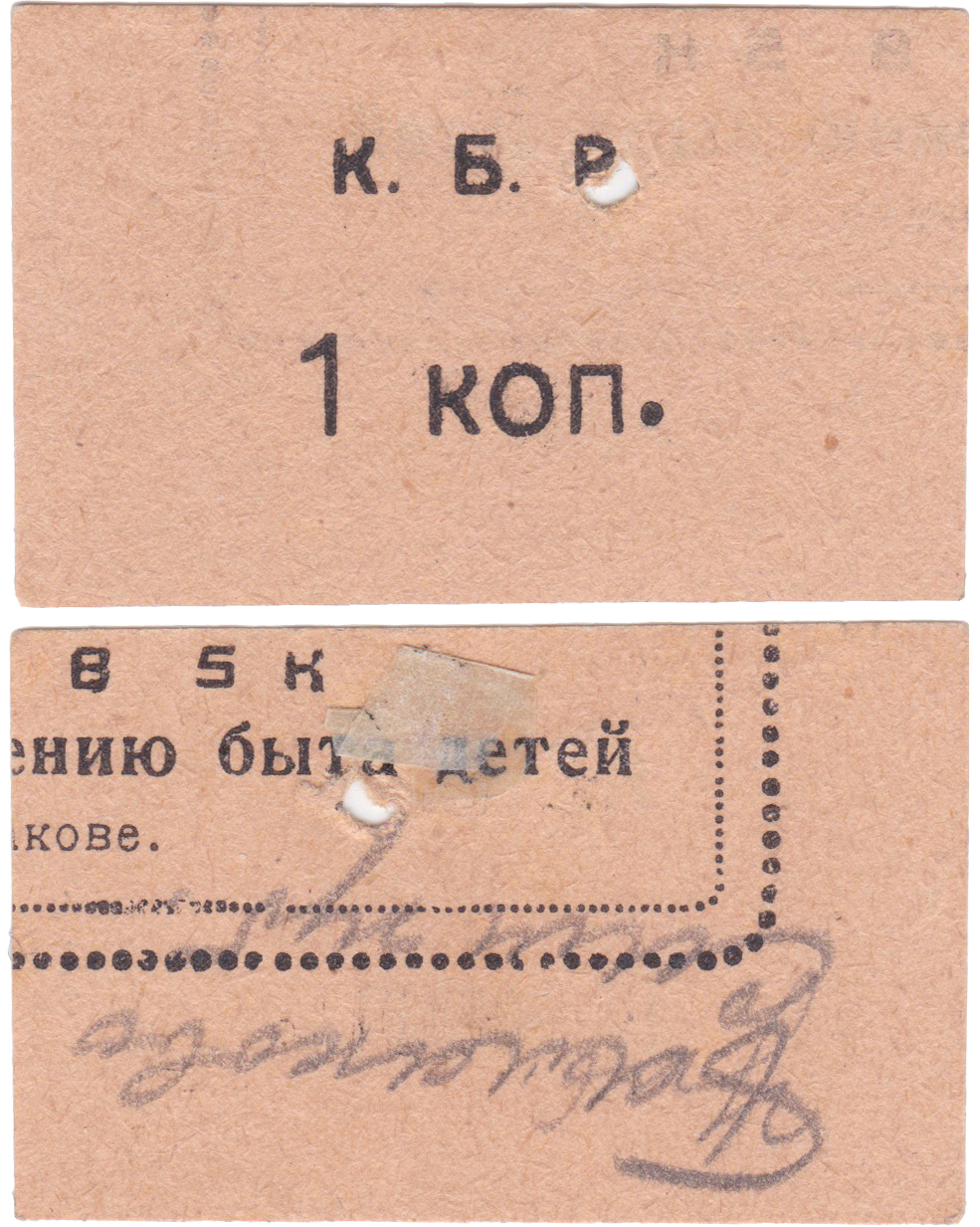
On the reverse side — Commission for Improving Children’s Living Conditions (secondary use?).
The first mention of Balakovo as a place where people lived dates to the second quarter of the 17th century. On the site of present-day Balakovo there were fishing camps. Less than a hundred years later — in 1738, two versts from the Volga — a Cossack meadow holding, Balakov Yurt, was established.
On December 14, 1762, Catherine II issued a manifesto calling Old Believers to return from abroad to Russia. The date of the manifesto is considered the starting point for the city of Balakovo. By imperial decree, a settlement was founded at a barge-haulers’ crossing with its own grain wharf, which attracted merchants, peasants, and people of all kinds. The founders of the village of Balakovo were Old Believers of the Vetska community who arrived from Poland.
Its advantageous geographic position on a historic trade route determined its further development. From the very beginning, Balakovo was considered an appanage village, i.e., belonging to the sovereign. In addition to farming, appanage peasants were allowed to engage in free trade, which led to an influx of outsiders. Its convenient location on navigable routes helped the village grow rapidly thanks to the wheat trade. As the grain trade developed, the cargo turnover of the wharves increased, and the fleet of freight and passenger vessels expanded. A ship-repair industry emerged to service them.
In the second quarter of the 19th century, the Balakovsky Prikaz was formed, comprising 10 villages and hamlets with a population of about 2.5 thousand people. At the same time, Balakovo had the second most important wharf on the Volga after Samara’s. During a single navigation season, up to 180 steamships departed from the city’s wharves, and grain turnover reached two million silver rubles. Balakovo’s unofficial status as the “wheat capital” of the Volga region, and the corresponding volume of trade, determined the village’s further development. According to the census conducted in 1887, 15,995 people lived in the village.
In the late 19th — early 20th centuries, the village of Balakovo became a true grain and industrial center of the Volga region. The Mamins brothers’ oil-engine plant expanded, and Fyodor Blinov’s plant produced fire pumps. At the Nizhny Novgorod Exhibition, Balakovo industrialists showcased the first modifications of a steam tracked tractor and a tractor with an internal combustion engine. This period in Balakovo’s history also saw a construction boom. Churches, large manor ensembles and homesteads, trading-and-guest courtyards, trading houses, shops, mills, educational institutions, as well as public and industrial buildings and complexes were built.
All of this so outgrew the settlement’s “rural” character that in May 1911 a Supreme Decree was signed granting Balakovo the status of an out-of-district town with rights of self-government. On the eve of the 1917 revolution, the town had (in stone alone) 5 churches, 7 schools, a grain exchange, a power station, Fyodor Blinov’s cast-iron foundry and the Mamins brothers’ mechanical oil-engine plant, ship-repair and furniture workshops, sawmills, mills, a commercial school, a zemstvo hospital, and a library. Self-taught inventors Fyodor Abramovich Blinov and Yakov Vasilyevich Mamin made Balakovo famous as the birthplace of the world’s first tracked tractor, the first domestic wheeled self-propelled vehicle, and the Russian diesel engine. In 1915, the Mamins brothers’ plant for oil engines and tractors produced 325 diesel engines with a total output of 5,100 horsepower. The image of old Balakovo was shaped by architects such as H. F. Meyer and академик architecture F. O. Shekhtel.
In terms of administrative affiliation, Balakovo for a long time was part of the Malykovskaya volost, and in 1780, when the village of Malykovka became the city of Volgsk (Volsk), it became part of Volgsk (Volsk) Uyezd of the Saratov Viceroyalty. In 1893, Balakovo with its lands became part of Nikolayevsky Uyezd (the town of Nikolayevsk — present-day Pugachyov), which at first was within Saratov Governorate and from 1850 within Samara Governorate. Until 1928, Balakovo was part of Samara Governorate (in 1919–1924, Balakovsky Uyezd existed), and afterward of the Lower Volga Krai; since December 5, 1936 — of Saratov Oblast.