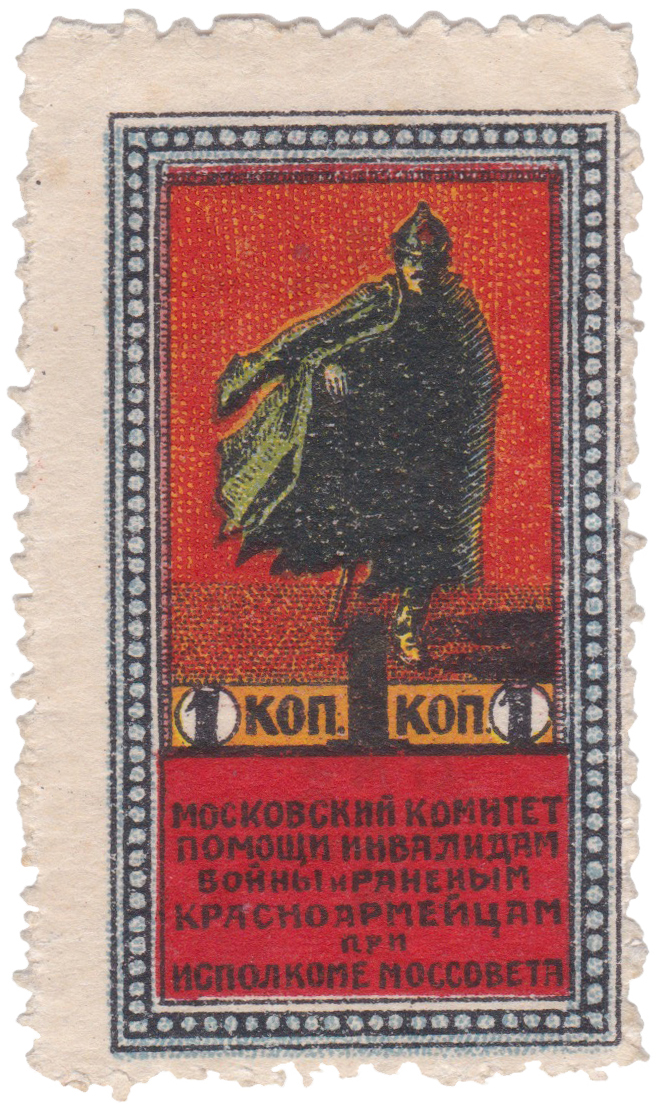
Issue 3.
The noble work of assisting the wounded in the Civil War took on a nationwide scale. The Moscow Committee (abbreviated as Moskompom) was especially active in this effort. At the capital’s railway stations, food stations for the wounded were set up, evacuation to municipal medical facilities was organized, and war invalids were assisted with clothing and money when being sent back to their home regions.
In search of funds, Moskompom decided to issue charity stamps for distribution among Muscovites: on June 16, 1924, the People’s Commissariat of Finance of the USSR granted permission to print 4,250,000 copies. These stamps began to circulate and became a noticeable competitor to the all-Union issues. As a result, an indignant letter followed from the leadership of Vserokompom, claiming that “in Moskompom’s issuance of stamps, one sees disorganization and an undermining of the work of Vserokompom’s publishing office.” The reply was immediate. In two concise but very specific letters it was stated: “Moskompom hereby forwards, for your information, samples of the 1, 2, 3, and 5 kopeck denominations issued by the Committee for distribution. Deputy Chairman of Moskompom Yakubovich. 16.8.24.”
Soon a second notice was sent: “Moskompom informs Vserokompom that it forwards, for your information, samples of stamps in 10 k., 25 k., 50 k., and 1 ruble, issued by the Committee.” Subsequently, no documents were received regarding issues in Moscow of other, additional denominations. This gives grounds to believe that the Moscow series had only the eight denominations listed.
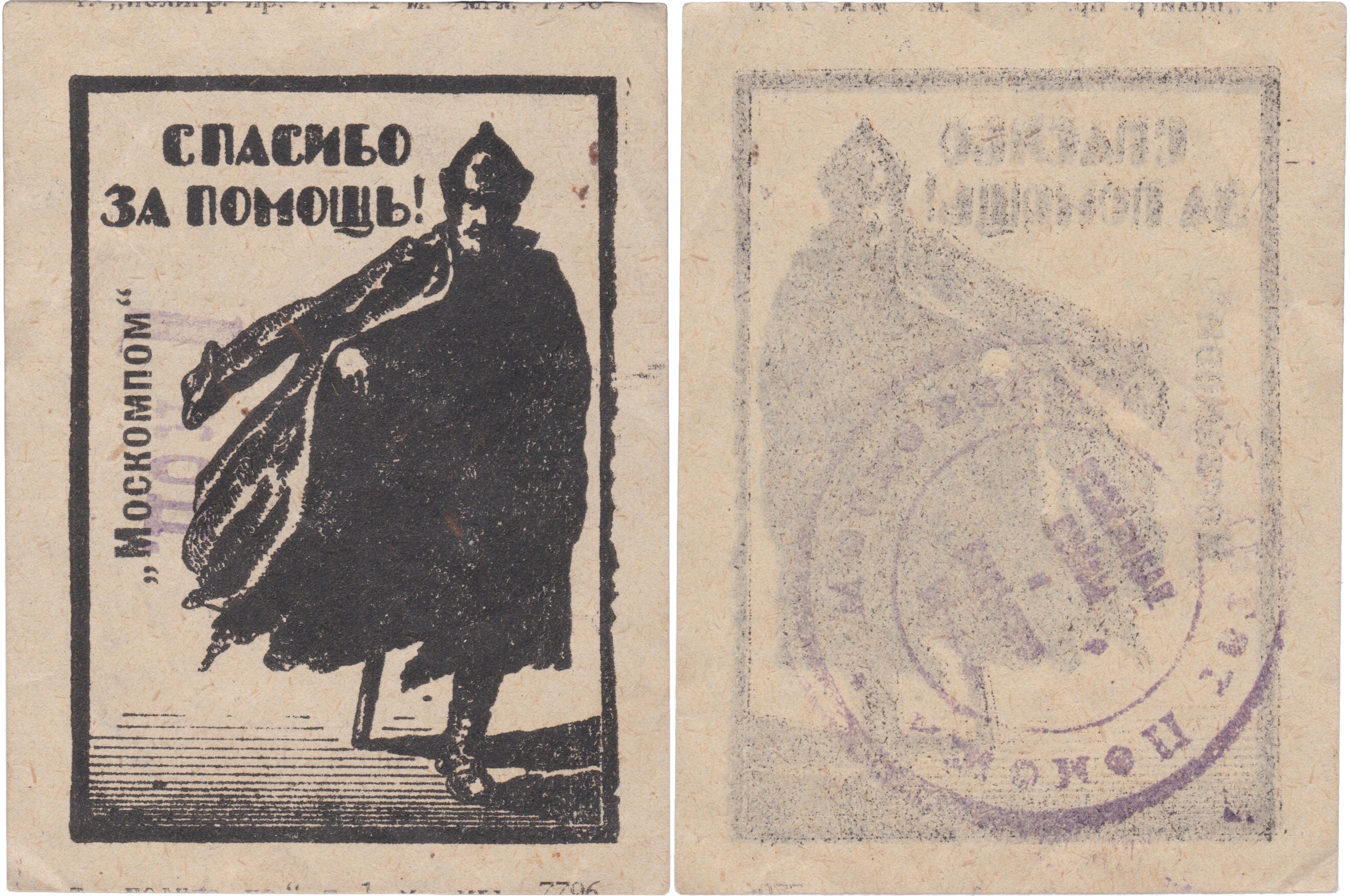
The period of circulation of this series is clearly documented: August 1924 — January 1925.
“Urgent, to Moskompom. 20.1.1925 No. 388. I propose that you immediately provide information on the quantity of charity stamps issued by you, as well as on the operations carried out with them. Surrender the remaining stock immediately to the Vserokompom warehouse. Deputy Chairman of Vserokompom R. Rein.”
Such peremptoriness was due to the fact that, under a Resolution of the Central Executive Committee of the USSR, Vserokompom received the monopoly right to issue and distribute charity stamps throughout the country. It was precisely after this “report” that the Moscow stamps were handed over to the central warehouse and ceased to circulate. Having counted its remaining stock, the Moscow Committee reported upward: “To Vserokompom. Re: No. 388 of 20.1.1925. On the basis of the Resolution of the Presidium of Vserokompom of 9.1.1925, Moskompom hereby reports that the charity stamps issued by Moskompom have been taken into account, and that the actual stock on February 1, 1925 is as follows: 1-ruble stamps — 244,816 pcs., 50 kopecks — 237,153 pcs., 25 kopecks — 268,653 pcs., 10 kopecks — 347,517 pcs., 5 kopecks — 348,496 pcs., 3 kopecks — 467,140 pcs., 2 kopecks — 828,968 pcs., 1 kopeck — 718,048 pcs.
Total amount: 520,556 rubles 29 kopecks. On the basis of all the above, Moskompom requests that you dispatch your representative to take inventory of the remaining stamps.
Chairman of Moskompom SVETLOV Head of Chancellery CHISTOVA”
In pieces, this amounted to 3,461,791 copies, and they were turned over to the warehouse; it follows that not all that many sets were actually distributed. In July of that same year, 1925, the Moscow Committee for Aid to Invalids was abolished.
1 Kopeck 1924.
Moscow Committee for Assistance to War Invalids and Wounded Red Army Soldiers under the Executive Committee of the Moscow Soviet (Vserokompom).