
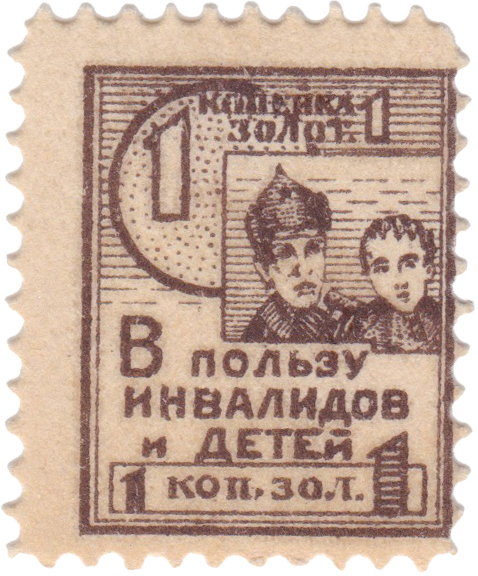
The Committee for Aid to Sick and Wounded Red Army Soldiers traces its origins to October 1919, when the All-Russian Central Executive Committee (VTsIK) adopted regulations on its establishment. In January 1922, the committee was renamed the All-Russian Committee for Aid to Sick and Wounded Red Army Soldiers and War Invalids. In December 1924, new regulations were approved that expanded the range of persons to whom assistance was addressed—“the families of persons killed in the war.” The abbreviation VSEROKOMPOM remained unchanged. From July 1926, the regulations on the committee were amended again, and the list was expanded to include “demobilized Red Army soldiers.” In March 1930, the committee was reorganized into a society (VSEROO BPOM) under the People’s Commissariat of Social Welfare of the RSFSR. Committees (later, societies) operated in a number of union republics (Ukraine, Uzbekistan, Azerbaijan, etc.). All issued badges, with the exception of the “Activist” and the “Shock Worker,” were intended for sale in order to raise funds for the society’s tasks specified in its regulations. The society ceased to exist in the mid-1930s.
The Committee’s purpose was to assist the bodies of Soviet authority in providing aid to wounded and sick Red Army soldiers during their treatment and evacuation, by engaging broad masses of workers and peasants, as well as party and economic organizations, in this work.
To achieve its objectives, the Committee—avoiding duplication of the activities of Soviet bodies and only supplementing them—(a) assisted the authorities in organizing the treatment and evacuation of Red Army soldiers; (b) assisted in organizing the provision of Red Army soldiers leaving hospitals with necessary clothing, footwear, foodstuffs, tobacco, etc.; (c) assisted in ensuring that wounded and sick Red Army soldiers received all types of allowances, including increased rations; (d) assisted in the broad organization of cultural and educational activities among sick and wounded Red Army soldiers; and (e) assisted in meeting the everyday needs of Red Army soldiers, such as obtaining various certificates and information for them, conducting their correspondence, drafting complaints, petitions, and so forth.
The Committee received no state subsidies; therefore, its main sources of funds were voluntary contributions and allocations, income from its own production activities, proceeds from concerts and performances, and the organization of lotteries. A steady and reliable income was generated by the Committee’s publishing section, which from the summer of 1922 began issuing postcards, portraits, badges, and stamps.
The People’s Commissariat of Posts and Telegraphs issued a circular on July 23, 1923, “On Establishing, in All Postal and Telegraph Enterprises, the Sale of Publications and Stamps of Vserokompom under the VTsIK.” It stated: “...it is proposed to establish, in all P. & T. enterprises, the sale on a commission basis of special stamps of Vserokompom. The distribution and sale of publications and stamps must be exclusively voluntary in nature; moreover, persons purchasing Vserokompom stamps should be warned that these stamps may be affixed to all kinds of mailings, are canceled with the postmark of the P. & T. enterprise, but are not counted toward payment of fees for the given mailing.”