
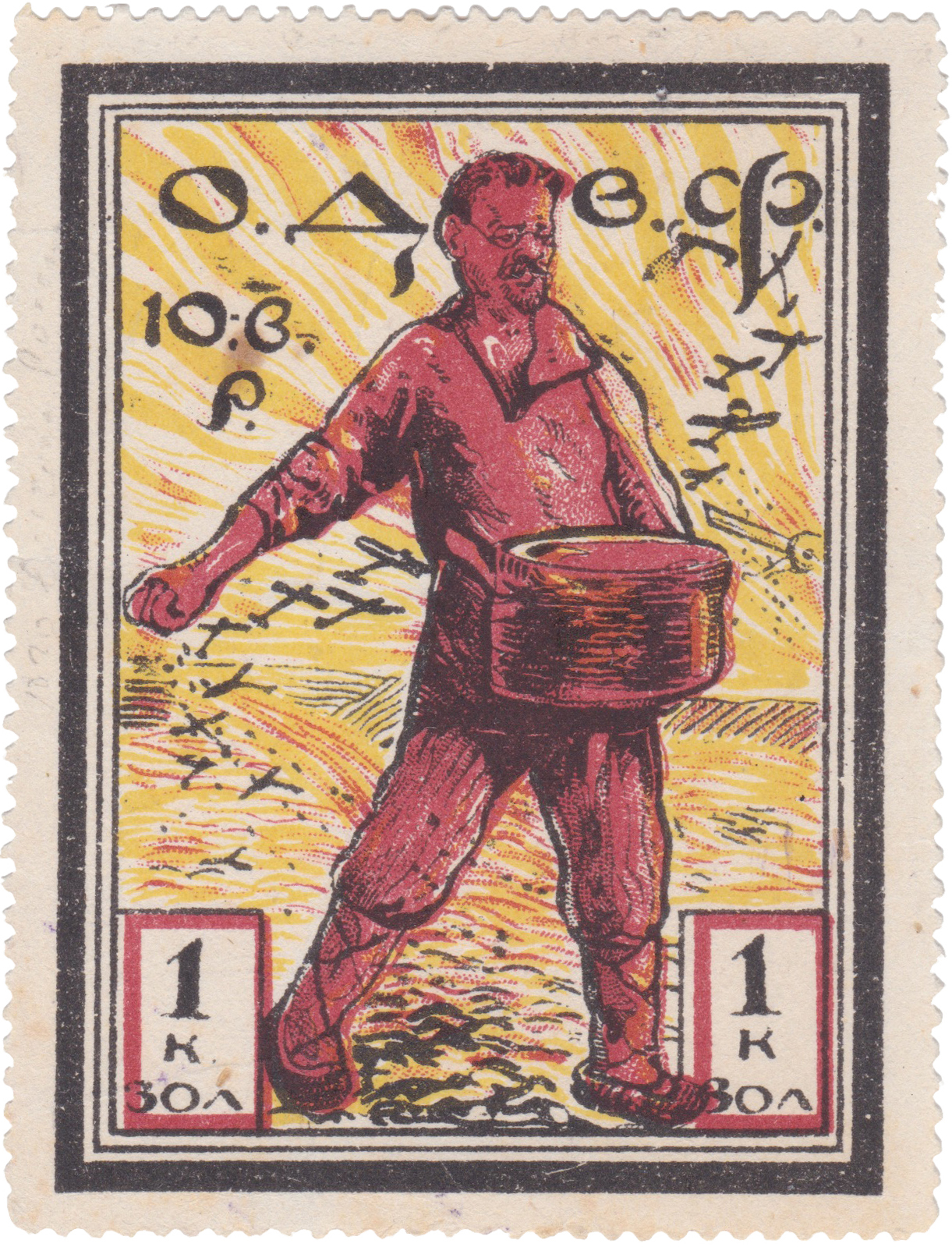
Third regional issue.
The voluntary society was founded on March 8, 1923. Its task was to promote aviation and to provide material and other assistance in creating a domestic aviation sector and aviation industry. The ODVF slogan was the appeal: “Working people, build an air fleet!” ODVF cells also operated in the Union republics—Ukraine, Transcaucasia, Central Asia, and other republics—where badges were likewise issued. The Ukrainian society was called the “Society of Aviation and Aeronautics of Ukraine and Crimea” (OAVUK). A membership badge with the abbreviation “TAPUK” is known—these are the first letters of the society’s name in the Ukrainian language (Tovarystvo Aviatsii ta Povitroplavannia Ukrainy y Krymu). At the beginning of 1924, all republican societies merged into an all-Union organization. In two years of its existence, ODVF issued more than thirty different badges. As a rule, all of them were issued for a fee.
ODVF actively raised funds for aircraft construction. One form was the distribution of badges. The society issued personalized badges to raise money for building named airplanes or squadrons. On March 13, 1925, ODVF merged with DOBROKHIM and became known as AVIAKHIM.
Trotsky the sower. Trotsky was the initiator of the creation of ODVF (later Aviakhim, Osoaviakhim, etc., up to DOSAAF) and its ideological driving force.
From Yaroslav Golovanov’s novel “Korolev. Facts and Myths”:
“Constantly seeking popularity—especially among the youth—Trotsky came forward with the idea of organizing the Society of Friends of the Air Fleet (ODVF) and sanctioned the emergence of a gigantic propaganda wave in the press. The slogan ‘Give us wings!’ was the main slogan in 1923. In 12 months the number of members grew from 16 thousand to 1,022,000 people. ODVF cells were created everywhere, even at Soviet embassies abroad. Aero clubs, aero courses, aero circles, aero exhibitions, and aero corners grew like yeast. There was no city where funds were not collected for building airplanes and gliders—and they were built in almost every city as well. Worker-correspondents allocated a percentage of their fees to build the airplane ‘Rabkor,’ and the Chemical Workers’ trade union laid down the airship ‘Red Chemist-Rubber Worker.’ In villages they took frightened peasants for rides on agit-planes; at fairs aero-agitation stands traveled around; in clubs ‘aero-dramatizations’ were staged; aero-mini-libraries were created. The number of ODVF members was planned to be brought to three million by the summer of 1925. The importance attached to the new society can be judged at least by the fact that almost all major party and state figures were elected to the ODVF Council: Bubnov, Voroshilov, Kalinin, Kamenev, Mikoyan, Ordzhonikidze, Podvoisky, Rykov, Stalin, Trotsky, Frunze, Chubar, Eikhe, Yakir.”
By the way, a not very widely known fact: at about the same time Trotsky and his associates founded a fully commercial enterprise (1923 was the heyday of the NEP), the “Russian Society of the Voluntary Air Fleet,” colloquially “Dobrolyot.” Soon, however, the organization ceased to be commercial and became fully state-run, and ultimately turned into the well-known “Aeroflot” (1932). The transformation story did not end there, because today we again have a fully capitalist public joint-stock company “Aeroflot,” in which the government of the Russian Federation holds a 51% stake.